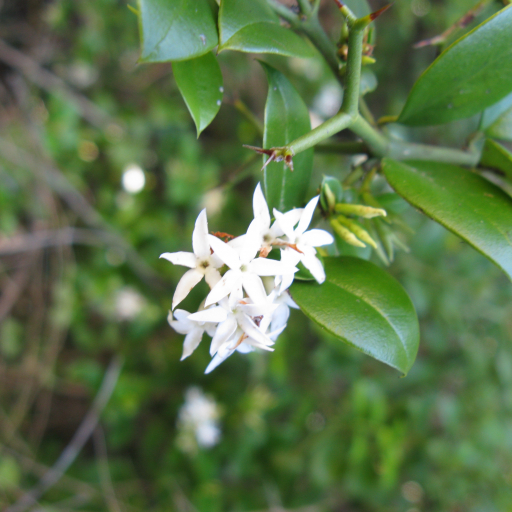
Plant Overview
Known affectionately as the "Forest Num-num" in its native South Africa, Carissa bispinosa is a versatile evergreen shrub that balances delicate beauty with rugged defense. While it produces sweet, star-shaped blossoms that perfume the air at night, its branches are armed with distinctive "forked" thorns that make it a favorite for natural security hedging. It is a resilient survivor, thriving where other plants might falter under heavy wind or coastal salt spray.
🔍 How to Identify
- 🍃 Glossy Foliage: The leaves are small, leathery, and dark green with a polished sheen, usually growing in opposite pairs along the stem.
- 🔱 Y-Shaped Thorns: Its most defining botanical feature is the "bispinosa" (two-spined) thorns, which are forked like a tiny slingshot or the letter "Y."
- 🌸 Starry Blooms: It produces clusters of dainty, white, jasmine-scented flowers that transition into small, egg-shaped berries that turn from green to bright red.
🏡 In Your Garden
- 🛡️ The Living Fence: Because of its dense growth habit and sharp thorns, it is one of the best choices for a "security hedge" to deter intruders while still looking ornamental.
- 🌬️ Coastal Resilience: This plant is incredibly salt-tolerant and wind-resistant, making it a top choice for seaside gardens where harsh breezes often kill more sensitive shrubs.
- 🌳 Low Maintenance: Once established, it is remarkably drought-tolerant; it prefers well-drained soil and actually performs better when left alone rather than being over-watered.
⚠️ Safety & Toxicity
- 🩹 Physical Hazard: The thorns are very stiff and sharp. Use caution when planting near high-traffic walkways or areas where children play, as they can cause painful punctures.
- 🥛 Milky Sap: The stems contain a white, milky latex sap typical of the Dogbane family. While not deadly, it can cause skin irritation for some people and should not be ingested.
- 🍒 The Ripeness Rule: The bright red fruits are edible and high in Vitamin C, but they should only be eaten when fully ripe. Unripe green fruits contain bitter tannins and may cause a mild stomach ache.
✨ Fun Fact
- 🍯 Gourmet Foraging: In Southern Africa, the fruit is a traditional wild snack. Because the berries are high in pectin, they are frequently harvested to make a tart, ruby-red jelly that tastes similar to cranberries or red currants.

Detailed Care Instructions
To grow Carissa Bispinosa, also known as Natal plum or large num-num, follow these steps:
- Obtain a healthy Carissa Bispinosa plant: Purchase a young plant from a reputable nursery or get a cutting from an established plant.
- Choose the right location: Carissa Bispinosa thrives in a sunny spot, so select an area with full sun exposure. Make sure the soil has good drainage as this plant does not tolerate waterlogged soil.
- Prepare the planting area: Dig a hole twice the width and depth of the plant's root ball. Add organic matter like compost to the soil to improve its fertility.
- Planting the Carissa Bispinosa: Place the plant in the hole, making sure the soil level matches the top of the root ball. Fill the hole with soil, gently firming it around the plant.
- Watering: Give the plant a thorough watering immediately after planting. After that, provide regular watering but avoid over-watering, as excessive moisture can lead to root rot.
- Pruning: Carissa Bispinosa can be pruned to maintain its shape and promote bushiness. Prune it immediately after flowering, removing any dead or crossed branches. This will enhance the plant's appearance and encourage more blooms.
- Fertilization: Feed your Carissa Bispinosa with a balanced fertilizer during the growing season. Follow the instructions on the fertilizer packaging for application rates and frequency.
- Mulching: Apply a layer of organic mulch around the base of the plant to conserve moisture and suppress weed growth. Leave a gap between the mulch and the stem to prevent rotting.
- Pest and disease control: Carissa Bispinosa is generally resistant to pests and diseases. However, aphids and scale insects may occasionally infest the plant. Monitor regularly and use appropriate control methods if needed, such as insecticidal soaps or horticultural oils.
- Winter care: In colder regions, Carissa Bispinosa may require protection from frost. Cover the plant with frost cloth or move it indoors during cold spells.
With proper care and attention, your Carissa Bispinosa plant should grow and thrive, producing beautiful flowers and potentially edible fruit.

Place in a bright room that is sun drenched almost all day. Or directly in a south-facing window.

To properly water this plant, it is important to understand its watering needs. This plant prefers moist but well-draining soil. Before watering, check the topsoil to see if it is dry to the touch. If it is, water the plant until the water drains from the bottom of the pot. It is important to not over-water or let the plant sit in standing water. Watering once a week is typically sufficient, but adjustments may be needed based on environmental factors such as temperature and humidity.
- Choose a balanced fertilizer with equal amounts of nitrogen, phosphorus, and potassium.
- Apply the fertilizer to the soil around the base of the plant.
- Use a small amount of fertilizer, following the manufacturer's instructions for the appropriate dosage.
- Water the plant thoroughly after fertilizing to help distribute the nutrients.
- Avoid over-fertilizing, as this can damage the plant's roots and lead to stunted growth or nutrient deficiencies.
- Fertilize once a month during the growing season, typically spring and summer.
Carissa bispinosa plant requires a well-draining, nutrient-rich soil that retains moisture without becoming waterlogged. The soil should have a slightly acidic to neutral pH. A mixture of loam, sand, and peat moss or compost can be used to create the ideal soil conditions for Carissa bispinosa plant. It is important to avoid using heavy, clay soils that can become compacted and impede drainage. Additionally, adding organic matter such as leaf litter or mulch to the soil can improve its quality and provide essential nutrients for plant growth.
To propagate this plant, you can first obtain a stem cutting from a mature plant. Make sure the cutting is approximately four to six inches long and has several leaves. Remove any leaves from the bottom of the cutting and dip the cut end in rooting hormone. Plant the cutting in a well-draining soil mix and water it thoroughly. Place the planted cutting in a warm, humid location with bright, indirect light. Mist the cutting regularly to keep it moist and ensure the soil remains damp. After several weeks, new roots should have formed and the cutting can be transplanted to a larger container or outdoor location.








