Plant Overview
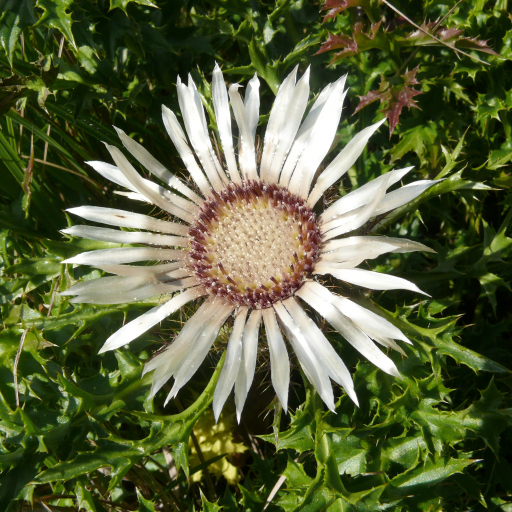
Known as the "Silver Thistle" or "Weather Thistle," Carlina acaulis is a striking, low-profile beauty native to the mountain pastures of the European Alps. It earned its nickname from its natural barometer-like ability: the silvery bracts close shut when the air becomes humid, accurately predicting approaching rain. In folklore, it was once seen as a powerful protective charm, often nailed to barn doors to ward off bad luck and disease.
🔍 How to Identify
- 🐚 The "Flower": What looks like a single white flower is actually a large, central disc surrounded by shimmering, straw-like silvery-white bracts that feel like dried paper.
- 📏 Stemless Stature: The species name acaulis means "without a stem." The flower head sits directly in the center of the leaf rosette, hugging the ground.
- 🗡️ Spiny Foliage: The leaves are dark green, deeply lobed, and tipped with sharp spines, forming a defensive circle around the delicate center.
🏡 In Your Garden
- ⛰️ Alpine Aspirations: This plant thrives in "starvation" conditions. It craves rocky, well-draining, and alkaline soil. If your garden soil is too rich or moist, the plant may lose its compact shape or suffer from root rot.
- ⚓ The Deep Anchor: It develops a very long, thick taproot to survive high-altitude winds and droughts. Because of this, it is notoriously difficult to transplant; choose its "forever home" in your rock garden carefully.
⚠️ Safety & Toxicity
- 🛡️ Physical Defense: While not chemically toxic to humans or pets, the plant is physically aggressive. The spines are sharp enough to puncture skin or irritate the paws of curious dogs.
- 🧤 Handling: Always wear thick gardening gloves when weeding around it or attempting to harvest the flower heads for dried arrangements.
✨ Fun Fact
The name "Carline Thistle" allegedly comes from a legend involving Charlemagne. It is said that an angel appeared to the Emperor and told him to shoot an arrow into the air; the plant the arrow landed on—Carlina acaulis—would provide the cure for a plague affecting his army.

Detailed Care Instructions
| Humidity | Dry |
| Lighting | Full Sun |
| Difficulty | Easy |
| Hibernation | Cold Period |
| Hardiness Zones | 4 - 10 |
To grow Carlina Acaulis plant, also known as Carline Thistle, follow these steps:
- Choose the appropriate growing location: Carlina Acaulis prefers full sun to partial shade and requires well-draining soil. It can tolerate various soil types, including sandy or rocky soils.
- Sow the seeds: Start by sowing the seeds indoors or directly in the ground in early spring or fall. If starting indoors, sow the seeds in trays filled with seed-starting mix. Lightly press the seeds into the soil, as they require light to germinate. Keep the soil consistently moist until germination occurs, which usually takes around 2-4 weeks.
- Transplanting: Once the seedlings have grown a few inches tall and developed several true leaves, they can be transplanted outdoors. Choose a location with sufficient space for the adult plants, as they can spread up to 24 inches in diameter. Space the transplants at least 12 inches apart to allow for adequate airflow.
- Watering and care: Water the plants regularly, especially during dry periods, and ensure the soil remains well-drained. Avoid overwatering, as excessive moisture can lead to root rot. Apply a layer of mulch around the plants to help retain soil moisture and suppress weed growth.
- Pruning: Carlina Acaulis plants tend to develop multiple rosettes. To maintain a more compact and tidy appearance, it's advisable to remove any dead or unsightly leaves.
- Protection: Protect the plants from extreme weather conditions, such as heavy rainfall or strong winds, by providing support stakes if needed. Additionally, protect young seedlings from slugs and snails, which may feed on them.
- Propagation: Carlina Acaulis plants can also be propagated by division. Every few years, when the plants become overly crowded, carefully lift the clumps and divide them into smaller sections. Replant the divisions immediately, ensuring they have enough space to establish themselves.
By following these steps, you can successfully grow Carlina Acaulis plants in your garden or outdoor space.

Place in a bright room that is sun drenched almost all day. Or directly in a south-facing window.

To water this plant, you should first make sure that the soil is dry to the touch before watering it. Overwatering can lead to root rot and other issues. Once you have confirmed that the soil is dry, you should water it thoroughly, ensuring that the water reaches the roots. Avoid getting the leaves wet, as this can lead to fungal diseases. You may want to use a watering can with a narrow spout to avoid getting water on the leaves. It is also important to avoid letting the plant sit in standing water, as this can also lead to root rot. Finally, make sure to keep an eye on the plant's overall health and adjust your watering schedule as needed.
To fertilize this plant, you should first wait until it has established itself in the soil. Then, in the spring, apply a balanced fertilizer at a rate of 1 tablespoon per square foot of plant area. Make sure to evenly distribute the fertilizer around the plant and water it in well. Repeat this process every 4-6 weeks during the growing season. Avoid fertilizing during the winter months or when the plant is dormant.
The optimal soil for Carlina Acaulis plant is well-draining and sandy with a pH range of 6.5 to 7.5. It should be rich in organic matter and capable of retaining moisture without becoming waterlogged. Additionally, adding perlite or vermiculite to the soil mix is highly recommended to aid in drainage and aeration. The plant thrives in soils that are well-drained and not prone to flooding during heavy rains. A slightly acidic to neutral soil is preferred for healthy growth of this plant.
To propagate this plant, collect its seeds in late summer or early fall and plant them immediately in well-draining soil. Cover the seeds with a thin layer of soil and keep the soil moist. The seeds will germinate in about 2-3 weeks. Once the seedlings are about 2-3 inches tall, transplant them into their permanent location in a sunny spot with well-draining soil. You can also propagate this plant by dividing the root ball in the spring or fall. Dig up the plant and gently separate the roots into smaller sections, then replant the sections in their permanent location. Allow the newly propagated plants to establish themselves before exposing them to full sun and dry conditions.
Common pests of the stemless carline thistle include Spider mites, aphids. Make a habit of checking your stemless carline thistle frequently for pests so that any infestations can be caught and managed early.








