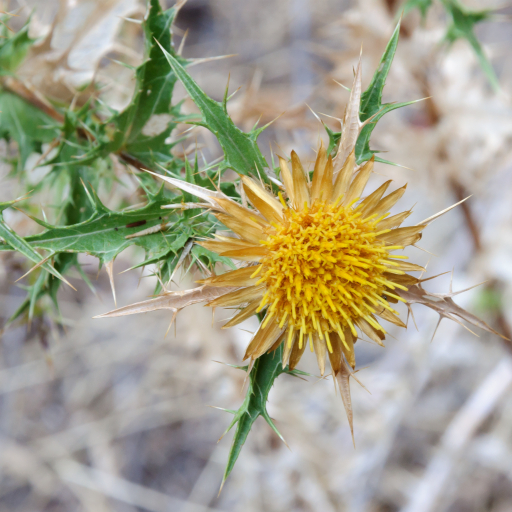
Plant Overview
Known as the "Clustered Carline Thistle," this Mediterranean native is a master of survival in the harshest, sun-baked landscapes. With its architectural shape and golden, straw-like blooms, it looks like a piece of sunshine frozen in time. In its native lands of Southern Europe, it is a symbol of the rugged, unyielding spirit of the dry summer hillsides.
🔍 How to Identify
- 🌼 The "Sun" Bracts: The central flower is surrounded by stiff, yellow, petal-like bracts that have a metallic, papery texture. These stay bright and rigid even long after the plant has dried.
- ⚔️ Spiny Armor: The grayish-green leaves are deeply lobed and lined with sharp, defensive spines designed to deter hungry livestock.
- 🏗️ Flat-Topped Clusters: Unlike other thistles that may grow tall and erratic, Carlina corymbosa forms a "corymb"—a flat-topped cluster where all the flowers sit at roughly the same height.
🏡 In Your Garden
- 🏜️ The Drought Champion: This plant is an absolute powerhouse for xeriscaping or rock gardens. It thrives in poor, stony soil and intense heat, requiring almost no supplemental water once it has settled in.
- 🌱 Don't Move Me: It develops a very long, sturdy taproot to find moisture deep underground. Because of this deep anchor, it hates being transplanted; once you plant it, it’s best to leave it where it is to avoid root shock.
⚠️ Safety & Toxicity
- 🌵 Physical Hazard: This plant is not known to be chemically toxic to humans or pets. However, its spines are incredibly sharp and can cause painful punctures or skin irritation.
- 🧤 Handle with Care: Always wear thick, leather gardening gloves when pruning or weeding around this plant. It is naturally "pet-safe" because most animals are smart enough to stay away from the prickles!
✨ Fun Fact
📜 The Emperor’s Herb: The genus name Carlina is legendary—it is said to be named after Charlemagne (Charles the Great). According to folklore, an angel pointed this plant out to the Emperor, claiming its medicinal roots could save his army from the plague.

Detailed Care Instructions
| Humidity | High |
| Difficulty | Easy |
| Temperature | 23°C - 28°C |
| Hardiness Zones | 8 - 11 |

Place in a bright room that is sun drenched almost all day. Or directly in a south-facing window.

1. Determine the watering needs of your plant. Carlina Corymbosa plants prefer a moist, but not waterlogged soil.
2. Check the soil moisture level regularly. To do this, stick your finger into the soil about an inch deep. If it feels dry to the touch, it is time to water.
3. Water the plant deeply and slowly. Use a watering can or hose to water at the base of the plant, making sure the water gets down to the roots.
4. Be careful not to overwater. Overwatering can lead to root rot and other problems. Always allow the soil to dry out slightly before watering again.
5. Consider using a moisture meter or hydrogel to help regulate water levels. These tools can give you a more accurate picture of when your plant needs water.
6. Monitor your plant for signs of stress. Wilting or yellowing leaves may indicate that the plant needs more water, while mushy or brown leaves may indicate overwatering.
7. Use a well-draining soil mix to help prevent water from sitting in the soil for too long.
8. When watering, avoid getting water on the foliage and flowers, as this can lead to issues with fungus and other diseases.
The Carlina Corymbosa plant prefers well-draining soil that is rich in nutrients but not too rich in organic matter. A soil with a pH level between 6.5 and 7.5 is ideal. It can grow in sandy, loamy or clay soils as long as it is well-draining. The soil should also retain some moisture but not be waterlogged. Adding some coarse sand, perlite or vermiculite to the soil mix can improve drainage. A general-purpose potting mix with added perlite or sand will work well. Heating and sterilizing the soil before planting can help prevent disease and pests. It is also important to avoid compacting the soil around the roots, as this can impede growth.








