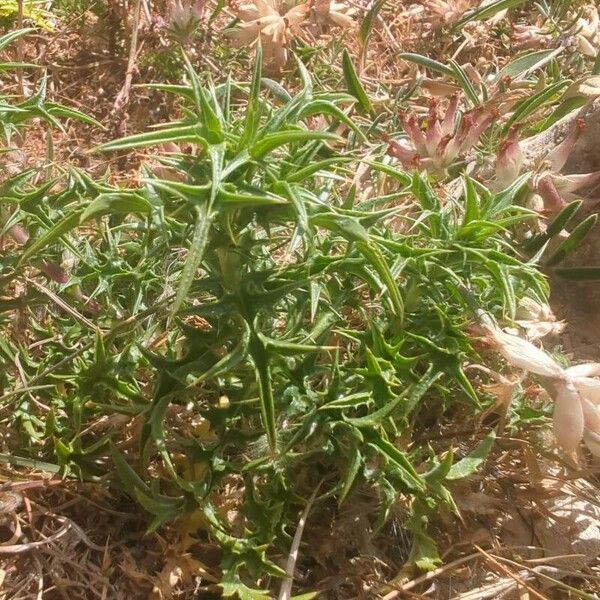
Plant Overview
Known as the "Sun of the Earth" or the Clustered Carline Thistle, Carlina involucrata is a resilient, sun-loving beauty native to the rocky landscapes of the Mediterranean. These plants are famous for their straw-like, "everlasting" flowers that look like metallic sunbursts even after the plant has dried. Legend has it that the genus was named after Charlemagne, who supposedly used a Carline thistle to cure his army of a plague.
🔍 How to Identify
- 🌼 Everlasting Bracts: The flower head is surrounded by stiff, golden-silvery bracts that look like dried, metallic petals. Unlike true petals, these remain stiff and shiny long after the blooming season.
- 🌵 Spiny Foliage: The leaves are deeply lobed and tipped with sharp, protective spines. They often form a defensive rosette close to the ground to protect the plant from grazing animals.
- 📏 Compact Growth: This species is generally shorter and more compact than its cousins, often appearing as a low-profile cluster of golden stars tucked against the soil or rocks.
🏡 In Your Garden
- ☀️ Drought Specialist: Evolved for the heat of North Africa and Southern Europe, this plant thrives in "neglected" spots. It loves poor, rocky, or limestone-heavy soil where more delicate flowers would wither.
- ⚓ Deep Taproot: It anchors itself with a long, vertical root that searches for water deep underground. Because of this, it is nearly impossible to transplant once established; it prefers to stay exactly where it first sprouted.
⚠️ Safety & Toxicity
- 🛡️ Mechanical Defense: The plant is not known to be chemically toxic to humans or pets. However, its spines are very sharp and can cause painful punctures or skin irritation.
- 🐾 Pet Safety: While it won’t poison a curious dog or cat, the prickly texture usually acts as a natural deterrent, keeping pets from trying to chew on it.
✨ Fun Fact
- 🌦️ Nature's Barometer: In traditional Mediterranean folk medicine and farming, these flowers were used to predict the weather. The bracts are sensitive to humidity and will fold inward when the air becomes moist, signaling that rain is on the way!

Detailed Care Instructions

Place in a bright room that is sun drenched almost all day. Or directly in a south-facing window.

Some plants require more regular watering than others, which should be done every few days. It's critical to maintain the soil moist all of the time. The water requirements of the same plant placed in pots with varying sizes will differ. Because the water in the smaller pot evaporates faster than the water in the larger pot, it will require more watering. Regardless of pot size, the surface should constantly be maintained moist.








