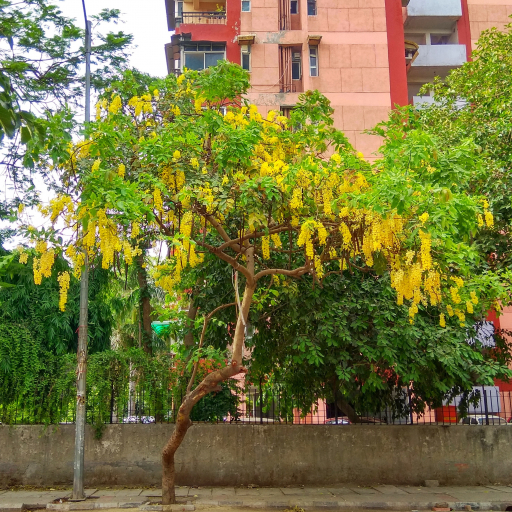
Plant Overview
Known as the "Golden Shower Tree," this tropical showstopper transforms into a literal waterfall of gold when it blooms. Its scientific name Cassia fistula refers to its "pipe-like" seed pods, but in its native South Asia, it is celebrated as the "Amaltas," a symbol of the peak of summer and the arrival of the monsoon.
🔍 How to Identify
- 🌼 Floral Cascades: The most striking feature is the hanging clusters (racemes) of bright yellow flowers, which can reach up to 20 inches in length and often cover the tree entirely.
- 🍃 Pinnate Foliage: The leaves are large and feathery, consisting of 4 to 8 pairs of smooth, oval leaflets that provide a light, dappled shade.
- 🫛 Sausage Pods: After the flowers fade, long, dark-brown, cylindrical seed pods appear. These "sausage-like" pods can grow up to two feet long and remain on the branches for months.
🏡 In Your Garden
- ☀️ Sun Obsession: To achieve that iconic "shower" of gold, this tree requires full, unadulterated sunlight. In shaded areas, it will grow tall and leggy with very few flowers.
- 🏗️ The Taproot Rule: Like many members of the legume family, it develops a deep, sensitive taproot. It hates being moved once planted, so choose its permanent location with care—ideally away from pipes or sidewalks.
- 💧 Drought Strategy: Once established, the Golden Shower Tree is remarkably drought-tolerant. In fact, a dry period in late winter is often what triggers the spectacular mass-blooming in the spring.
⚠️ Safety & Toxicity
- 🐾 Mildly Toxic: The seeds and the dark pulp inside the pods contain anthraquinones, which act as a powerful laxative. While used in traditional medicine, they can cause severe stomach upset in humans and pets if ingested in large quantities.
- 👶 Child Safety: Because the long pods look like large beans or carob, keep an eye on curious children who might be tempted to crack them open.
✨ Fun Fact
- 🇹🇭 National Pride: The Cassia fistula is the national flower of Thailand. Its yellow color is chosen to represent Thai royalty and is a symbol of glory and harmony within the country.

Detailed Care Instructions
| Humidity | Normal |
| Lighting | Full Sun |
| Difficulty | Medium |
| Hibernation | Cold Period |
| Temperature | 18°C - 29°C |
| Hardiness Zones | 9 - 11 |
To grow Cassia Fistula plant, also known as the Golden Shower Tree, you can follow these steps:
- Choose a suitable location: Ensure that the plant receives full sunlight for at least 6-8 hours a day. The soil should be well-draining and rich in organic matter.
- Prepare the soil: Before planting, loosen the soil using a garden fork or tiller. Remove any weeds or grass and add compost or well-rotted manure to improve the soil's fertility.
- Planting the seed: Soak the Cassia Fistula seeds in water for 24 hours before planting. Dig a hole about 2-3 times the size of the seed and place the seed in the hole. Cover it with soil, ensuring that the seed is not planted too deep.
- Watering: Water the plant thoroughly after planting and keep the soil consistently moist during the germination period. Once the plant establishes itself, water it regularly, especially during dry spells.
- Fertilizing: Apply a balanced, slow-release fertilizer in the spring or early summer to promote healthy growth. Follow the package instructions for the appropriate dosage.
- Pruning: Prune the Cassia Fistula tree during the dormant season to remove dead or diseased branches. This will help maintain its shape and promote better flowering.
- Mulching: Apply a layer of organic mulch around the base of the plant to conserve moisture, suppress weeds, and provide nutrients as it breaks down.
- Pests and diseases: The Cassia Fistula plant is generally not prone to significant pest or disease issues. However, keep an eye out for aphids, whiteflies, or leaf spot diseases. Treat them using organic or chemical solutions, if necessary.
- Support and protection: In its early years, you may need to provide support for the Cassia Fistula tree until it establishes a strong, stable trunk. Protect the tree from strong winds and extreme weather conditions that may damage young branches or flowers.
- Patience: Growing a Cassia Fistula plant from a seed can take time. It may take several years for the plant to mature and produce flowers. Be patient, as the vibrant golden flowers are worth the wait.
Remember to research your local climate and growing conditions specific to your region to ensure the best success in growing the Cassia Fistula plant.

Place in a bright room that is sun drenched almost all day. Or directly in a south-facing window.

The best way to water this plant is to avoid waterlogging the soil. Allow the top layer of the soil to dry out before watering, as the plant prefers moist but well-draining soil. Water deeply once a week, or as needed depending on the weather conditions and humidity levels. Avoid over-fertilizing or over-watering, as this may lead to root rot. It is also important to ensure that the plant is receiving adequate sunlight for optimal growth and blooming.
To fertilize this plant, use a slow-release granular fertilizer that contains balanced ratios of nitrogen, phosphorus, and potassium. Apply the fertilizer to the soil around the base of the plant, avoiding direct contact with the stem. Water thoroughly after applying the fertilizer. Avoid over-fertilizing, as this can damage the plant. Apply the fertilizer every 2-3 months during the growing season.
Cassia Fistula is a tropical plant that requires well-draining soil with moderate to high fertility. The soil should be slightly acidic, with a pH level between 5.5 and 7.0. It is recommended to use a loamy soil that is rich in organic matter, such as compost or well-aged manure. The soil should be kept moist, but not waterlogged, as the plant does not tolerate standing water. When planting, it is important to ensure that the soil is loose and aerated to allow for proper root development. Additionally, the plant should be fertilized regularly with a balanced fertilizer to promote healthy growth and vibrant blooms.
Cassia Fistula plant can be propagated through various methods such as seeding, stem cutting, and air layering. Here are some details about each method:
- Seeding: To propagate through seeding, collect the ripe seeds from the plant and remove their outer shell. Soak the seeds in warm water for a few hours and plant them in a pot that has well-draining soil. Keep the soil moist and place the pot in a warm and bright area. The seeds will germinate in a few weeks.
- Stem cutting: To propagate through stem cutting, take a 4-6 inch long stem cutting from a healthy plant. Remove the leaves from the bottom half of the stem and dip it into a rooting hormone. Plant the stem in a pot filled with a well-draining soil mixture, and keep it in a warm and bright area. Water the soil regularly, and the stem will develop roots in a few weeks.
- Air layering: To propagate through air layering, select a healthy branch of the plant and make a small incision on the branch. Apply some rooting hormone on the area and wrap a wad of moistened sphagnum moss around the cut area. Cover the moss with a plastic wrap and secure it with a rubber band. In a few weeks, the moss will develop roots, and you can cut the branch and plant it in a pot.
Common pests of the golden shower tree include Spider mites, thrips, whiteflies, larvae. Make a habit of checking your golden shower tree frequently for pests so that any infestations can be caught and managed early.








