Plant Overview
Often called the "Bread Tree" by ancient mountain communities, the Sweet Chestnut is a majestic titan of the forest with a history of feeding civilizations. Unlike its cousin, the Horse Chestnut, this tree produces the delicious, mahogany-colored nuts famously roasted over open fires in winter. It is a symbol of longevity and resilience, often living for over a thousand years while providing both shade and sustenance.
🔍 How to Identify
- 🍃 Serrated Leaves: Look for long, lance-shaped leaves with very distinct "teeth" along the edges. They are glossy green and can grow up to 10 inches long.
- 🌼 Summer Catkins: In early summer, the tree is draped in long, creamy-yellow flower spikes (catkins) that emit a heavy, honey-like scent to attract pollinators.
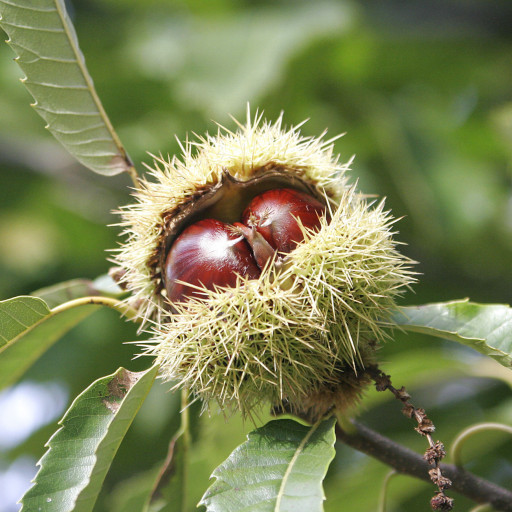
- 🌰 The "Hedgehog" Fruit: The nuts are encased in incredibly sharp, lime-green husks covered in dense spines. These "burrs" look like tiny curled-up hedgehogs hanging from the branches.
🏡 In Your Garden
- 🌳 A Legacy Tree: This is a large-scale specimen that needs significant room to spread its broad, rounded canopy. It’s a "legacy" plant, often outliving the person who planted it by centuries.
- 🏜️ Soil Nuances: It is quite picky about its "feet." It thrives in well-drained, slightly acidic soil but will struggle or die in heavy clay or lime-rich (alkaline) environments.
- ⚓ The Taproot Factor: Sweet Chestnuts develop a deep, powerful taproot very quickly. This makes them drought-tolerant once established, but it also means they despise being transplanted. Choose their permanent spot wisely!
⚠️ Safety & Toxicity
- ✅ Generally Safe: The Castanea sativa is non-toxic to humans, dogs, and cats. The nuts are a healthy, gluten-free food source.
- 🌵 Physical Hazard: The primary danger is the prickly husk. The spines are needle-sharp and can easily pierce skin or thin gardening gloves, leading to painful splinters.
- 🔥 Kitchen Safety: If you harvest the nuts, always "score" (cut a cross into) the shell before roasting. Without a vent for steam, the nuts will explode with surprising force!
✨ Fun Fact
The "Hundred Horse Chestnut" on Mount Etna in Sicily is the oldest known chestnut tree in the world, estimated to be between 2,000 and 4,000 years old. Legend says it earned its name when a Queen and her 100 knights all took shelter under its massive canopy during a sudden thunderstorm!

Detailed Care Instructions
To grow a Castanea sativa plant, also known as the sweet chestnut tree or chestnut tree, you can follow these steps:
- Climate and Soil: Ensure you live in a suitable climate for chestnut trees, which is typically temperate regions with mild winters and long, warm summers. Chestnut trees prefer loamy, well-draining soil with a pH between 5.5 and 6.5.
- Planting Seeds or Seedlings: Obtain chestnut seeds or seedlings from a reputable nursery or collect mature chestnuts directly from the tree in the autumn. If using seeds, stratify them by storing in a sealed plastic bag with moist peat moss or vermiculite in the refrigerator for 2-3 months before planting. Plant the seeds or seedlings in early spring.
- Site Selection: Choose an open, sunny location with sufficient space for the tree's size and potential spread. Ensure there are no competing trees or structures nearby that could hinder its growth.
- Planting: Dig a hole that is twice as wide and deep as the root ball or seedling container. Place the seed or seedling in the hole, making sure the graft union (if present) is above the soil level. Backfill the hole with soil, gently firming it around the tree. Water thoroughly after planting.
- Watering and Maintenance: Keep the soil consistently moist but not waterlogged. Water deeply and infrequently to encourage deep root growth. Mulch around the base of the tree to help retain moisture and suppress weeds. Regularly inspect for pests and diseases, and take appropriate measures if needed.
- Pruning: Chestnut trees require minimal pruning. Remove any dead or diseased branches, as well as any crossing or rubbing branches. Prune in late winter or early spring while the tree is still dormant.
- Fertilization: Chestnut trees generally do not require excessive fertilization. However, you can apply a balanced fertilizer in early spring to promote healthy growth.
- Harvesting: Be patient, as chestnut trees can take several years to produce their first crop. Chestnuts typically ripen in late summer or early autumn. Harvest the nuts once the husks split open and the nuts are brown.
By following these steps, you can successfully grow a Castanea sativa plant and enjoy the beauty of the tree as well as the delicious chestnuts it produces.

Place in a bright room that is sun drenched almost all day. Or directly in a south-facing window.

The plant in question should be watered regularly during the growing season, ensuring that the soil around the roots remains consistently moist but not waterlogged. It may be necessary to adjust watering frequency depending on weather conditions, such as drought or heavy rain. Water should be applied directly to the soil, rather than on the leaves or foliage. In periods of extreme heat or dryness, it may be beneficial to mist the foliage with water to increase humidity. During the dormant season, watering frequency can be reduced, but it is still important to ensure that the soil does not completely dry out. Overwatering can lead to root rot and other fungal diseases, so it is important to monitor soil moisture levels and adjust watering as needed. Applying a layer of mulch around the base of the plant can help to retain moisture in the soil and regulate temperature fluctuations.
To fertilize this plant, apply a balanced fertilizer once in the early spring and again in mid-summer. Use a slow-release fertilizer and apply it to the soil around the base of the plant, being careful not to get it on the leaves or stem. Water the plant well after fertilizing. Avoid over-fertilizing as it can lead to excessive growth and weakened branches.
Castanea Sativa requires a well-draining soil that is loamy with a slightly acidic to neutral pH. A mix of humus-rich topsoil, sand, and peat moss is recommended for optimal growth. The soil should be moist but not waterlogged, and it is important to avoid compacted soils. Mulching around the base of the plant with organic matter can also help to retain moisture and improve soil fertility.
Propagation of this plant can be done through a process called grafting. Grafting involves taking a small section of the plant, called a scion, and attaching it to the rootstock of another plant. The scion and rootstock must be carefully matched so that they are compatible and can grow together successfully.
To prepare the scion, choose a healthy shoot from the desired plant and remove a section about 4-6 inches long. Remove all the leaves except for a few at the top. The bottom end should be cut at an angle to increase the surface area for contact with the rootstock.
The rootstock should also be healthy and strong, with a stem diameter similar to the scion. Remove any side shoots and leaves from the rootstock. Cut the top of the rootstock straight across to create a flat surface for attaching the scion.
Using a sharp knife, make a diagonal cut on the scion and the rootstock, matching the cuts together to create a smooth union. Bind the two pieces together tightly with grafting tape or parafilm.
The newly grafted plant should be kept in a warm, humid environment for several weeks until the scion and rootstock have grown together. Once the union has healed, the tape can be removed, and the plant can be transplanted to its final location.
Common pests of the sweet chestnut include Larvae. Make a habit of checking your sweet chestnut frequently for pests so that any infestations can be caught and managed early.








