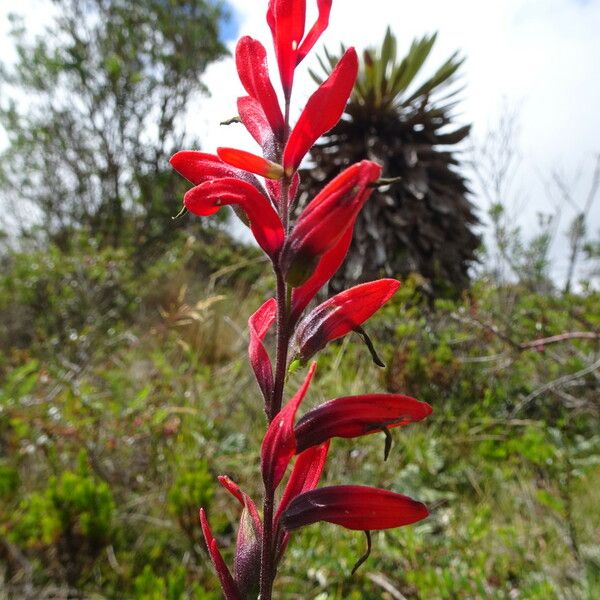
Plant Overview
Known affectionately as the Mexican Paintbrush, this striking wildflower looks as though a botanical artist accidentally dipped its tips into a bucket of crimson paint. Native to the high-altitude regions of Mexico and parts of the Southwestern United States, it is a master of survival with a "secret" lifestyle. While it appears self-sufficient, it is actually a hemiparasite, quietly connecting its roots to neighboring plants to steal water and minerals.
🔍 How to Identify
- 🎨 The "Paintbrush" Bracts: The most vivid part of the plant isn't the flower itself, but the leaf-like bracts. These are typically a fiery red or deep orange, surrounding the smaller, inconspicuous green flowers.
- 🍃 Smooth Leaves: True to its name (integrifolia meaning "whole leaf"), the foliage is slender and smooth-edged, lacking the deep lobes or teeth found on many of its paintbrush cousins.
- 📏 Growth Habit: It usually grows in upright, somewhat woody clumps, reaching about 12 to 24 inches in height, often standing out against rocky or grassy landscapes.
🏡 In Your Garden
- 🤝 The Need for a Host: If you are trying to grow this in a meadow setting, remember it is a "social" plant. It thrives best when planted alongside native grasses or shrubs, as its roots need to attach to a host plant to truly flourish.
- 🏔️ Tough Environment: This species is adapted to rocky, well-draining soils and cooler mountain air. It hates "wet feet" and will quickly rot if left in heavy, waterlogged clay.
- 🐦 Pollinator Magnet: In its natural habitat, its tubular shape and brilliant red color act as a neon sign for hummingbirds, who are the primary pollinators for this species.
⚠️ Safety & Toxicity
- 🟢 Non-Toxic Status: Castilleja integrifolia is generally considered non-toxic to humans and common household pets.
- ⛏️ Mineral Accumulation: Be aware that all members of the Castilleja genus can be "selenium accumulators." If the soil they are growing in is rich in selenium, the plant absorbs it. Ingesting large quantities of such plants can lead to selenium poisoning, though this is primarily a concern for grazing livestock rather than home gardeners.
✨ Fun Fact
The Mexican Paintbrush is a "partial thief." While it steals water and nutrients from its neighbors, it still has green leaves and performs photosynthesis. This survival strategy allows it to thrive in harsh, nutrient-poor soils where other flowers would wither!

Detailed Care Instructions

Place in a bright room that is sun drenched almost all day. Or directly in a south-facing window.

Some plants require more regular watering than others, which should be done every few days. It's critical to maintain the soil moist all of the time. The water requirements of the same plant placed in pots with varying sizes will differ. Because the water in the smaller pot evaporates faster than the water in the larger pot, it will require more watering. Regardless of pot size, the surface should constantly be maintained moist.








