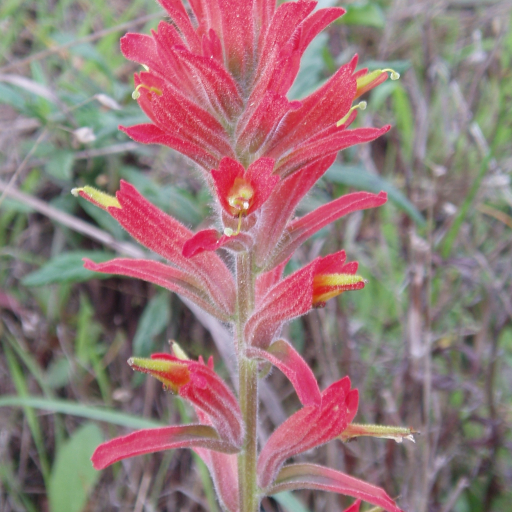
Plant Overview
Often called the Franciscan Paintbrush or Long-leaf Indian Paintbrush, this striking wildflower is a master of survival and a splash of fire against the muted greens of the California chaparral. Native to the coastal ranges and slopes of the Western United States, it looks as though a painter took a bundle of leaves and dipped the tips into a bucket of neon-red pigment. Beyond its beauty, it leads a fascinating "double life" as a botanical parasite.
🔍 How to Identify
- 🎨 Vibrant Bracts: The "petals" you see aren't actually flowers; they are modified leaves called bracts. These are usually a brilliant scarlet, orange, or crimson, designed to catch the eye of pollinators from a distance.
- 🎺 Tubular Flowers: The true flowers are hidden within the colorful bracts. They are narrow, greenish-yellow tubes that look like tiny drinking straws, perfectly shaped for a bird’s beak.
- 🌿 Slender Foliage: The stems are upright and covered in long, narrow, grayish-green leaves that are often slightly wavy or crinkled along the edges.
🏡 In Your Garden
- 🤝 The "Vampire" Lifestyle: This plant is hemiparasitic, meaning it cannot survive on its own. It sends out underground suckers to "plug" into the roots of neighboring plants—usually grasses or shrubs like Sagebrush—to steal water and nutrients.
- 🐦 Hummingbird Heaven: If you are lucky enough to have these in a naturalized garden area, expect plenty of avian visitors. Hummingbirds are the primary pollinators, drawn to the bright red color and the nectar hidden deep in the tubular blooms.
- ⛰️ Slope Specialist: In nature, they thrive on rocky hillsides and well-drained slopes. They despise "wet feet" and will quickly rot if planted in heavy, water-logged garden soil.
⚠️ Safety & Toxicity
- ✅ Generally Non-Toxic: The Franciscan Paintbrush is not considered poisonous to humans or common household pets like cats and dogs upon contact.
- ⛏️ Mineral Accumulator: A word of caution: Castilleja species are known to accumulate selenium from the soil in their tissues. If grown in selenium-rich soil, the plant can become toxic if eaten in large quantities by livestock or curious foragers.
✨ Fun Fact
Because they steal nutrients from their neighbors, Indian Paintbrushes are often used by ecologists as a "biological control." They can help keep aggressive grasses from taking over a meadow by siphoning off the grass's energy, allowing other wildflowers to thrive!

Detailed Care Instructions
To grow Castilleja subinclusa, also known as woolly Indian paintbrush or woolly paintbrush, follow these steps:
- Climate: Castilleja subinclusa prefers a cool and moist climate, typically found in mountain meadows or alpine regions. Make sure you live in or can recreate these conditions.
- Seeds: Obtain Castilleja subinclusa seeds from a reputable native plant nursery or online seed supplier. Alternatively, you can collect seeds from mature plants in the wild, following local regulations.
- Planting time: Plant the seeds in late fall or early spring, depending on your climate. In colder regions, fall planting allows a period of cold stratification, which enhances germination.
- Soil preparation: Prepare the planting site by removing weeds and grasses to minimize competition. Castilleja subinclusa typically prefers well-draining, sandy or loamy soil.
- Planting: Sow the seeds on the soil surface, as Castilleja subinclusa requires light for germination. Press the seeds gently into the soil or cover them with a thin layer of fine sand.
- Germination: Keep the soil consistently moist until germination occurs, which may take several weeks or even months. Avoid saturating the soil, as excessive moisture can lead to rot.
- Transplanting: When the seedlings have developed their first true leaves, usually in late spring or early summer, they can be transplanted to their permanent location. Make sure to gently lift and transplant without damaging the delicate roots.
- Maintenance: Water regularly to keep the soil slightly moist, but avoid overwatering. Additionally, regularly weed the area around the plants to reduce competition.
- Pollination: Castilleja subinclusa relies on pollinators, particularly hummingbirds, to facilitate seed production. Encourage pollinators by providing a diverse range of flowering plants nearby.
- Winter care: In colder regions, apply a layer of mulch around the plants before winter to protect them from freezing temperatures. Take care not to smother the seedlings.
With proper care and suitable conditions, your Castilleja subinclusa plants should grow and thrive, providing you with beautiful, woolly paintbrush blooms.

Place in a bright room that is sun drenched almost all day. Or directly in a south-facing window.

Castilleja Subinclusa is a plant that requires regular watering to thrive. It is important to water the plant consistently, but not excessively to avoid waterlogging the root system. To water the plant, it is best to use a watering can or hose, and slowly trickle the water at the base of the plant. It is important to avoid wetting the leaves and foliage as this can lead to disease and fungus. The soil around the plant should be kept moist but not waterlogged, and should be allowed to dry out slightly between watering sessions. The frequency of watering will depend on the climate and soil type, but typically Castilleja Subinclusa requires watering once or twice a week, especially during warm weather or dry spells.
To properly fertilize the Castilleja Subinclusa plant, you should begin by preparing the soil where it will be planted. Ensure that the soil is well-draining and has a slightly acidic pH.
In the early spring, apply a slow-release fertilizer to the soil around the base of the plant. This fertilizer will provide the necessary nutrients over several months.
Throughout the growing season, you can also apply a balanced liquid fertilizer every two weeks to ensure the plant has a sufficient amount of nutrients.
Be careful not to over-fertilize the Castilleja Subinclusa plant, as this can lead to burnt foliage and stunted growth. Always follow the fertilizing instructions on the fertilizer package and adjust accordingly for the size of your plant.
Castilleja Subinclusa plant grows well in a well-draining soil that is rich in organic matter. The soil should have a pH level that is slightly acidic to neutral. The ideal soil composition for this plant is a loamy soil that contains a mix of sand, silt, and clay. The soil should also be able to retain moisture without becoming waterlogged or soggy. The plant prefers a soil that receives moderate amounts of water and is not drought-tolerant. Moreover, it requires a soil that is well-aerated. The plant grows in sunny to partially shady areas and prefers soils that are not compacted.
Castilleja subinclusa can be propagated through both seed and vegetative means. To propagate through seeds, collect mature seeds in late summer or early fall and sow them in a well-draining soil mix. Cover the seeds with a thin layer of soil and keep the soil consistently moist until germination, which can take several weeks. Once the seedlings have several true leaves and are large enough to handle, they can be transplanted into individual pots or directly into the ground.
To propagate through vegetative means, take cuttings in the summer or fall from healthy, mature plants. Make sure the cuttings are at least 3-4 inches long and have several nodes (where the leaves emerge from the stem). Trim off the lower leaves and dip the cut end in rooting hormone before planting in a well-draining soil mix. Keep the soil consistently moist and provide bright, indirect light. Roots should begin to form in several weeks and the cutting can be transplanted once it has established a healthy root system.








