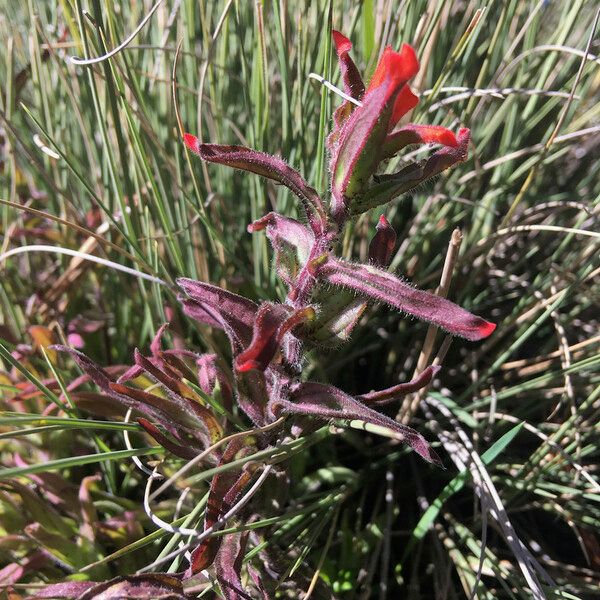
Plant Overview
Known as the Narrow-leaf Indian Paintbrush, Castilleja tenuiflora looks as though a desert artist dipped a cluster of leaves directly into a pot of vivid sunset-orange paint. Native to the rugged landscapes of Mexico and the Southwestern United States, this perennial herb is a resilient beauty that brings a splash of fire to rocky slopes and dry brushlands.
🔍 How to Identify
- 🎨 The "Flowers": What looks like bright red or orange petals are actually modified leaves called bracts. The true flowers are small, greenish tubes hidden discreetly inside these showy structures.
- 🌿 Slender Foliage: True to its name (tenuiflora meaning "thin flower"), the leaves are narrow, linear, and covered in fine, grayish hairs that give the plant a slightly dusty appearance.
- 📏 Growth Habit: It typically grows in upright clumps, reaching about 1 to 2 feet in height, often appearing somewhat woody at the base.
🏡 In Your Garden
- 🏴☠️ The Green Pirate: This plant is "hemiparasitic," meaning it steals water and nutrients from the roots of neighboring plants (like grasses or sagebrush). Because of this, it is notoriously difficult to transplant and rarely survives in a pot alone; it needs a "host" plant to thrive.
- ☀️ Sun & Soil: It thrives in the "tough stuff." If you are trying to establish it, choose a spot with full sun and very well-draining, rocky, or sandy soil. It is extremely drought-tolerant once it has latched onto a host's root system.
⚠️ Safety & Toxicity
- 🧪 Selenium Collector: While not considered inherently "poisonous" like a nightshade, Castilleja species are known to absorb selenium from the soil. In high-selenium areas, the plant can become toxic if eaten in large quantities.
- 🐾 Pets & Kids: It is generally safe to touch, but it’s best to keep curious pets or children from snacking on it, as the concentrated minerals can cause stomach upset or more serious issues if the soil is mineral-heavy.
✨ Fun Fact
Native American folklore often associates the Indian Paintbrush with a young brave who tried to paint the sunset with his war paints; when he grew frustrated and threw his brushes on the ground, they turned into these vibrant flowers. From a scientific perspective, they are just as cool—they are "part-time" parasites!

Detailed Care Instructions
To grow Castilleja tenuiflora, also known as the desert paintbrush or narrow-leaf Indian paintbrush, you can follow these steps:
- Climate: Ensure that you live in an area with a suitable climate. Castilleja tenuiflora is native to western North America and thrives in arid or semi-arid regions with full sun exposure.
- Soil: The plant prefers well-draining sandy or loamy soil. If your soil lacks drainage, consider amending it with organic matter or sand to improve drainage.
- Propagation: You can propagate Castilleja tenuiflora through seeds or division. Seeds can be acquired from reputable nurseries or collected from existing plants. Sow the seeds in early spring, lightly covering them with soil. If starting with divisions, carefully separate them from an established plant and replant in well-prepared soil.
- Watering: In the initial stages, keep the soil consistently moist. However, once the plant is established, it is drought-tolerant and only requires occasional watering, as it is adapted to arid conditions. Overwatering can lead to root rot and other issues.
- Fertilization: Castilleja tenuiflora typically does not require regular fertilization. However, if you want to provide a boost, you can use a slow-release, balanced fertilizer in the early stages of growth.
- Maintenance: Remove any weeds or competing plants around the Castilleja tenuiflora to prevent them from overshadowing or outcompeting it. Deadhead spent flowers to encourage further blooming.
- Pests and diseases: Generally, Castilleja tenuiflora is not susceptible to many pests or diseases. However, keep an eye out for common garden pests like aphids, mealybugs, or powdery mildew. If necessary, treat them with appropriate organic or chemical solutions.
- Enjoy and observe: Castilleja tenuiflora is a visually striking plant, with bright red or orange tubular flowers. Take the time to appreciate its beauty and observe any wildlife it may attract, such as hummingbirds or butterflies.
Remember to check with your local agricultural extension or gardening experts for specific regional guidelines and advice.

Place in a bright room that is sun drenched almost all day. Or directly in a south-facing window.

To water the plant that belongs to the species Castilleja Tenuiflora, you should first check the soil moisture level. Stick your finger about an inch into the soil and see if it feels dry or moist. If it feels dry, it's time to water.
Use a watering can or a hose with a gentle spray nozzle to water around the base of the plant. Avoid getting water on the leaves or flowers as this can cause damage or disease.
Water the plant deeply, allowing the water to penetrate several inches into the soil. Stop watering once you see water begin to drain from the bottom of the pot or container.
During dry or hot weather conditions, you may need to water the plant more frequently to prevent the soil from drying out completely. However, over-watering the plant can also be harmful, so always check the soil moisture level before watering.
To maintain the health and growth of this plant, use a well-balanced fertilizer with a balanced N-P-K ratio. Apply the fertilizer once a month during the growing season, and follow the label instructions for the amount to use. It is important to avoid over-fertilizing, as this can lead to excessive growth and weaken the plant. Additionally, be sure to water the plant well before and after applying fertilizer to prevent root burn.
Castilleja Tenuiflora plant thrives in well-drained soil with a neutral to slightly acidic pH level. Ideally, the soil should have good moisture retention capacity, but not be too wet or waterlogged, as this can cause root rot. Mixing in organic matter, such as compost or aged manure, can provide the plant with necessary nutrients for healthy growth. Avoid using heavy clay soils or those that are highly alkaline, as these can cause stress to the plant. It is also recommended to plant the Castilleja Tenuiflora in a location that receives partial to full sunlight for optimal growth.
To propagate this plant, you will need to collect seeds from mature plants. Wait until the flowers have bloomed and the plant has formed seed pods. Once the pods have dried out and turned brown, remove them from the plant and carefully open them to collect the small, brown seeds inside.
Next, prepare a seed-starting tray with a well-draining potting mix. Sprinkle the seeds evenly on top of the soil and cover with a thin layer of additional soil. Water gently to moisten the soil and cover the tray with plastic wrap or a clear lid to create a mini greenhouse.
Place the tray in a warm, bright location but out of direct sunlight. Keep the soil evenly moist and in a few weeks, you should see tiny seedlings sprouting from the soil. Once the seedlings have developed their first set of true leaves, they can be transplanted into individual containers.
Transplant the seedlings into small pots filled with the same well-draining potting mix as before. Keep the pots in a warm, bright location and water regularly to keep the soil moist but not waterlogged. As the plants grow, gradually acclimate them to more sunlight.
Once the plants have become established in their pots, they can be transplanted into your desired growing location outdoors. Choose a spot with well-draining soil and partial to full sun. Castilleja tenuiflora is a hardy plant that can tolerate a variety of growing conditions, but be sure to water regularly during dry spells.








