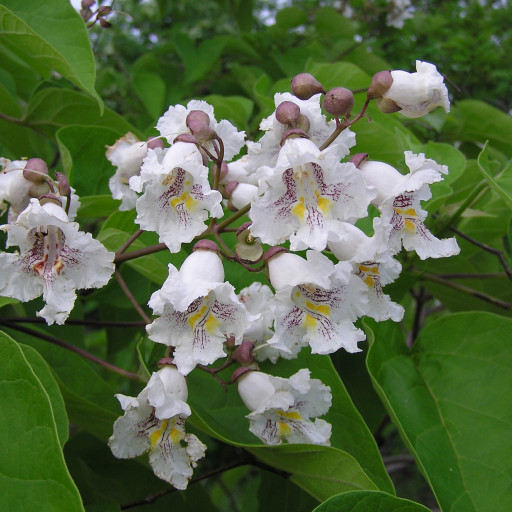
Plant Overview
Often called the "Cigar Tree" or the "Indian Bean Tree," Catalpa bignonioides is a Southern showstopper known for its dramatic foliage and orchid-like summer blooms. Despite its exotic, tropical appearance, it is a hardy North American native that provides some of the densest shade in the plant kingdom. It has a storied history as a favorite for grand estate gardens and is famously known among anglers as the home of the "fish-bait" caterpillar.
🔍 How to Identify
- 🍃 Elephant-Ear Leaves: Features massive, heart-shaped (cordate) leaves that can grow up to 10 inches long. They are light green and have a soft, velvety texture on the underside.
- 🌸 Orchid-like Blooms: In late spring, the tree is covered in upright clusters of white, bell-shaped flowers. If you look closely inside, you’ll see intricate purple spots and yellow stripes.
- 🚬 "Cigar" Seed Pods: By autumn, the tree produces long, thin, bean-like pods that can reach 15 inches in length. These brown pods hang through the winter, resembling dangling cigars.
🏡 In Your Garden
- 🌳 Space for a Giant: This tree grows very quickly and develops a wide, spreading canopy. Because of its brittle wood and large leaf drop, it is best planted away from house foundations or delicate power lines where it has room to "breathe."
- 🐛 The Fisherman’s Friend: You may notice large, colorful caterpillars (Catalpa Sphinx Moths) munching on the leaves. While they can defoliate the tree, they won't kill it. Many gardeners actually welcome them, as they are legendary as the best live bait for catching catfish.
⚠️ Safety & Toxicity
- 🐾 Low Risk Status: The leaves and flowers are generally considered non-toxic to humans and pets. However, the roots and bark are known to contain compounds that can be poisonous if ingested in large quantities.
- 🤧 Pollen & Skin: While rare, the showy flowers can cause mild hay fever in some people, and the sap may cause minor skin irritation for those with sensitive skin during heavy pruning.
✨ Fun Fact
The Catalpa is one of the few trees that "warns" you of its presence; when the leaves are crushed, they emit a distinct, slightly unpleasant odor that helps distinguish them from the very similar Paulownia (Princess Tree).

Detailed Care Instructions
| Color | White |
| Soil Ph | 5.5-7 |
| Humidity | Normal |
| Lighting | Part Sun |
| Toxicity | Non-Toxic |
| Soil Type | Moist, Well-Drained Alkaline Soil |
| Bloom Time | Late Spring/Early Summer |
| Difficulty | Medium |
| Plant Type | Deciduous Tree |
| Hibernation | Cold Period |
| Mature Size | 50–60 Ft. Tall |
| Native Area | Southeastern United States In Alabama, Florida, Georgia, Louisiana, And Mississippi |
| Sun Exposure | Full Sun, Partial Shade |
| Hardiness Zones | 5-9 |
To grow a Catalpa bignonioides plant, also known as the Southern Catalpa or Indian Bean Tree, you can follow these steps:
- Choose the right location: Catalpa bignonioides prefer full sun to partial shade. Make sure the location you select offers well-draining soil.
- Planting: Dig a hole that is slightly wider and deeper than the container the plant is currently in. Gently remove the plant from its container, being careful not to damage the root system. Place the plant in the hole, making sure the top of the root ball is level with or slightly above the ground. Fill the hole with soil and press it firmly around the base of the plant.
- Watering: Keep the soil moist but not waterlogged. Water deeply and thoroughly whenever the top inch of soil feels dry. During dry spells, you may need to water more frequently.
- Fertilizing: Apply a balanced slow-release fertilizer in early spring or use a liquid fertilizer according to the package instructions. This will help provide the necessary nutrients for healthy growth.
- Pruning: Catalpa bignonioides generally require minimal pruning. However, you can remove any dead or damaged branches in late winter or early spring to encourage new growth.
- Mulching: Apply a layer of organic mulch around the base of the plant to help retain moisture, regulate soil temperature, and suppress weed growth.
- Protecting from pests and diseases: Catalpa bignonioides are generally resistant to pests and diseases. However, you may need to monitor for common issues like leaf spot or fungal diseases and take appropriate measures if needed.
- Patience: Have patience as Catalpa bignonioides can take a few years to establish and reach their full size. Once they are established, they can grow rapidly and reach heights of 40 to 60 feet (12 to 18 meters).
Remember to regularly monitor your Catalpa bignonioides plant for any signs of stress, water it appropriately, and provide it with the necessary care for optimal growth.

Place in a bright room that is sun drenched almost all day. Or directly in a south-facing window.

To water this plant, it is important to make sure the soil is well-drained but does not dry out completely. When watering, it is recommended to thoroughly saturate the soil to ensure the roots receive enough moisture. However, allowing the soil to become waterlogged can also be harmful to the plant. Watering should be done regularly during the growing season, but less frequently during the winter months. It is important to monitor the soil moisture levels and adjust watering as needed based on the plant's individual conditions such as location, weather, and age.
To fertilize this plant, apply a balanced fertilizer with equal amounts of nitrogen, phosphorus, and potassium in the spring, just as new growth begins. Use a slow-release fertilizer formulated for trees and shrubs, and follow the manufacturer's instructions for application rates. Avoid fertilizing late in the growing season, as this can stimulate new growth that may not have time to harden off before winter. Water the plant well before and after fertilizing.
The optimal soil to use with the plant requires good drainage and a slightly acidic to neutral pH range. It should be rich in organic matter and have good water retention capabilities. Additionally, the soil should be well aerated and not compacted. A recommended soil mix is a combination of peat moss, vermiculite, and perlite. It is also important to avoid using heavy clay soils or soils that are excessively sandy since this can negatively impact plant growth and health.
- Collect seeds from a mature plant: Wait for the Catalpa Bignonioides plant to produce seed pods, which usually appear in late summer or early fall. Harvest the seed pods when they start to turn brown and split open. Collect the seeds and separate them from the pod.
- Stratify the seeds: Catalpa Bignonioides seeds need to go through a period of dormancy before they can germinate. To encourage this, stratify the seeds by placing them in moist sand or peat moss and storing them in a cool, dark place for at least 90 days. Check the seeds occasionally to make sure they are still moist.
- Sow the seeds: After stratification, sow the Catalpa Bignonioides seeds in a seed tray or pot filled with nutrient-rich potting soil. Make sure the soil is moist, but not waterlogged. Cover the seeds lightly with soil, then place the tray or pot in a warm, sheltered location.
- Provide the right growing conditions: Catalpa Bignonioides plants prefer to grow in full sun and need plenty of water during the growing season. If possible, provide a sheltered location with protection from strong winds and frost.
- Transplant the seedlings: Once the Catalpa Bignonioides seedlings have reached a height of around 12 inches, they can be transplanted into larger containers or directly into the ground. Make sure the new location provides the right growing conditions, and water the plants regularly until they become established.
Common pests of the southern catalpa include Mealybugs, aphids, larvae. Make a habit of checking your southern catalpa frequently for pests so that any infestations can be caught and managed early.








