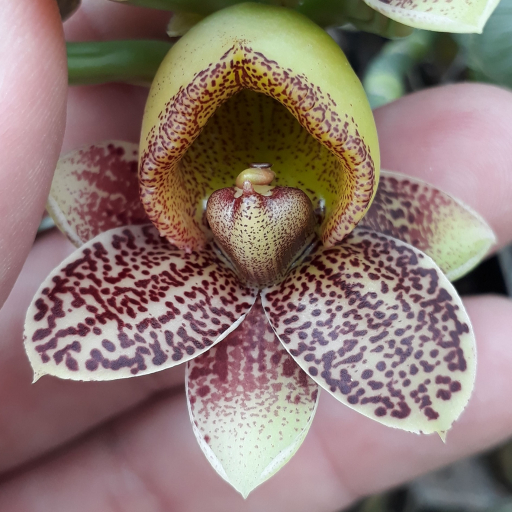
Plant Overview
Known as one of the most charming "dwarf" orchids in the Catasetum family, Catasetum denticulatum is a resilient little gem hailing from the humid lowlands of the Brazilian Amazon. Unlike its larger cousins, this plant stays compact, making it a favorite for indoor collectors who are short on space. It is famous in the botanical world for its "exploding" pollen sacs and its dramatic, seasonal transformation from a lush leafy fan to a bare, resting bulb.
🔍 How to Identify
- 🥚 Pseudobulbs: Look for fat, spindle-shaped bulbs (pseudobulbs) that resemble smooth green cigars. These serve as the plant's water reservoir during dry spells.
- 🍃 Pleated Foliage: The leaves are thin, papery, and feature deep longitudinal ribs or pleats. They grow in a fan shape from the top of the bulb.
- 🦷 "Toothed" Flowers: The flowers are waxy and clustered on a drooping stem. They are easily identified by the "denticulate" (finely toothed) fringe along the edges of the lip, usually decorated with bold mahogany or chocolate-colored spots.
🏡 In Your Garden
- 💤 The Seasonal "Big Sleep": This orchid is strictly deciduous. It will drop all its leaves once a year to go dormant. It is vital to stop watering entirely when the leaves turn yellow and fall, as the plant is "sleeping" and cannot process moisture, making it highly prone to rot.
- 🍼 Thirsty Growers: During the peak summer growing season, this plant is a "heavy feeder." It grows incredibly fast and requires frequent watering and fertilizer to bulk up its pseudobulbs for the next flowering cycle.
- 🌡️ Warmth Seekers: Native to the Amazon, it hates the cold. It thrives in "intermediate to warm" temperatures and loves high humidity—think of a steamy bathroom or a bright kitchen windowsill.
⚠️ Safety & Toxicity
- ✅ Safe for Pets: Like most orchids, Catasetum denticulatum is generally considered non-toxic to cats, dogs, and horses.
- 🍯 Sticky Nectar: During blooming, the plant may produce "happy sap"—a clear, sticky nectar on the flower spikes. While harmless, it can attract ants if kept outdoors or leave a sticky residue on furniture.
✨ Fun Fact
This plant is a literal sharpshooter! To ensure pollination, the male flowers have two tiny "trigger" hairs. When a bee brushes against them, the orchid physically launches its pollen packets (pollinia) at the insect’s back with enough force to be felt by a human finger. The bee, startled but unharmed, carries the pollen to the next flower.

Detailed Care Instructions
To grow a Catasetum denticulatum plant successfully, follow these steps:
- Potting: Select a well-draining pot with a drainage hole. Use a mix of orchid bark, perlite, and sphagnum moss in equal parts as the potting medium.
- Lighting: Place the plant in a location that receives bright, indirect light. Catasetums prefer medium to high light levels but avoid direct sunlight, as it can burn the leaves.
- Temperature and Humidity: Provide temperatures between 65°F to 85°F (18°C to 29°C) during the day and slightly cooler temperatures at night. Maintain a humidity level between 50% to 70%. You can use a humidifier or place the pot on a tray filled with water and pebbles to increase humidity.
- Watering: Water the plant thoroughly when the top inch of the potting medium feels dry. Allow excess water to drain from the bottom of the pot. During active growth, water more frequently, and reduce watering during the dormant period.
- Fertilizing: Use a balanced orchid fertilizer with a ratio of 20-20-20 during the growing season. Dilute the fertilizer to half strength and apply every two weeks. Reduce fertilizing during the dormant period.
- Dormancy: Catasetums undergo a natural dormancy period. As temperatures cool in autumn, reduce watering and fertilizer. The plant will drop its leaves and enter dormancy. During this time, keep it in a cooler location with reduced light until new growth appears.
- Repotting: Repot the plant every 2 to 3 years, preferably after the dormant period, to refresh the potting medium and allow for root growth. Be careful not to damage the fragile roots during repotting.
- Pseudobulb Division: If the Catasetum denticulatum plant becomes too large for its pot, you can divide it by carefully separating the pseudobulbs and repotting them individually.
With proper care and attention, your Catasetum denticulatum should thrive and produce beautiful flowers. Remember to observe and adjust to the specific needs of your plant as it grows.

Place in a window with dappled sun or a spot in the middle of a room. Or directly in a window facing west or east.

To water this plant, it is important to use fresh, distilled or rainwater. The plant should be watered every 7 to 10 days, and it is important to allow the potting mix to dry out slightly between waterings. When watering, the potting mix should be thoroughly soaked, and any excess water should be drained away. It is important not to keep the potting mix too moist, as this can lead to rot and other plant health issues. Additionally, during the growing season, it may be beneficial to fertilize the plant every 2 to 3 weeks with a balanced fertilizer at half-strength.
To fertilize your plant, dilute a balanced fertilizer with water to half strength and apply it to the soil every two weeks during the growing season. You can also add a slow-release fertilizer to the potting mix. Be careful not to over-fertilize as this can damage the plant. Water the plant thoroughly before and after each fertilization.
Catasetum Denticulatum is an orchid species that requires a unique soil mixture to thrive. The soil should be well-draining and airy, allowing oxygen to reach the roots and preventing waterlogging. A mix of bark, sphagnum moss, and perlite is ideal for this plant, as it balances moisture retention with hydration needs. The bark provides structure and drainage, while the moss retains moisture and prevents dehydration. The perlite further improves drainage and aerates the soil. This combination of soil components mimics the plant's natural habitat in South America, where it grows on trees and absorbs nutrients from the surrounding air. It's essential to avoid using soil mixes that are dense or retain too much water, as this will lead to root rot and other fungal diseases. Overall, providing a well-draining, airy soil mix will help your Catasetum Denticulatum plant to flourish and thrive.
To propagate this plant, start by selecting a healthy and mature plant with multiple growths. Carefully remove one of the pseudobulbs from the parent plant with a clean and sharp knife. Ensure that the pseudobulb has healthy roots and leaves.
Next, sterilize a small pot or container with a mixture of water and bleach. Rinse the container with water and allow it to dry. Fill the container with a well-draining orchid potting mix consisting of bark, sphagnum moss, and perlite.
Plant the pseudobulb in the potting mix, ensuring that it is planted at the same depth as it was in the parent plant. Water the plant thoroughly and place it in a location that receives bright, indirect sunlight.
Mist the plant regularly to maintain humidity levels and prevent the potting mix from drying out. Avoid overwatering the plant, as this can lead to root rot.
Within a few weeks, the plant should start to grow new roots and leaves. Once the new growth is established, it can be repotted into a larger container or placed in a permanent location.








