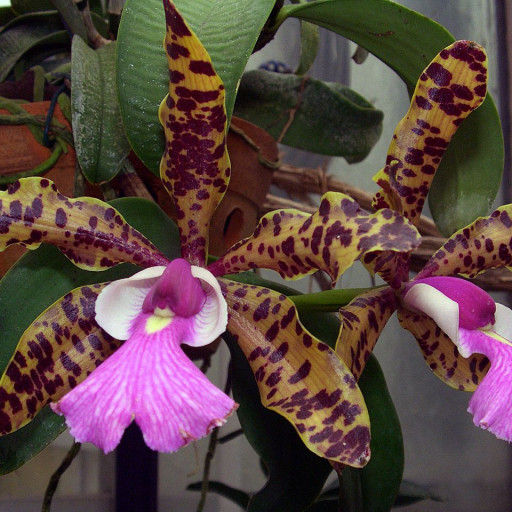
Plant Overview
Known as the undisputed "Queen of Orchids," the Cattleya has long been the gold standard for floral beauty, famously serving as the quintessential prom corsage of the mid-20th century. Native to the tropical canopies of Central and South America, these "air plants" grow nestled in tree branches rather than in soil. Their intoxicating fragrance and flamboyant, ruffled petals make them the crown jewel of any indoor jungle or greenhouse collection.
🔍 How to Identify
- 🌸 The Bloom: Features large, showy flowers often characterized by a prominent, trumpet-shaped "lip" (labellum) that is frequently a different color or pattern than the surrounding petals.
- 🌿 The Pseudobulbs: Look for thick, fleshy, cane-like stems at the base; these are water-storage organs that allow the plant to survive periods of drought in the wild.
- 🍃 The Foliage: Typically possesses stiff, leathery, evergreen leaves that are oval or strap-shaped, growing either singly or in pairs from the top of the pseudobulbs.
🏡 In Your Garden
- ☀️ Light Seekers: Cattleyas are high-light orchids; if their leaves are a deep, dark green, they are likely "sun-starved" and will refuse to bloom. Aim for a grassy, lime-green leaf color.
- 💨 Air & Drainage: Because they are epiphytes (tree-dwellers), they will suffocate in regular potting soil. They require a chunky orchid bark mix and pots with plenty of drainage holes to mimic their breezy mountain homes.
⚠️ Safety & Toxicity
- 🐾 Pet Safe: Cattleya orchids are non-toxic to cats, dogs, and horses, making them a worry-free choice for pet-owning households.
- 👄 Not for Snacking: While not poisonous, the orchid's tissues are fibrous and not intended for consumption; keep them out of reach of curious toddlers to avoid choking or mild stomach upset.
✨ Fun Fact
Many Cattleya species have a "fragrance clock"—they release their intense, honey-sweet perfume only during specific hours of the day to attract the exact bees needed for pollination, turning the scent "off" at night to save energy!

Detailed Care Instructions
To grow a Cattleya plant successfully, follow these steps:
- Choose a suitable location: Cattleyas prefer bright, indirect sunlight. Place them near a window with filtered light or provide shade if necessary.
- Use the right pot and growing medium: Cattleyas should be potted in well-draining orchid mix, such as bark or sphagnum moss. Select a pot with good drainage holes to prevent waterlogging the roots.
- Watering and humidity: Water your Cattleya plant thoroughly when the top inch of the potting mix dries out. Avoid overwatering, as it may cause root rot. Since Cattleyas are epiphytic orchids, they also appreciate slightly higher humidity levels. You can mist the air around the plant or use a humidity tray to provide adequate moisture.
- Fertilization: Cattleyas require regular feeding during their active growth period. Use a balanced orchid fertilizer, diluted to half the recommended strength, every two to three weeks during the growing season. Reduce or stop fertilizing during the winter months when growth slows down.
- Temperature and ventilation: Cattleyas prefer temperatures ranging from 70-85°F (21-29°C) during the day and a slight drop to 60-65°F (15-18°C) at night. Adequate air circulation is important to prevent fungal diseases, so ensure proper ventilation around the plant.
- Repotting: Cattleyas should be repotted every 2-3 years or when the potting mix breaks down and becomes too compact. Choose a slightly larger pot and remove any dead or decaying roots before repotting.
- Pruning: Remove any yellow or dead leaves, as well as old flower spikes, once they have finished blooming. This will redirect the plant's energy to new growth and improve its overall health.
- Blooming: Cattleyas typically bloom once a year, usually in the spring or summer. Provide a slight cooler period (about 55-60°F or 13-15°C) for 4-6 weeks in the winter to encourage blooming. They produce vibrant, showy flowers in various colors and sizes.
By following these care guidelines, you can successfully grow and enjoy your Cattleya orchid plant.

Place in a window with dappled sun or a spot in the middle of a room. Or directly in a window facing west or east.

To water the plant, fill a container with water and let it sit until it reaches room temperature. Then, carefully pour the water over the soil until it begins to drain out of the bottom of the pot. Avoid getting water on the leaves or flowers, as this can cause damage or rot. Allow the soil to dry out slightly before watering again, being sure not to let it completely dry out. It is important to avoid over-watering, as this can lead to root rot and other issues.
- Use a balanced fertilizer with equal amounts of nitrogen, phosphorus, and potassium.
- Dilute the fertilizer at a ratio of 1:2 or 1:3 with water.
- Apply the fertilizer every two to four weeks during the growing season.
- Water the plant thoroughly before fertilizing to prevent burning the roots.
- Avoid fertilizing during the dormant season.
- Alternate between a complete fertilizer and a bloom booster throughout the growing season.
- Consider using a slow-release fertilizer for convenience.
- Do not over-fertilize as it can harm the plant.
When growing a type of orchid called Cattleya, it is important to choose the appropriate soil for its growth. The soil that is ideal for this plant has a mixture of various components that can provide proper nutrition, drainage, and aeration. It should be well-draining and have an acidic pH level between 5.5 and 6.5.
One key component to look for in the soil mix is bark, which provides good drainage and aeration. It is also important to include perlite, which helps to loosen the soil and prevent it from becoming compacted. Additionally, adding sphagnum moss can help retain moisture, and coconut coir can provide additional organic matter.
To ensure that the soil is suitable for the growth of a Cattleya orchid, it is recommended to use a specialized orchid mix that is formulated for this type of plant. This will provide the ideal balance of nutrients, drainage, and aeration that the plant needs to grow properly.
Overall, choosing the right soil mix is essential to the health and growth of a Cattleya orchid, and it is important to select a mix that is appropriate for the plant's specific needs.
There are several ways to propagate this type of orchid plant, but one of the most common methods is through division. To do this, wait until the plant has finished flowering and new growth has appeared. Carefully remove the plant from its pot and gently separate the roots and pseudobulbs into smaller sections, making sure each section has at least three pseudobulbs. Trim any damaged or dead roots. Plant each section in a pot with fresh potting mix and water thoroughly. Provide bright but indirect light and keep the soil moist but not waterlogged. Another way to propagate this plant is through stem cuttings. Select a healthy stem and make a clean cut just below a node. Dip the cut end into rooting hormone and plant it in a small pot filled with a mixture of perlite and peat moss. Keep the soil moist and the cutting in a warm, humid environment with bright, indirect light. With proper care, the stem cutting will develop roots and eventually grow into a new plant.
Common pests of the burbank flare include Scale insect, mealybugs, spider mites, thrips. Make a habit of checking your burbank flare frequently for pests so that any infestations can be caught and managed early.







