Plant Overview
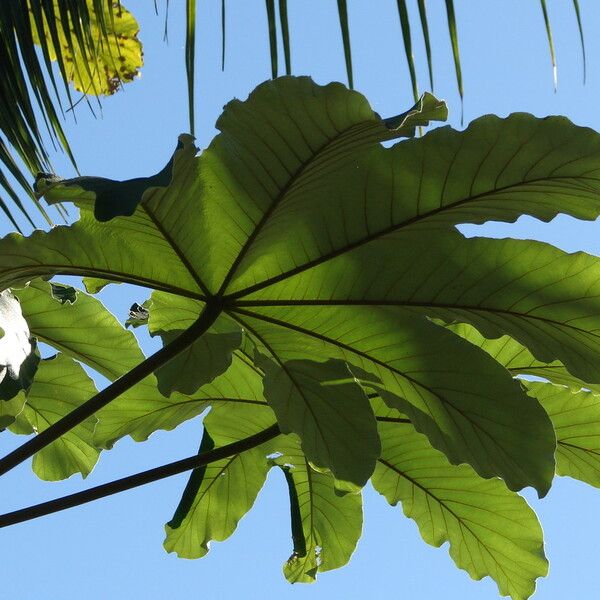
Often called the "Mountain Trumpet" or "Yagrumo Hembra," Cecropia schreberiana is a Caribbean icon. If you’ve ever hiked a tropical trail after a storm, this is likely the first tree to greet you in the clearing. Its giant, umbrella-like leaves seem to dance in the wind, revealing a shimmering silver underside that can be seen from miles away.
🔍 How to Identify
- 🍃 Large Palmate Leaves: These massive leaves can grow up to two feet wide, deeply divided into 7–11 lobes that look like a giant, outstretched hand.
- 🥈 Silvery Underside: The bottom of each leaf is covered in dense, white-silvery hairs, creating a striking "shimmering" effect against the deep green top when the wind blows.
- 🎋 Hollow Segmented Trunks: The trunk is light-colored and ringed with horizontal scars, looking remarkably like a thick, woody stalk of bamboo.
- 🍌 Fingered Fruit: It produces long, thin, hanging clusters of fruit that look like tiny green fingers or "catkins."
🏡 In Your Garden
- 🚀 The Ultimate Pioneer: This tree is built for speed! It is one of the fastest-growing trees in the world, specialized to fill gaps in the forest canopy after a landslide or storm.
- 🌬️ Wind & Space: Because it grows tall and thin so quickly, it can be susceptible to breaking in high winds. In a garden setting, it needs plenty of space away from houses or power lines.
- 🐜 Symbiotic Shelter: Its hollow stems often provide a home for "Bodyguard Ants" (Azteca ants), which protect the tree from herbivores in exchange for sugary snacks produced by the leaves.
⚠️ Safety & Toxicity
- 🛡️ Low Risk: This plant is generally considered safe for humans and animals to be around, though it is not meant for consumption.
- 💧 Sap Irritation: The milky sap found in the stems can cause mild skin irritation for people with sensitive skin or latex allergies.
- 🐾 Pet Safety: While not specifically listed as "toxic" like a Lily or Sago Palm, the leaves are high in tannins and may cause digestive upset if chewed on by curious dogs or cats.
✨ Fun Fact
🌀 Nature's Weather Vane: In Puerto Rico, locals say the Yagrumo "shows its white side" to warn of an approaching storm. Because the leaves flip upward when the air pressure drops and the wind picks up, the silver undersides become visible, acting as a natural early warning system for hurricanes!

Detailed Care Instructions
To grow Cecropia Schreberiana plant, also known as the Yagrumo hembra or Puerto Rican Fiddlewood, you can follow these steps:
- Obtain seeds or cuttings: You can obtain seeds or cuttings of the Cecropia Schreberiana plant from a reputable nursery or online store.
- Choose a suitable location: Cecropia Schreberiana prefers a warm and humid climate. If you live in a region with a similar climate, you can plant it outside. Otherwise, it's best to grow it indoors or in a greenhouse.
- Prepare the soil: The plant thrives in rich, well-draining soil. Prepare the planting area by loosening the soil with a garden fork and incorporating organic matter such as compost or leaf mold.
- Plant the seeds or cuttings: If starting from seeds, plant them about 1/4 inch deep in the soil. If using cuttings, make a small hole in the soil and place the cutting inside, ensuring that at least one node is below the soil surface.
- Watering: Keep the soil consistently moist, but not waterlogged. Water the plant regularly, especially during dry periods. Reduce watering during the colder months when growth slows down.
- Provide adequate sunlight: Cecropia Schreberiana thrives in bright, indirect sunlight. If growing indoors, place it near a window where it will receive adequate light. Outdoors, provide some shade during the hottest parts of the day.
- Fertilization: Feed the plant with a balanced fertilizer during the growing season (spring and summer) to promote healthy growth. Follow the instructions on the fertilizer package for application rates.
- Pruning: To keep the plant looking tidy and to encourage a bushy growth habit, you can prune it lightly. Remove any dead or diseased branches regularly.
- Monitor for pests and diseases: Keep an eye out for common plant pests such as aphids, mealybugs, or spider mites. If you notice any signs of pests or diseases, take appropriate measures to control them, such as using organic insecticides or contacting a professional if necessary.
- Patience: Cecropia Schreberiana is a slow-growing plant, so be patient as it takes time to establish and grow. With proper care and patience, you can enjoy the beautiful foliage of this plant.
Remember to research and provide care specific to your region and climate to ensure optimal growth and health of your Cecropia Schreberiana plant.

Place in a bright room that is sun drenched almost all day. Or directly in a south-facing window.

Cecropia Schreberiana is a tropical plant that requires regular watering to flourish. When watering, it is important to use room temperature water to avoid shocking the plant's roots. The soil should be moist but not waterlogged as this can lead to root rot and other fungal diseases. It is recommended to water the plant once a week, but this may vary depending on the climate and humidity levels in your area. To ensure proper drainage, make sure the pot has drainage holes and the plant is not sitting in standing water. Additionally, it is important to avoid getting the leaves wet while watering as this can cause fungal infections.
To fertilize this plant, use a well-balanced fertilizer with equal parts nitrogen, phosphorus, and potassium. Apply once every 2-3 months during the growing season, following the package instructions for dosage. Be sure to water the plant prior to fertilizing and do not apply the fertilizer to dry soil. Avoid getting fertilizer on the plant's leaves, as this can cause burning.
The ideal soil for the plant should be well-draining and moist. It should have good fertility and water retention capacity. Sandy loam soil with a pH range of 5.5 to 7.5 is highly suitable for the plant. The soil should be rich in organic matter and should not be compacted or heavy. Adding compost or well-decomposed manure to the soil will help improve its fertility and water-holding capacity. Regular application of a balanced fertilizer can also help to support the plant's growth. It is important to avoid using soil that is contaminated with chemicals or pesticides that can harm the plant.
Propagation of this plant can be done through several methods. One way is through seed propagation, which involves planting the seeds in a suitable potting mix and providing adequate moisture, light, and temperature. Another method is through stem cuttings, where a stem with several nodes is cut and planted in a rooting hormone. The cutting is then kept in a moist and warm environment until it develops roots and can be transplanted into a pot with appropriate potting mix. The plant can also be propagated through division, where the root ball is carefully separated into several smaller sections and each section is replanted into a separate pot. Careful attention to watering, light, and temperature during propagation is necessary for successful growth of the plant.








