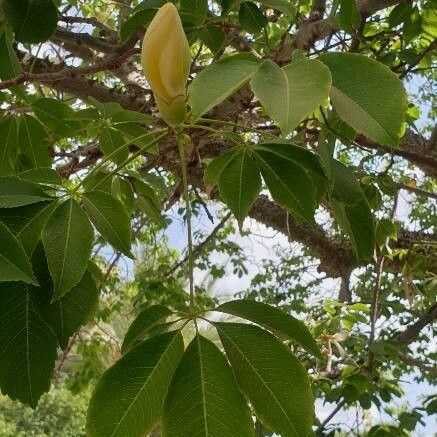
Plant Overview
Often called the White Silk Floss Tree, this South American giant looks like something straight out of a prehistoric landscape. Known for its distinct "pot-bellied" trunk and a canopy that erupts in creamy, star-shaped blossoms, it is a centerpiece of subtropical landscapes. In its native lands, it is often viewed as a symbol of protection, standing tall with its "armored" bark.
🔍 How to Identify
- 🌳 The Trunk: Young trees have a vibrant green bark that helps the tree photosynthesize; as it matures, it develops a stout, bottle-shaped trunk covered in thick, conical grey prickles.
- 🌸 The Blooms: Large, trumpet-shaped flowers with five petals, typically creamy white or pale yellow with a darker, speckled throat that attracts pollinators.
- 🧶 The Pods: Following the flowers, large green pear-shaped pods appear, which eventually burst open to reveal a mass of fluffy, white "kapok" (silk-like fibers) surrounding the seeds.
🏡 In Your Garden
- 🏜️ The Storage Tank: That bulging trunk isn't just for show—it is a water storage organ. This makes the tree incredibly drought-tolerant once established, though it prefers deep, occasional watering to look its best.
- 🏗️ Root Management: Be mindful of where you plant it! The Ceiba Insignis has powerful surface roots that can lift sidewalks and driveways. Give it plenty of room to expand away from your home or underground pipes.
- 🍂 Winter Shedding: This is a deciduous tree. Don't be alarmed if it drops its leaves in late autumn; the bare, thorny silhouette is part of its natural cycle and allows the flowers to take center stage.
⚠️ Safety & Toxicity
- 🌵 Physical Hazard: The primary safety concern is the sharp, woody thorns covering the trunk. These can cause painful puncture wounds, so avoid planting them near narrow walkways or play areas.
- 🐾 Pet & Child Safety: While the tree is not considered highly toxic if accidentally nibbled, the "silk" from the pods can be a respiratory irritant for sensitive individuals if it blows around in large quantities.
✨ Fun Fact
The fluffy "kapok" fibers found inside the seed pods were historically used to stuff life jackets and pillows because the material is naturally buoyant, water-resistant, and incredibly lightweight!

Detailed Care Instructions
To grow Ceiba insignis, also known as the silk floss tree, you can follow these steps:
- Choose a suitable location: Ceiba insignis thrives in full sun, so select a spot in your garden that receives at least six hours of direct sunlight daily. Ensure the soil is well-draining with a pH between 6.0 and 7.5.
- Prepare the soil: Mix organic matter, such as compost or well-rotted manure, into the soil to improve fertility and drainage. This will provide a good foundation for the plant to grow.
- Select the right container (if growing in pots): If you plan to grow Ceiba insignis in a pot, choose a container with sufficient drainage holes and a size that allows the roots to spread. Ensure it is large enough to accommodate the plant's growth.
- Sow seeds or plant a seedling: You can sow fresh seeds directly into the ground or in containers. Alternatively, you can purchase a seedling from a nursery. If sowing seeds, plant them about 1 inch deep into the soil or potting mix. Space multiple seeds or seedlings at least 10-15 feet apart to allow for their eventual mature size.
- Water appropriately: Ceiba insignis requires regular watering, especially during the growing season. Keep the soil moist but not waterlogged. Avoid overwatering to prevent root rot. Once established, the plant can handle occasional drought conditions.
- Provide support: Young Ceiba insignis plants may benefit from staking or the use of a tree guard to protect them from strong winds. As they grow, the trunk will naturally become stronger and more stable.
- Prune when necessary: Ceiba insignis generally requires minimal pruning. Remove any dead, damaged, or diseased branches as needed. Pruning can also shape the tree if desired, but it is not necessary for the health of the plant.
- Fertilize sparingly: Ceiba insignis does not typically require heavy feeding. However, applying a balanced slow-release fertilizer once a year in spring can provide additional nutrients. Follow the instructions on the fertilizer packaging for proper usage.
- Monitor for pests and diseases: Although relatively pest-resistant, Ceiba insignis can occasionally be affected by aphids or mealybugs. Regularly inspect the plant for any signs of infestation and take appropriate action if necessary. Monitor for any diseases such as root rot or leaf spots and treat promptly, if needed.
- Enjoy the majestic beauty: Ceiba insignis is known for its stunning flowers and large, shiny green leaves. Allow the plant to grow and mature, providing shade and a focal point in your garden.

Place in a bright room that is sun drenched almost all day. Or directly in a south-facing window.

Ceiba Insignis plants require regular watering to thrive, especially during their growing season. When watering, it is important to thoroughly saturate the soil around the plant, allowing the water to reach the roots. However, it is also important to avoid overwatering as this can lead to root rot.
To water a Ceiba Insignis plant, you can either use a watering can or a hose with a gentle spray attachment. Water the plant at the base, making sure to water the entire root system. Allow the top few inches of soil to dry out slightly between waterings to prevent waterlogged conditions.
It is also important to take into account the temperature and humidity levels in the plant's environment, as these factors can affect the plant's water requirements. During periods of high heat or low humidity, the plant may need more frequent watering. Conversely, during cooler temperatures or high humidity, the plant may require less water.
By monitoring the plant's soil moisture levels and adjusting your watering schedule accordingly, you can ensure that your Ceiba Insignis plant receives the proper amount of water to remain healthy and vibrant.
To fertilize this plant, use a balanced fertilizer with equal amounts of nitrogen, phosphorus, and potassium. Apply the fertilizer evenly around the base of the plant, avoiding contact with the stem or leaves. Water thoroughly after fertilizing. Fertilize every 2-3 months during the growing season. Avoid over-fertilization, as it can damage the plant.
The recommended soil for Ceiba Insignis plants should be well-draining and rich in nutrients. The soil should have a pH level of around 6.0 to 7.0, which is slightly acidic to neutral. A mixture of loam, peat moss, and sand can be used to create an ideal growing medium for this plant. Additionally, the soil should be kept moist but not overly wet, as this can lead to root rot. It is also important to ensure that the soil is not compacted, as Ceiba Insignis plants require good air circulation around their roots.
Ceiba insignis can be propagated using seeds or cuttings.
Seed propagation:
- Collect mature seeds from the parent plant in the dry season.
- Soak the seeds in water for 24 hours.
- Sow the seeds in well-draining soil mix, approximately 1-2 centimeters deep.
- Water the soil as needed to keep it moist.
- Germination should occur within 14-21 days.
Cutting propagation: - Take a cutting from the parent plant that is approximately 20-30 centimeters tall.
- Remove the bottom leaves from the cutting.
- Dip the cut end of the stem in rooting hormone.
- Plant the cutting into well-draining soil mix, making sure to leave at least one node above the soil line.
- Water the soil as needed to keep it moist.
- Place the cutting in a location with bright, indirect light.
- Rooting should occur within 3-4 weeks.








