Plant Overview
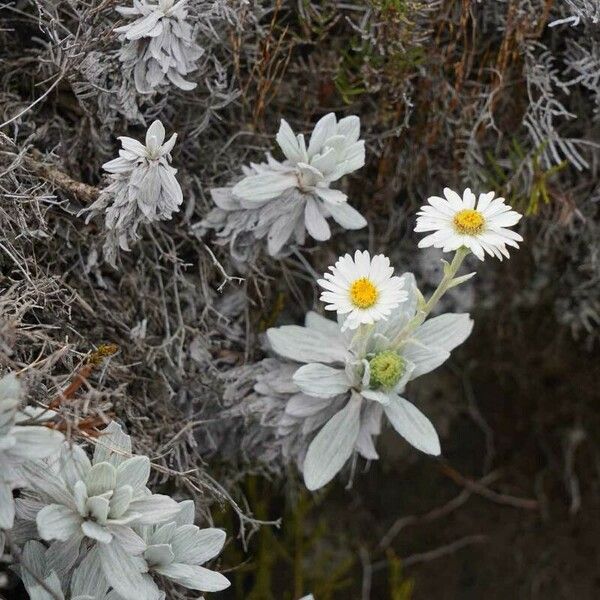
Known as the White Mountain Daisy or the "Hoary Mountain Daisy," this high-altitude jewel is a signature species of the New Zealand Alps. With its shimmering, frosted foliage, it looks as though it has been dusted with a light layer of snow even in the peak of summer. It is a resilient survivor, perfectly adapted to the wind-swept, rocky ridges of the South Island.
🔍 How to Identify
- 🍃 Foliage Texture: The leaves are thick, leathery, and covered in a dense, silvery-white "tomentum" (fine woolly hairs) that gives the plant a distinct metallic sheen.
- 🌼 The Bloom: It produces striking, solitary daisy-like flowers with pure white ray florets and a bold, golden-yellow central disc, standing atop sturdy, felted stems.
- 📏 Growth Habit: This plant is a low-growing, mat-forming perennial that creates tight rosettes, eventually spreading into a beautiful, silvery carpet over rocky ground.
🏡 In Your Garden
- 🏔️ The Alpine Specialist: Because it originates from mountain scree, it requires exceptional drainage. It thrives in gritty, volcanic, or rocky soils and will quickly rot if left in heavy, waterlogged clay.
- 🌬️ Climate Nuance: It is incredibly cold-hardy but struggles in high humidity. The fine hairs on its leaves are designed to trap moisture in dry alpine air, but in humid gardens, they can trap pathogens, so it prefers a spot with excellent air circulation.
⚠️ Safety & Toxicity
- ✅ General Safety: Celmisia incana is non-toxic and is not known to pose a threat to humans, cats, or dogs.
- 🧤 Skin Sensitivity: While not poisonous, the dense hairs on the leaves can be slightly irritating to individuals with very sensitive skin if handled extensively; wearing light gardening gloves is recommended during pruning.
✨ Fun Fact
🏔️ The thick, white "fuzz" on the leaves acts as a biological sunscreen. It reflects intense ultraviolet light at high altitudes and creates a micro-buffer of still air against the skin of the leaf to prevent dehydration from freezing mountain winds.

Detailed Care Instructions

Place in a bright room that is sun drenched almost all day. Or directly in a south-facing window.

When the top few inches of soil dry out, water your plants. If the top few inches of soil are still moist, do not water your plant. Wait a few days, then poke your finger into the soil to see if anything has changed. Overwatering poses a disease risk, such as the development of fungal diseases in the roots. These plants have adaptations in there leaves that allow them to survive in low water supply.







