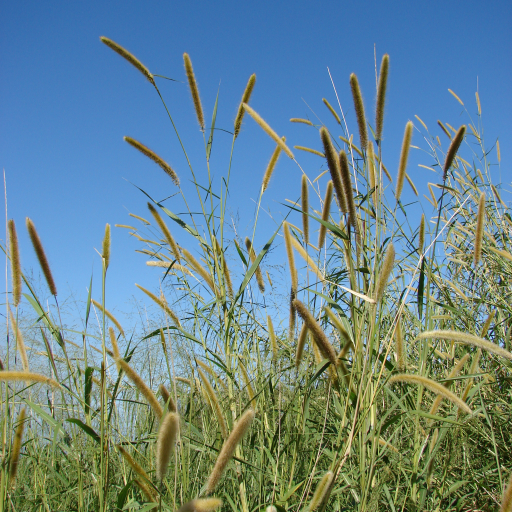
Plant Overview
Known as Elephant Grass or Napier Grass, this towering perennial is a true giant of the grass family. Originally from the tropical grasslands of Africa, it earned its nickname because it grows tall enough to hide an entire elephant! While it is a vital crop for livestock fodder and biofuel, in a garden setting, it is prized for its dramatic, bamboo-like presence and its ability to create instant privacy.
🔍 How to Identify
- 🐘 The Stature: This is no ordinary lawn grass; it can reach heights of 10 to 15 feet. Its thick, cane-like stems resemble bamboo and grow in dense, robust clumps.
- 🗡️ The Foliage: The leaves are long, sword-shaped, and can grow up to 3 feet in length. They have a prominent white midrib and a rough, finely serrated texture along the edges.
- 🌾 The "Fox-Tail" Blooms: During the flowering season, it produces bristly, cylindrical spikes that look like fuzzy fox tails. These plumes are usually yellow-green but can sometimes take on a purple hue.
🏡 In Your Garden
- 🌱 Space and Control: Because of its massive root system and rapid growth, it needs plenty of room. It is excellent for erosion control on slopes, but be cautious—in tropical climates, it can become invasive if not managed, spreading through underground rhizomes.
- ☀️ Sun Lover: This plant thrives on heat and light. It is incredibly drought-tolerant once established because its roots can dive deep into the soil to find moisture, making it a "plant it and forget it" choice for large landscapes.
⚠️ Safety & Toxicity
- 🟢 Non-Toxic: Elephant Grass is generally considered non-toxic to humans, dogs, cats, and livestock (it is actually a primary food source for many).
- ⚔️ Physical Irritant: The main safety concern is the leaf texture. The edges are sharp enough to cause "paper cuts," and some varieties have tiny, stiff hairs on the stems that can irritate sensitive skin. It is best to wear gloves when pruning or harvesting.
✨ Fun Fact
Elephant Grass is a "climate hero" in the agricultural world. It is used in a clever "Push-Pull" farming strategy where it is planted around maize crops to lure away stem-borer pests, acting as a natural, pesticide-free bodyguard for food crops!

Detailed Care Instructions
Growing Cenchrus purpureus, commonly known as purple pampas grass or purple fountain grass, requires the following steps:
- Select a suitable location: Choose an area that receives full sun for at least six to eight hours a day. The soil should be well-draining and of average fertility.
- Prepare the soil: Loosen the soil to a depth of 12-18 inches, removing any weeds or rocks. Add compost or well-rotted manure to improve fertility and drainage if necessary.
- Sow seeds or plant seedlings: You can start purple pampas grass from seeds or purchase seedlings from a nursery. If sowing seeds, sow them directly into the prepared soil, barely covering them with a thin layer of soil. If using seedlings, dig a hole slightly larger than the root ball and gently place the plant into it, backfilling with soil. Space the plants about 3-5 feet apart to allow for their mature size.
- Watering: After planting, water the newly planted grass thoroughly to ensure the soil is evenly moist. Water regularly, especially during hot and dry periods, to keep the soil slightly damp but not waterlogged.
- Fertilization: Apply a slow-release, balanced fertilizer in the spring to provide nutrients for healthy growth. Follow the instructions on the fertilizer packaging for application rates.
- Pruning: In late winter or early spring, prune the grass back to approximately 6-8 inches above the ground to remove any dead or damaged foliage. This encourages new growth and prevents the plant from becoming too leggy.
- Winter care: Purple pampas grass is hardy in USDA zones 7-11, but it may require additional winter protection in colder regions. Mulch around the base of the plant in late fall to insulate the roots and prevent them from freezing.
- Maintenance: Remove any dead or fading foliage throughout the growing season to keep the plant looking tidy. Division can also be done every few years to rejuvenate overcrowded clumps.
With proper care, Cenchrus purpureus can thrive and add beauty to your garden with its striking purple plumes and graceful arching form.

Place in a bright room that is sun drenched almost all day. Or directly in a south-facing window.

Cenchrus Purpureus plant is a type of perennial grass that requires proper watering to thrive. To adequately water this plant, you need to follow these steps:
1. Observe the soil - Before watering the plant, it's crucial to check the soil's moisture level. You can insert your finger into the soil to gauge its dryness or wetness. If the soil feels dry to the touch, it's an indication that the plant needs water.
2. Watering frequency - Cenchrus Purpureus plant should be watered regularly, especially during the growing season, which is mainly spring and summer. However, the frequency of watering depends on the type of soil, climate, and the location of the plant. Typically, watering once or twice in a week is enough.
3. Watering method - The best way to water Cenchrus Purpureus plant is by using a hose or watering can, directing the water to the soil around the plant's base. Avoid watering the foliage or the stem, as this may cause damage to the plant.
4. Water quantity - The quantity of water needed by the Cenchrus Purpureus plant depends on the soil's moisture level. It's recommended to water the plant until the soil feels moist, but not wet or waterlogged. Also, ensure that the water penetrates the soil deeply enough to reach the plant's roots.
5. Watering time - It's best to water the plant early in the morning or in the late afternoon when the sun is less intense and the temperature is cooler. Watering at this time helps to prevent water evaporation and allows the plant to absorb the water better.
By following these watering guidelines, you can help your Cenchrus Purpureus plant thrive in its environment.
To fertilize this plant, apply a balanced fertilizer with equal parts nitrogen, phosphorus, and potassium. Use a slow-release fertilizer every three to four months during the growing season. It is recommended to avoid over-fertilization as this may lead to excessive vegetative growth and reduced flowering. Follow label instructions and water the plant thoroughly after applying fertilizer.
When planting this specific plant, it is recommended to use soil that is well-draining and has a pH range of 5.5 to 7.5. The soil should be rich in organic matter and have a good balance of nutrients, including nitrogen, phosphorus, and potassium. It is also important to ensure that the soil is not compacted and has good aeration. Avoid using heavy clay soils or soils that are prone to waterlogging as these can negatively affect the growth of the plant. Adding compost or other organic amendments to the soil can help improve its structure and fertility.
Propagation of this plant can be done through various methods such as seed propagation, vegetative propagation, and tissue culture. In seed propagation, the seeds are collected from matured plants and sown in the soil during the favorable growing season. The soil is kept moist and the seeds germinate within a few weeks.
Vegetative propagation can be done through different methods such as stem cuttings, root cuttings, or division of the plant. In stem cutting, a portion of the stem is taken from the parent plant and rooted in moist soil. In root cutting, a piece of the plant's root system is removed and planted in the soil to develop new shoots. In division of the plant, the matured plant is divided into smaller sections and each section is replanted to develop new plants.
Tissue culture is another method of propagation, which involves the growth of plant cells or tissues in a laboratory setting. Small pieces of plant tissue are excised and placed into a nutrient-rich media where they develop into plantlets. Once the plantlets are matured, they are transferred to the soil for further growth.
Regardless of the method used, it is important to ensure that the soil is well-drained, and the growing conditions are favorable for the plant to thrive. This includes providing the plant with regular water, nutrients, and adequate sunlight.








