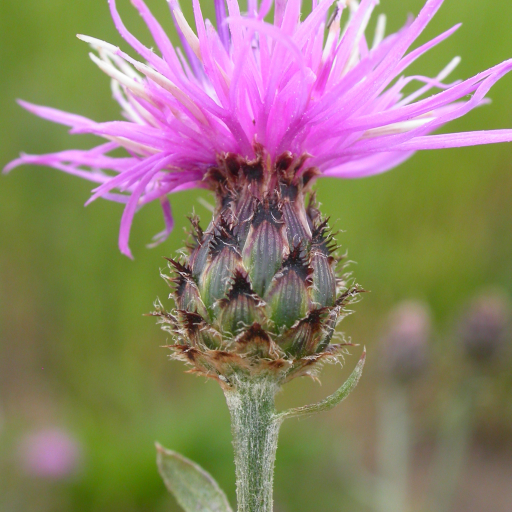
Plant Overview
Known as the Spotted Knapweed, this plant is a master of disguise and a legend of survival. Originally hailing from the meadows of Europe and Asia, it has traveled across the globe, often becoming a dominant force in any landscape it touches. While its delicate, fringed purple blooms look like a wildflower’s dream, it is actually a fierce competitor known for its "takeover" personality.
🔍 How to Identify
- 🌸 The Bloom: Features thistle-like flower heads that are bright pink to purple, consisting of many tiny tubular flowers that create a fringed, "shredded" appearance.
- 🖤 The "Spots": Look at the green base of the flower head (the bracts). You will see distinctive dark, comb-like fringes at the tips that look like tiny black spots, giving the plant its name.
- 🌿 The Foliage: The leaves are a dusty, grayish-green. Lower leaves are deeply lobed and arranged in a rosette, while upper leaves are smaller and more linear.
🏡 In Your Garden
- ⚔️ Chemical Warfare: This plant is "allelopathic," meaning it releases a chemical called catechin from its roots into the soil. This toxin prevents other nearby plants from growing, effectively clearing out its competition.
- 🏜️ Extreme Resilience: It is a drought-survivor thanks to a massive, sturdy taproot. Because of this root, simply snapping the stem won't kill it; it will grow back unless the entire root is removed from the earth.
⚠️ Safety & Toxicity
- 🧤 Skin Irritation: The sap of Spotted Knapweed can cause "knapweed dermatitis" in sensitive individuals. It is highly recommended to wear long sleeves and gloves if you are pulling it from your yard.
- 🐾 Pet & Livestock Safety: While generally avoided by animals due to its bitter taste, it is considered a noxious weed that can degrade grazing land, making it difficult for horses and cattle to find nutritious forage.
✨ Fun Fact
🧪 Spotted Knapweed doesn't just grow—it hunts! Scientists have discovered that its root secretions can actually trigger a "self-destruct" sequence in the DNA of the roots of surrounding native grasses, allowing the Knapweed to expand its empire unchallenged.

Detailed Care Instructions
To grow Centaurea Stoebe (spotted knapweed) plants, follow these steps:
- Choose a suitable location: Centaurea Stoebe prefers full sun and well-draining soil. Select an area with these conditions.
- Prepare the soil: Remove any weeds or grass from the selected area. Loosen the soil using a garden fork or tiller. Add compost or aged manure to enrich the soil if needed.
- Sow the seeds: Scatter the Centaurea Stoebe seeds directly on the soil surface. Lightly press them into the soil, but avoid covering them completely as they require light to germinate.
- Water the seeds: Moisture is essential for germination. Water the seeds gently to keep the soil moist, but not waterlogged.
- Maintain optimal conditions: Keep an eye on the moisture level of the soil and water when needed. Also, ensure the seedlings are protected from strong winds.
- Thin the seedlings: Once the seedlings have grown to about 2-3 inches tall, thin them out by removing weaker seedlings, leaving about 8-12 inches of space between each plant.
- Mulch and weed control: Apply a layer of organic mulch around the plants to help retain soil moisture and suppress weed growth. Regularly remove any weeds that may compete with the Centaurea Stoebe plants.
- Fertilization: Centaurea Stoebe typically does not require heavy fertilization. However, you can use a balanced, slow-release fertilizer if the plants appear to be struggling.
- Monitor and care: Regularly monitor the plants for signs of pests or diseases. Prune off any dead or diseased parts and support the plants with stakes if they become too tall or weak.
- Harvesting: If you wish to harvest the flowers or seeds, wait until the flowers have fully bloomed and the seeds have matured. Cut the flowers or collect the seeds carefully to avoid damaging the plant.
Remember that Centaurea Stoebe is considered an invasive species in some regions, so it is important to check local regulations before cultivating it.

Place in a bright room that is sun drenched almost all day. Or directly in a south-facing window.

Centaurea Stoebe plants prefer to be watered when the soil is dry to the touch. To water, place a moderate amount of water at the base of the plant, avoiding direct contact with the leaves. Ensure that the water seeps into the soil and that excess water drains away from the plant to prevent root rot. Depending on the size of the plant and environmental conditions, watering may be required once or twice per week. Adjust watering frequency as needed to maintain healthy growth and avoid overwatering.
To fertilize this plant, mix a slow-release fertilizer into the soil at the base of the plant in early spring. Alternatively, use a liquid fertilizer diluted in water to feed the plant every two weeks during the growing season. Be careful not to over-fertilize, as this can lead to excessive growth and weakened stems.
Centaurea Stoebe plants require well-draining soil with moderate to low fertility. The soil should have a pH level between 5.5 and 7.5. It is important to avoid using heavy, clay soils as they can cause root rot. A sandy loam soil that is mixed with compost or well-rotted manure can provide the necessary nutrients. The soil should be kept moist but not soggy, as the plant can be susceptible to root rot in wet conditions. It is also important to avoid over-fertilizing the plant, as this can lead to excessive foliage growth and reduce flowering.
To propagate this plant, first, choose a mature and healthy plant with strong stems. Then, select a stem that is at least 4 inches long and not too woody. Take a sharp, clean pair of scissors or pruning shears and cut the stem at a 45-degree angle, just below a node. Remove the lower leaves from the stem, leaving only the top few leaves.
Next, prepare a rooting hormone by dipping the cut end of the stem into a powdered or liquid hormone. This will help the stem grow roots faster. Then, fill a small container with a well-draining potting mix and make a small hole in the center. Place the stem into the hole and gently press the soil around it to hold it in place.
Water the soil thoroughly, making sure it stays consistently moist but not waterlogged. Place the container in a warm, bright location but out of direct sunlight. Check the soil daily and water as needed to keep it moist.
In a few weeks, the stem should begin to grow roots and new growth. Once the plant has a few sets of leaves, it can be transplanted into a larger pot or into the garden.








