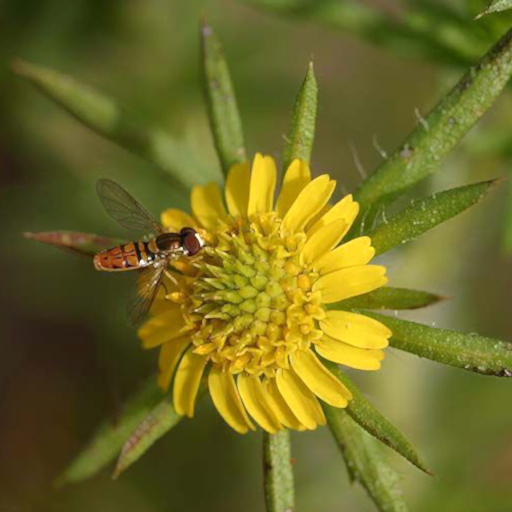
Plant Overview
Often called the Common Spikeweed, this resilient California native is a summer survivor that thrives where other plants wither. Known for its prickly personality and bright yellow blooms, it often populates "alkali sinks"—harsh, salty flatlands that would challenge most garden favorites. It serves as a vital late-season bridge for pollinators, blooming when the rest of the landscape has turned golden and dry.
🔍 How to Identify
- 🌵 Spiny Foliage: The most distinct feature is its leaves; the lower leaves are deeply lobed, while the upper leaves are stiff, narrow, and end in a sharp, needle-like point.
- 🌼 Sunny Blooms: It produces small, bright yellow flower heads that resemble miniature daisies, featuring both ray and disc florets that crowd the ends of the branches.
- 🍯 Resinous Texture: If you touch the stems (carefully!), you’ll notice a sticky, resinous coating that often carries a pungent, herbal scent typical of the tarweed family.
🏡 In Your Garden & Landscape
- 🧂 Alkaline Specialist: Unlike most plants that crave neutral pH, Spikeweed is a specialist in heavy clay and salty or alkaline soils. It’s an excellent choice for restoration projects in tough, "un-growable" patches of land.
- 🐝 Pollinator Lifeline: Because it blooms in the heat of late summer and autumn, it is a crucial nectar source for honeybees, native bees, and butterflies when other flowers have finished their cycle.
- 💧 Drought Champion: This plant has evolved to survive with almost zero summer irrigation, utilizing a deep taproot to find moisture far below the surface.
⚠️ Safety & Toxicity
- 🟢 Non-Toxic Status: Centromadia pungens is not known to be toxic to humans, dogs, or cats if ingested in small amounts.
- ⚔️ Mechanical Hazard: The "Spikeweed" name is well-earned. The dried foliage becomes incredibly sharp and stiff; it can easily pierce light clothing or thin gardening gloves, causing skin irritation or minor punctures.
✨ Fun Fact
Common Spikeweed is a "tarweed," a group of plants famous for secreting sticky resins. These resins aren't just for scent; they act as a natural "sunscreen" and water-sealer, helping the plant retain moisture under the punishing summer sun!

Detailed Care Instructions
To grow Centromadia pungens, also known as tarweed or dwarf tarweed, you can follow these steps:
- Climate: Centromadia pungens is native to dry regions of California and Oregon in the United States. It thrives in Mediterranean climates with mild, wet winters and warm, dry summers. Ensure that your location has similar conditions.
- Soil: The plant prefers well-draining soil that is sandy or loamy. Amend heavy clay soil with sand or organic matter to improve drainage.
- Sunlight: Centromadia pungens thrives in full sun. It requires at least 6-8 hours of direct sunlight daily.
- Watering: Once established, Centromadia pungens is quite drought-tolerant. However, during the germination and establishment stage, provide regular watering. Aim for moist but not saturated soil. Once the plant is established, reduce watering frequency.
- Seeds: Obtain Centromadia pungens seeds from a reliable source. Scarify the seeds by lightly sanding or nicking the tough outer coat to enhance germination. Alternatively, immerse the seeds in hot water for a few hours before planting.
- Planting: Sow the seeds directly into prepared soil in spring or fall. Scatter the seeds on the soil surface and lightly press them into the soil, keeping them at a depth of about 1/8 to 1/4 inch.
- Maintenance: Once the plants have grown, they generally require minimal care. Remove weeds regularly to reduce competition. If the plants become too tall and leggy, you can pinch or prune them to encourage bushier growth.
- Harvesting: Centromadia pungens plants produce small, daisy-like flowers in yellow or white. The flowers will eventually develop dry seed heads. If you wish to collect seeds for propagation, wait until the seed heads turn brown and dry, then carefully collect and store the seeds in a dry place until ready for planting.
Remember that Centromadia pungens is a wildflower species that self-sows readily. Be mindful if you want to prevent it from spreading too much in your garden. Enjoy the vibrant blooms and natural beauty of this native plant.

Place in a bright room that is sun drenched almost all day. Or directly in a south-facing window.

To water this plant, you should wait until the top inch of soil is dry before watering it thoroughly. When watering, make sure to pour water around the base of the plant and avoid getting water on the leaves. Use a watering can or a hose with a nozzle that allows for a gentle stream of water. It is important not to overwater this plant, as it prefers well-draining soil and can suffer from root rot if left in wet conditions for too long.
To fertilize this plant, apply a balanced fertilizer with an N-P-K ratio of 10-10-10 in the early spring and again in mid-summer. Use a slow-release fertilizer to prevent over-fertilization and apply according to package instructions. Water the plant thoroughly after fertilizing to help the nutrients penetrate the soil. Avoid fertilizing in late fall or winter since the plant is dormant during this time.
Centromadia pungens is a plant that grows best in a well-draining soil that is loose and airy. It prefers a neutral pH soil but can tolerate mildly acidic to mildly alkaline soils. It requires a soil that is rich in organic matter, such as compost or aged manure, as this will provide the necessary nutrients for healthy growth.
The ideal soil type for Centromadia pungens is a sandy loam, which is a soil that contains a balance of sand, silt, and clay particles. This type of soil allows for good drainage and aeration, which is essential for healthy root growth. This plant can also grow well in rocky soils that are well-draining, but its growth will be slower.
It is important to avoid using soils that are too heavy or compacted, as this can lead to poor drainage and inadequate oxygen levels for the roots. Additionally, soils that are too clayey or that have high levels of salt should be avoided as they can inhibit growth.
Overall, the best soil for Centromadia pungens is one that is well-draining, loose, rich in organic matter, and has a neutral pH.
To propagate this plant, you can begin by collecting seed heads from mature plants. These seed heads should be left on the plant until they turn brown and start to split open. Once they have split, carefully collect the seeds and spread them onto a seed tray filled with moist, well-drained seed compost.
Gently press the seeds into the compost, but do not cover them as they require light to germinate. Place the tray in a cool, bright location out of direct sunlight and keep the compost moist but not waterlogged.
Germination can take up to three weeks, and once the seedlings have developed true leaves, they can be transplanted into individual pots filled with a well-draining soil mix. Allow the seedlings to grow for one year before transplanting them into the garden.
Alternatively, you can propagate this plant via stem cuttings. Take cuttings of 4-5 inches in length from mature plants in early summer. Remove the lower leaves and dip the cut end of the stem in rooting hormone.
Insert the stem cuttings into a well-draining soil mix or perlite. Place the cuttings in a warm, bright location, out of direct sunlight, and keep the soil moist. After four weeks, the cuttings should have developed roots and can be transplanted into individual pots or directly into the garden.








