Plant Overview
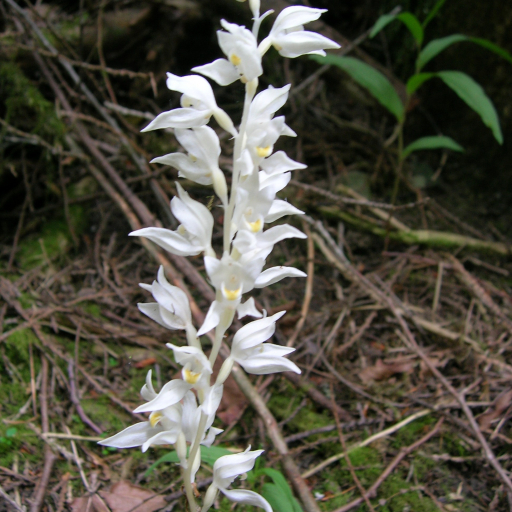
Often called the "Phantom Orchid" or "Snow Orchid," Cephalanthera austiniae is one of nature’s most mysterious and ethereal inhabitants. Unlike most plants that bask in the sun, this orchid glows like a specter in the darkest shadows of the Pacific Northwest forests. It looks as if it belongs in a Victorian ghost story, appearing suddenly as a stark, bone-white stalk against the damp, dark forest floor.
🔍 How to Identify
- 🤍 Monochromatic Look: The entire plant—from the stem to the delicate flowers—is a ghostly white or cream color, completely lacking the green pigment (chlorophyll) found in typical plants.
- 🍂 Scaly Leaves: Since it doesn't photosynthesize, it has no need for broad leaves; instead, it features small, paper-like scales wrapped tightly around the stem.
- 🌼 Vanilla Blooms: The small, elegant flowers grow in a terminal spike and feature a tiny splash of yellow or gold on the "lip" (labellum), often emitting a faint, sweet fragrance.
🌲 Habitat & Ecology
- 🍄 The Fungal Thief: This orchid is a "mycoheterotroph," meaning it doesn't make its own food from sunlight. Instead, it survives by "stealing" nutrients from specific underground fungi that are already connected to the roots of nearby trees.
- 🌲 Old-Growth Resident: You will typically find it in mature, shaded coniferous or mixed forests with heavy leaf litter. It thrives in the deep gloom where other plants would starve from a lack of light.
- 🚫 The "No-Garden" Rule: This is one of the few plants that is virtually impossible to grow at home. Because it relies on a highly specific, invisible web of forest fungi to survive, it cannot be transplanted into a garden or a pot.
⚠️ Safety & Toxicity
- 🟢 Non-Toxic: The Phantom Orchid is not known to be poisonous to humans, cats, or dogs.
- 🛑 Legal & Ecological Danger: While not chemically toxic, it is a rare and sensitive species. In many regions, it is protected by law. Digging it up or picking the flowers can permanently damage the local population and the delicate fungal network it relies on.
✨ Fun Fact
✨ The Great Vanishing Act: A Phantom Orchid can remain completely dormant underground for several years at a time. If the weather is too dry or conditions aren't perfect, it simply stays hidden beneath the soil, waiting for the right moment to "haunt" the forest surface once again.

Detailed Care Instructions
To grow Cephalanthera austiniae, commonly known as the Austin's bog orchid, you can follow these steps:
- Find the right location: Cephalanthera austiniae is a terrestrial orchid that thrives in wet, boggy environments. Choose a spot in your garden or outdoor area where the soil stays consistently moist.
- Prepare the soil: Cephalanthera austiniae prefers slightly acidic to neutral soil. Amend the soil by adding organic matter such as compost or well-rotted leaf litter to improve drainage and provide nutrients.
- Obtain plants or seeds: You can obtain Cephalanthera austiniae plants or seeds from specialty nurseries, botanical gardens, or online retailers that specialize in native plants or orchids.
- Planting the orchid: Plant Cephalanthera austiniae in early spring or late fall. Dig a hole just deep enough to accommodate the roots and gently place the plant in the hole. Cover the roots with soil and lightly tamp it down.
- Watering: Keep the soil consistently moist but not waterlogged. Water the plant regularly, especially during dry periods. Avoid overwatering, as excessive moisture can lead to root rot.
- Provide shade: Cephalanthera austiniae prefers partial to full shade. Choose a location where the plant receives dappled sunlight or shade for most of the day. Direct sunlight can be too intense and may scorch the leaves.
- Mulching: Apply a layer of organic mulch around the base of the plant to help retain moisture, regulate soil temperature, and inhibit weed growth. Use shredded bark, straw, or leaf mold as mulch.
- Fertilization: Cephalanthera austiniae doesn't require regular fertilization. However, you can apply a slow-release, balanced orchid fertilizer in early spring to provide some nutrients.
- Maintenance: Remove any weeds or vegetation that competes with the orchid for resources. Regularly monitor for pests or diseases and take appropriate actions if any issues arise.
- Winter care: In colder regions, apply a layer of mulch or winter protection to the plant to insulate it from extreme cold and frost. This will help protect the roots and preserve the plant during winter months.
Remember that Cephalanthera austiniae is a native orchid in the Pacific Northwest of the United States, so it may require specific climate conditions to thrive. It's important to consider the suitability of your region's climate before attempting to grow this plant.

Place in a window with dappled sun or a spot in the middle of a room. Or directly in a window facing west or east.

Cephalanthera austiniae is a species of plant that requires careful attention when it comes to watering. It is important to keep the soil moist but not waterlogged, as this can lead to root rot. Watering should be done thoroughly but infrequently, allowing the soil to partially dry out between waterings. The plant should also be kept out of direct sunlight and in a well-ventilated area to prevent moisture buildup. When watering, it is recommended to water the base of the plant rather than the leaves to prevent damage or disease. Regularly check the soil moisture level by sticking a finger into the soil, and adjust watering accordingly.
To fertilize this plant, it is recommended to use a balanced fertilizer with equal amounts of nitrogen, phosphorus, and potassium. Apply the fertilizer at half strength every two to three weeks during the growing season, starting in early spring and ending at the beginning of fall. Be sure to water the plant thoroughly before and after applying fertilizer. Avoid fertilizing during dormancy in winter.
The ideal soil for this plant would have a well-draining quality, a slightly acidic pH level, and a relatively moist consistency. This is because it prefers to grow in habitats with lower light levels, such as shaded forest floors, and requires consistent moisture levels to thrive. The soil could be a combination of sand, loam, and organic matter, which would allow for proper drainage while also providing necessary nutrients for healthy growth. It is important to avoid soils that are too heavy or compact, as this can inhibit root development and lead to waterlogging. A soil mixture that is lightweight and airy would also be beneficial for the plant's ability to uptake nutrients and water. Periodic fertilization with a balanced blend of nutrients can further support the plant's growth and health.
Cephalanthera Austiniae plant can be propagated through division of rhizomes or by collecting and planting its seeds.
For propagating through division of rhizomes, the plant must be carefully dug up from the soil and its rhizomes must be separated. The separated rhizomes should be planted immediately in a substrate or soil mix with proper care.
For propagating through seeds, the plant flowers in early spring, and seeds are formed subsequently. The seeds should be collected from the plant, cleaned, and planted on a substrate. The substrate should be kept moist and kept in a warm place. The plantlets will start to emerge in a few weeks to a couple of months. The plantlets should be carefully transplanted to a suitable soil mix.
Both of these propagation methods require careful attention to maintain an appropriate amount of moisture in the substrate. These methods may also require specific temperature and lighting conditions depending on the type of soil mix used.








