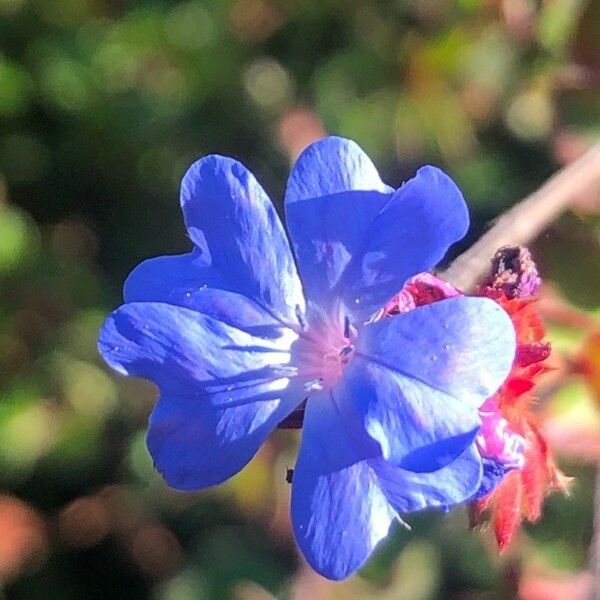
Plant Overview
Commonly known as the Griffith's Leadwort or Burmese Plumbago, this Himalayan native is a master of color transformation. While many plants fade as summer ends, this resilient shrub starts its true performance in late August, pairing electric blue flowers with foliage that blushes into a deep, burnt red. It is a favorite for rock gardens where its "wiry" personality can truly shine.
🔍 How to Identify
- 💙 The Flowers: Clusters of intense, cobalt-blue blossoms that resemble Phlox. Each flower has five petals and emerges from bristly, cone-like bracts.
- 🍃 The Foliage: Small, dull green leaves with a distinct "hairy" or bristly texture along the margins. In autumn, these leaves turn a dramatic russet-red or purple.
- 🌿 The Form: A low-growing, mound-forming shrub with stiff, reddish-brown stems that give it a slightly wild, twiggy appearance.
🏡 In Your Garden
- ☀️ Sun Seeker: This plant hails from the rocky slopes of Bhutan and Tibet, meaning it craves sunlight to produce those vivid blue pigments. While it tolerates partial shade, too much shadow makes the stems "leggy" and weak.
- ✂️ Pruning Strategy: Because it blooms on new growth, it benefits from a hard haircut in early spring. Cutting it back close to the ground encourages a flush of fresh, vigorous stems and a more compact, tidy shape.
- 🪨 Drainage is Key: It absolutely hates "wet feet" during the winter. Planting it in a raised bed or a sloped area mimics its natural mountain habitat and prevents root rot during dormant months.
⚠️ Safety & Toxicity
- ✅ General Safety: Ceratostigma griffithii is generally considered non-toxic to humans, cats, and dogs. It is a safe choice for family-friendly landscapes.
- 🌵 Mechanical Irritation: The leaves and stems are covered in fine, stiff hairs. While not "stinging," these can be slightly abrasive to sensitive skin, so wearing gloves during heavy pruning is recommended.
✨ Fun Fact
The genus name Ceratostigma comes from the Greek words keras (horn) and stigma, referring to the tiny, horn-like projections found on the stigma of the flower. It is one of the few plants that provides a "true blue" color, which is notoriously rare in the botanical world!

Detailed Care Instructions
To grow Ceratostigma Griffithii plants, follow these steps:
- Select a suitable location: Choose a spot in your garden that receives full to partial sun. Ceratostigma Griffithii prefers well-draining soil.
- Prepare the soil: Loosen the soil in the planting area and mix in some compost or organic matter to improve drainage and soil fertility.
- Planting: Dig a hole that is slightly larger than the root ball of the plant. Place the plant in the hole and backfill with soil, gently firming it around the roots. Ensure that the plant is at the same level as the surrounding soil.
- Watering: Water the plant thoroughly after planting and then regularly throughout the growing season. Ceratostigma Griffithii prefers moderate watering but should be allowed to slightly dry out between waterings.
- Mulching: Apply a layer of mulch around the base of the plant to help conserve moisture, suppress weed growth, and regulate soil temperature.
- Pruning: While Ceratostigma Griffithii does not require frequent pruning, you can trim back any dead or damaged branches in early spring to promote healthy growth.
- Fertilizing: You can feed the plant with a balanced fertilizer in spring and late summer to enhance its growth. Follow the instructions on the fertilizer packaging for application rates.
- Protecting from frost: Ceratostigma Griffithii is not frost-tolerant. If you live in a region with cold winters, consider protecting the plant with a layer of mulch or a frost cover during the winter months.
- Pests and diseases: Ceratostigma Griffithii is generally pest and disease-resistant, but it may occasionally be susceptible to powdery mildew. Ensure good airflow around the plant, water at the base, and avoid overhead watering to reduce the risk.
By following these steps and providing proper care, you should be able to successfully grow Ceratostigma Griffithii plants in your garden.
Ceratostigma griffithii is a perennial plant native to certain regions. It has specific needs when it comes to watering in order to ensure proper growth and health. Here are some guidelines on how to water this plant effectively without using its common names:
- Soil Moisture: Check the moisture level of the soil before watering. Insert your finger about an inch into the ground near the plant's roots to determine if it is dry or wet.
- Watering Schedule: Ceratostigma griffithii requires regular watering, especially during the growing season. However, it is important not to overwater, as it prefers moderately moist soil rather than being constantly wet.
- Watering Technique: To water this plant, use a gentle and direct watering technique. Avoid using overhead sprinklers as they may cause too much moisture on the leaves, leading to potential diseases. Instead, use a watering can or a hose with a nozzle attachment that allows for controlled watering at the base of the plant.
- Irrigation Amount: When watering, provide enough water to thoroughly moisten the soil around the root zone. Avoid waterlogging the soil, as this can lead to root rot. Allow the top inch or so of soil to dry out slightly between watering sessions.
- Rainfall Considerations: Adjust your watering schedule according to the amount of rainfall received. If there has been substantial rain, you may need to reduce the frequency of watering to prevent waterlogging.
- Drought Tolerance: While Ceratostigma griffithii prefers consistent moisture, it does have some tolerance to short periods of drought once established. However, prolonged dry spells can negatively affect the plant's health and overall appearance, so it is best to provide regular watering during such times.
Remember, each plant's specific watering needs can vary based on various factors such as climate, soil type, and local conditions. Monitoring your Ceratostigma griffithii plant's response to watering and adjusting accordingly is key to maintaining its health and promoting optimal growth.
To fertilize Ceratostigma Griffithii, follow these instructions:
- Choose a balanced, slow-release fertilizer, such as a 10-10-10 or 14-14-14 blend. This will provide essential nutrients to the plant without overwhelming it with excessive amounts of certain elements.
- Apply the fertilizer during the active growing season, which is typically from spring to early fall. Avoid fertilizing during the plant's dormant period in winter.
- Dilute the fertilizer according to the manufacturer's instructions. Usually, this involves mixing a specific amount of fertilizer with water. Use a watering can or sprayer to apply the fertilizer solution to the soil around the plant.
- Spread the fertilizer evenly around the base of the plant, ensuring it reaches the root zone. Avoid direct contact with the foliage, as this can cause burning or damage.
- After applying the fertilizer, water the plant thoroughly to help the nutrients penetrate the soil and reach the roots.
- Repeat the fertilization process every 4-6 weeks throughout the growing season. However, be cautious not to over-fertilize, as excessive nutrients can harm the plant.
- Monitor the plant's growth and visual appearance to determine if adjustments to the fertilizer regimen are needed. If the foliage starts turning yellow or shows signs of nutrient deficiencies, you may need to increase the fertilizer application. Conversely, if the plant appears overly green and lush, reduce the frequency or strength of fertilization.
Remember, it's important to follow the specific needs of Ceratostigma Griffithii, including sunlight, water, and soil requirements, in addition to fertilization, to ensure its healthy growth and development.
When selecting the appropriate soil for the Ceratostigma griffithii plant, it is essential to take into account its specific nutrient and moisture requirements. This species thrives best in well-draining soil that is rich in organic matter. By providing it with a loose and porous soil composition, it ensures proper oxygen flow to the roots while preventing waterlogged conditions.
A mixture containing equal parts of sandy loam, compost, and peat moss is widely recommended for this plant. Sandy loam contributes to good drainage properties, preventing excess moisture retention, while compost enhances soil fertility and nutrient content. Peat moss aids in moisture retention, promoting sufficient hydration for the roots.
It is important to note that Ceratostigma griffithii prefers slightly acidic to neutral soil with a pH range of 6.0 to 7.0. Therefore, it is beneficial to conduct a soil pH test before planting and make necessary amendments to achieve an optimal pH level within this range.
When preparing the soil, ensure that it is thoroughly mixed and free of any clumps, debris, or large stones. This allows for proper root development and easy penetration of water and nutrients.
Overall, the choice of soil for Ceratostigma griffithii should prioritize a balance between effective drainage, sufficient moisture retention, and optimal nutrient availability to support healthy growth and development for this particular plant species.
To propagate the Ceratostigma griffithii plant, follow these steps:
- Find a healthy and mature Ceratostigma griffithii plant. Look for a plant that is well-established and has strong, vibrant leaves and stems.
- Choose a suitable cutting. Look for a stem that is non-flowering and has a length of about 4-6 inches (10-15 cm). Make sure the cutting has at least 2-3 nodes, which are the points where leaves emerge from the stem.
- Prepare the cutting. Using clean and sharp pruning shears or scissors, make a clean cut just below a node, removing any leaves from the lower section of the cutting.
- Apply rooting hormone (optional). Although not necessary, applying a rooting hormone powder or gel to the cut end of the stem can enhance root development and increase the chances of successful propagation.
- Fill a small pot with well-draining soil. A mixture of equal parts potting soil, perlite, and sand works well for Ceratostigma griffithii. Moisten the soil slightly before planting.
- Make a hole in the soil with a pencil or your finger, about an inch (2.5 cm) deep. Insert the cutting into the hole, burying it up to the lowest node. Gently press the soil around the cutting to secure it in place.
- Water the cutting thoroughly after planting. Ensure the soil is evenly moist, but not waterlogged. Avoid overwatering, as it can lead to rotting.
- Create a humid environment. Cover the potted cutting with a clear plastic bag or place it in a propagator to retain moisture and create a greenhouse-like environment. This will help prevent excessive moisture loss and encourage root development.
- Place the cutting in a warm and bright location, but avoid direct sunlight. Ideal temperatures for root growth range from 70-80°F (21-27°C).
- Monitor the cutting regularly. Check for signs of new growth or root development. Mist the cutting lightly with water if the soil becomes dry, but be cautious not to overwater.
- After 4-8 weeks, gently tug on the cutting to check for resistance, indicating root development. Once roots have formed, you can remove the plastic bag or propagator.
- Transplant the rooted cutting into a larger pot or desired location in your garden. Gradually acclimate it to outdoor conditions if it has been grown indoors.
By following these steps, you can successfully propagate Ceratostigma griffithii and expand your plant collection.








