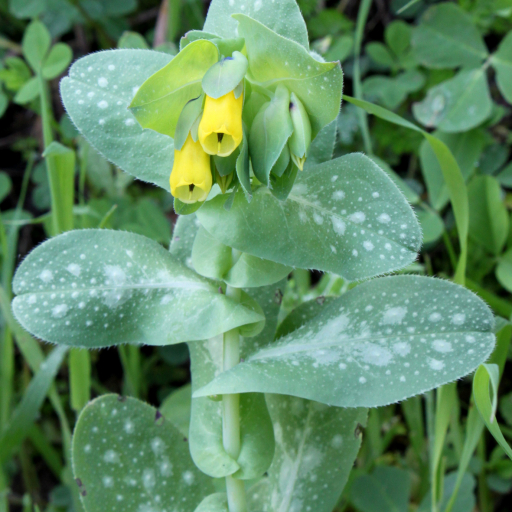
Plant Overview
Commonly known as Honeywort or the "Blue Shrimp Plant," Cerinthe major is a Mediterranean treasure that looks like it belongs in a watercolor painting. With its unique, metallic-blue bracts and nodding bell-shaped flowers, it has transitioned from a coastal wildflower to a darling of the modern cottage garden. Its name comes from the Greek words for "wax" (keros) and "flower" (anthos), rooted in an ancient belief that bees used the blooms to gather wax for their hives.
🔍 How to Identify
- 🍃 Foliage Texture: The leaves are smooth, fleshy, and "glaucous" (covered in a waxy, blue-grey coating) that almost feels like succulent foliage.
- 🔔 Flower Shape: It produces clusters of pendant, tubular flowers that dangle downward. These are typically deep purple or maroon, tipped with white or yellow.
- 🎨 The Bracts: Perhaps its most striking feature is the heart-shaped bracts (modified leaves) surrounding the flowers, which turn a vivid, iridescent electric blue as the plant matures.
🏡 In Your Garden
- 🐝 The Pollinator Magnet: True to its name, Honeywort is a five-star hotel for bees. Because the flowers face downward, they provide a sheltered feeding spot for bumblebees even during light rain.
- 🌱 The Self-Sowing Secret: While technically an annual in many climates, it is a prolific "self-sower." Once you plant it, it will likely return year after year by dropping its large, black, pebble-like seeds into the soil.
- 🪴 Taproot Sensitivity: These plants develop a deep taproot early on. They generally dislike being moved once established, so it is best to plant them in their "forever home" or start them in biodegradable peat pots.
⚠️ Safety & Toxicity
- 🐾 Status: Generally considered non-toxic to humans in small amounts, but it contains small amounts of pyrrolizidine alkaloids.
- 🐱 Pet Caution: While not listed as highly "deadly," these alkaloids can be harmful to grazing livestock and potentially pets if consumed in large quantities. It is best kept as an ornamental rather than an edible curiosity.
✨ Fun Fact
In the Victorian "Language of Flowers," giving someone Honeywort was often associated with a sense of "mysterious" or "hidden" beauty because of the way the flowers tuck themselves away beneath their colorful bracts.

Detailed Care Instructions
To grow Cerinthe Major (also known as Honeywort), you can follow these steps:
- Prepare the soil: Cerinthe Major prefers well-draining soil. Ensure the soil is loose, fertile, and amended with organic matter. Remove any existing weeds or grass from the area.
- Choose the right location: Cerinthe Major thrives in full sun to partial shade. Select a spot that receives at least 6 hours of direct sunlight per day. Avoid areas with strong winds, as the plant can be delicate.
- Sow seeds or transplant seedlings: Cerinthe Major can be grown from seeds or seedlings. If sowing seeds directly, do so in early spring after the last frost date. Plant the seeds ¼ inch deep and space them at least 8-12 inches apart. If using transplants, plant them at the same depth they were in their nursery pots.
- Watering: Keep the soil consistently moist but not waterlogged. Water the plants deeply when the top inch of soil feels dry. Provide enough water to keep the roots hydrated, especially during dry spells.
- Fertilization: Cerinthe Major doesn't require heavy fertilization. However, if the soil is poor, you can apply a balanced organic fertilizer once a month during the growing season.
- Mulching: Apply a layer of organic mulch, like straw or wood chips, around the base of the plants. Mulch helps retain moisture, suppress weeds, and regulate soil temperature.
- Pruning: Cerinthe Major doesn't require much pruning. However, if the plant becomes leggy or unruly, you can pinch back the tips to encourage bushier growth.
- Pests and diseases: Cerinthe Major is relatively pest and disease-resistant. However, it can be susceptible to aphids, slugs, and snails. Monitor the plants regularly and take appropriate measures to control pests if necessary.
- Harvesting: Cerinthe Major produces clusters of purple or blue flowers, which have a unique shape and attract pollinators. Allow the flowers to bloom fully before harvesting them for floral arrangements or drying.
- Saving seeds: Cerinthe Major is an annual plant, meaning it completes its life cycle in one year. To preserve the plant for the following year, allow some flowers to become seed capsules. Harvest and dry the seeds before storing them in a cool, dry place for future planting.
Remember to check your specific growing zone and adjust the planting and care times accordingly.

Place in a window with dappled sun or a spot in the middle of a room. Or directly in a window facing west or east.

The best method to water this plant is to give water around the base of the plant, avoiding getting water on its leaves or stem. Allow the soil to dry between watering, as these plants prefer moderate to low moisture levels. Overwatering can lead to root rot and other fungal diseases. It's also important to avoid getting water on the leaves of this plant, as it can lead to fungal diseases and damage the foliage. To ensure proper drainage, plant it in well-draining soil or add drainage materials to its pot.
The Cerinthe Major plant prefers a fertile and well-draining soil. Fertilize it with a balanced and organic plant food, such as compost or worm castings, once every 4-6 weeks during the growing season. Avoid over-fertilizing as it can cause the plant to produce excessive foliage instead of flowers. Water the plant deeply after fertilizing to help the nutrients reach the roots.
When planting Cerinthe Major, it is recommended to use a well-draining soil that is rich in organic matter. The soil should have a pH level of around 6.0 to 7.5. A mixture of sand, loam, and peat moss can be used to create the ideal soil for Cerinthe Major to thrive in. It is also important to ensure that the soil is moist, but not waterlogged, as this can cause root rot. Additionally, adding a slow-release fertilizer to the soil can help provide the plant with essential nutrients throughout the growing season.
To propagate this plant, you will need to collect mature seeds from a mature plant. The seeds should be collected when the seed pods have dried out and turned brown.
Once you have collected the seeds, you will need to prepare the planting site. This plant requires well-draining soil with good sunlight exposure. Till the soil to loosened it up and amend it with organic matter if necessary.
Sow the seeds directly into the planting site during the spring or fall. Plant the seeds about 1/4 inch deep and space them about 10 inches apart. Water the site well after planting.
Keep the soil moist during the germination period, which typically takes 10-14 days. Once seedlings have sprouted and are large enough to handle, thin them out to their required spacing.
Cerinthe Major plants can also be propagated through cuttings. Take cuttings from healthy plants during the growing season and rooting them in a moist, well-draining soil mix. To do this, remove the lower leaves of a stem and dip it into rooting hormone. Plant the stem in the soil mix and keep the soil moist until the cutting has rooted.








