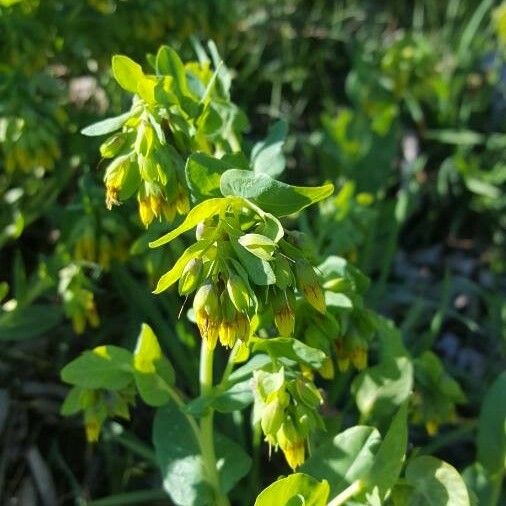
Plant Overview
Commonly known as the Lesser Honeywort, Cerinthe minor is the understated, elegant cousin of the more famous Cerinthe major. This hardy biennial or short-lived perennial is native to the meadows of Central and Southern Europe. Its name reflects an ancient belief: the Greeks thought bees visited these flowers to gather wax ("keros") for their hives, though we now know they are actually after the high-quality nectar hidden deep within its tubular bells.
🔍 How to Identify
- 🔔 The Flowers: Small, drooping, tubular blossoms that are typically a pale, creamy yellow. If you look closely at the base of the petals, you’ll often find five distinct maroon or purple spots.
- 🍃 The Foliage: The leaves are "glaucous," meaning they have a beautiful waxy, blue-green sheen. They are spatula-shaped and often clasp the stem directly, creating a seamless, architectural look.
- 📏 The Stature: Unlike its "Major" relative, this plant stays relatively compact and upright, usually reaching about 12 to 24 inches in height.
🏡 In Your Garden
- 🐝 A Pollinator Magnet: True to its name, this plant is a favorite for honeybees and bumblebees. Its long, tubular shape is perfectly designed for long-tongued insects looking for a sugary reward.
- 🌱 The Self-Seeding Habit: While it is a short-lived plant, it is an "independent spirit." Once established, it will gently drop seeds to ensure new sprouts appear the following spring, making it perfect for cottage-style or "wild" garden designs.
- ☀️ Sun & Soil Nuance: It thrives in full sun but prefers well-draining, slightly gritty soil. It hates "wet feet" during the winter, which can cause the roots to rot before the next growing season.
⚠️ Safety & Toxicity
- ✅ Status: Generally considered non-toxic.
- 🐾 Details: There are no records of Cerinthe minor being highly toxic to cats, dogs, or horses. However, like many members of the Boraginaceae family, it contains small amounts of pyrrolizidine alkaloids. While not typically dangerous in passing, it’s best to keep curious nibblers away to avoid mild stomach upset.
✨ Fun Fact
Ancient herbalists believed that if you planted Honeywort near a beehive, the bees would never lose their way home because they were so "enchanted" by the taste of the nectar!

Detailed Care Instructions
To grow Cerinthe Minor (also known as honeywort), follow these steps:
- Selection of planting location: Choose a location that receives full sunlight to partial shade. The soil should be well-draining and fertile.
- Soil preparation: Amend the soil with organic matter, such as compost or well-rotted manure, to improve its fertility and drainage. Remove any weeds or debris from the area.
- Sowing seeds: Sow the seeds directly into the ground in early spring when the soil has warmed up. Space the seeds about 12-18 inches apart and ¼ inch deep. Alternatively, you can start the seeds indoors 6-8 weeks before the last frost date and transplant them outdoors once the threat of frost has passed.
- Watering: Keep the soil consistently moist until the seeds germinate, which usually takes around 10-14 days. After germination, water occasionally, allowing the topsoil to dry out slightly between waterings. Cerinthe Minor is somewhat drought-tolerant once established.
- Fertilization: Apply a balanced slow-release fertilizer or a side dressing of compost around the plants after they have become established. Repeat this fertilization every 3-4 weeks during the growing season.
- Mulching: Apply a layer of organic mulch, such as straw or wood chips, around the plants to suppress weeds, retain moisture, and regulate soil temperature.
- Pruning and deadheading: Cerinthe Minor may require minimal pruning to maintain its shape or remove damaged or wilted parts. Deadhead the spent flowers regularly to encourage continuous blooming.
- Pests and diseases: Cerinthe Minor is generally resistant to pests and diseases. However, regularly inspect the plants for aphids, caterpillars, and snails. If necessary, treat with organic insecticides or remove pests manually.
- Harvesting: You can harvest the flowers and foliage of Cerinthe Minor for use in floral arrangements or as a garnish. Cut the stems just above the foliage when the flowers are fully open.
- Saving seeds: Allow some flowers to remain on the plant until they form small dark seeds. Harvest the seeds by snipping off the entire seed heads and placing them in a paper bag. Store the bag in a cool, dry place until the seeds dry out completely. Label and store the seeds in airtight containers for future use.
Remember to research your specific growing zone and adapt these instructions as needed, as conditions may vary.

Place in a bright room that is sun drenched almost all day. Or directly in a south-facing window.

The watering requirements for this plant depend on various factors such as the season, the location, and the type of soil.
In general, this plant prefers moist but well-drained soil that is rich in organic matter. During the growing season, it should be watered regularly, especially during hot and dry periods.
To water this plant, use a watering can or a hose with a gentle stream to avoid damaging the foliage and the delicate flowers. Aim to water the soil around the plant, rather than the leaves or the stems.
Before watering, check the soil moisture level by sticking your finger into the soil about an inch deep. If the soil feels dry, water the plant until the water reaches the bottom of the root ball.
Avoid overwatering the plant, as this can lead to root rot and waterlogging, which can be fatal to the plant. Also, make sure to water the plant early in the morning or late in the afternoon to prevent the water from evaporating quickly in the hot sun.
To fertilize this plant, prepare a potting mix with equal parts perlite and peat moss. Use a slow-release fertilizer with a 10-10-10 NPK ratio, mixing it into the potting mix according to package instructions. Water the plant deeply before applying the fertilizer, then apply it to the soil around the base of the plant. Repeat every six weeks during the growing season. Avoid over-fertilizing, as this can lead to root burn and damage to the plant.
Cerinthe Minor plant requires well-draining soil with a neutral pH level. The soil should be loamy and rich in organic matter, with good water-holding capacity. It is recommended to mix in sand or perlite for better drainage. Avoid using heavy clay soils or soils with high salinity levels. In addition, the plant prefers full sun to partial shade and should be watered regularly, allowing the soil to dry between waterings. Fertilizer can be applied during the growing season to promote healthy growth and flowering.
To propagate this plant, you can take stem cuttings from an existing plant. Select a healthy stem and use a sharp, clean pair of scissors or pruning shears to make a clean cut at a 45-degree angle. The cutting should be about 6 inches long and have several leaves. Remove the leaves from the lower half of the stem.
Next, dip the cut end of the stem in rooting hormone powder. This will encourage the cutting to form roots. Place the cutting in a pot filled with moist, well-draining soil. Cover the pot with a clear plastic bag to create a humid environment. Place the pot in a bright, indirect light.
Keep the soil moist but not soaking wet. After a few weeks, you should see new growth and roots forming. Once the cutting has established roots, you can remove the plastic bag and move the plant to a larger pot or transplant it outdoors.








