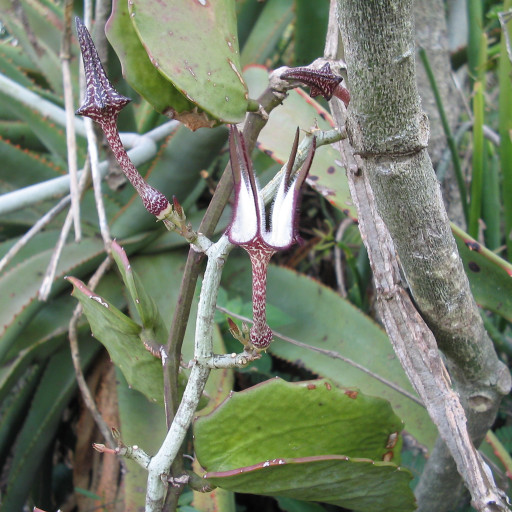
Plant Overview
Often called the Snake Creeper, Ceropegia stapeliiformis is a master of disguise. Native to the arid regions of South Africa, it looks more like a collection of weathered sticks or a slithering serpent than a living plant. It is a favorite among succulent collectors who enjoy "weird" botany that doubles as a conversation piece.
🔍 How to Identify
- 🐍 Stems: Thick, cylindrical, and succulent stems that are grey-green or purplish with dark, mottled spots, closely resembling the scales of a snake.
- 🌸 The Flower: Bizarre, upright funnel-shaped blooms that look like a "lantern" or a "cage," featuring white petals with dark purple mottling and delicate, fringed hairs at the tips.
- 🍂 Vestigial Leaves: Tiny, scale-like leaves appear on new growth but often drop off quickly, leaving the succulent stems to perform all the photosynthesis.
🏡 In Your Garden
- 🧗 Climbing Nature: Unlike many common succulents, this species loves to scramble and climb. In the wild, it weaves through scrub bushes; in your home, it will appreciate a small trellis or a hanging basket where it can trail.
- 💧 Drought Strategy: Because of its thick, tuberous root system, it stores a significant amount of water underground. It is far more likely to suffer from "kindness" (overwatering) than neglect, so ensure the soil is bone-dry before even thinking about the watering can.
⚠️ Safety & Toxicity
- 🐾 Pet Friendly: Ceropegia stapeliiformis is generally considered non-toxic to cats, dogs, and horses, making it a safe choice for pet owners.
- 🧪 Sap Sensitivity: While not poisonous, the clear sap can be slightly irritating to those with very sensitive skin. It is always a good practice to wash your hands after pruning or taking cuttings.
✨ Fun Fact
🪰 The Gentle Kidnapper: The flowers of this plant act as temporary "pitfall traps" for flies. Small insects are lured inside by a scent, where downward-pointing hairs keep them prisoner. The fly is held captive just long enough to be dusted with pollen, then the hairs wither and the insect is released to find another flower!

Detailed Care Instructions
To grow Ceropegia stapeliiformis, also known as the "String of Hearts" plant, you can follow these steps:
- Purchase or find a healthy and established Ceropegia stapeliiformis plant.
- Choose a suitable pot with drainage holes that is slightly larger than the current root ball.
- Fill the pot with well-draining soil mix, such as a combination of cactus or succulent soil mix with perlite or pumice for extra drainage.
- Gently remove the plant from its current pot, being careful not to damage the delicate roots.
- Place the plant in the new pot and fill any empty spaces with additional soil.
- Water the plant thoroughly until water drains out of the bottom of the pot, then allow the soil to dry out before watering again. Ceropegia stapeliiformis prefers a moderately dry environment, so it's important not to overwater.
- Place the pot in a bright location with indirect sunlight. The plant can also tolerate some direct sunlight, but avoid exposing it to intense midday sun, as this can scorch the leaves.
- Maintain a temperature between 60-80°F (15-27°C), as this is the typical range for indoor environments. Avoid exposing the plant to extreme cold or hot temperatures.
- Provide the plant with occasional fertilization using a balanced houseplant fertilizer diluted to half strength, following the instructions on the fertilizer packaging. Fertilize once every 2-3 months during the growing season (spring and summer).
- As the plant grows, it may develop long vines that tend to hang down. You can either allow them to cascade or gently train them along a trellis or support to encourage more upright growth.
- Regularly check the plant for any signs of pests, such as mealybugs or spider mites. If any pests are found, treat them with appropriate insecticidal soap or horticultural oil, following the manufacturer's instructions.
- During the winter months, reduce watering frequency and allow the plant to go through a period of dormancy with cooler temperatures (around 50-60°F or 10-15°C). This can help promote better growth in the following growing season.
With proper care, your Ceropegia stapeliiformis plant should grow and thrive, rewarding you with its unique and delicate trailing heart-shaped leaves.

Place in a window with dappled sun or a spot in the middle of a room. Or directly in a window facing west or east.

To water this plant, you should carefully pour room temperature water directly onto the soil around the base of the plant. Be sure to avoid getting water on the leaves or stems, as this can cause damage to the plant. Allow the soil to dry out slightly between waterings, typically every 2-3 weeks depending on environmental conditions. Additionally, it is important to ensure that the pot has adequate drainage, as this plant is susceptible to root rot if left sitting in standing water.
To fertilize this plant, use a balanced fertilizer with equal amounts of nitrogen, phosphorus, and potassium. Dilute the fertilizer to half strength and apply it every two weeks during the growing season, which is generally from spring to fall. Avoid over-fertilizing, as this can cause damage to the plant's delicate roots. Be sure to water the plant thoroughly before and after fertilizing to prevent burning of the roots.
For optimal growth and health of the Ceropegia Stapeliiformis plant, it is recommended to use a well-draining soil mix that allows for adequate air circulation to the root system. A soil mix that includes a combination of perlite, sand, and peat moss is ideal, as it provides the plant with the necessary nutrients while also preventing water from sitting stagnant at the roots. It is important to avoid using a soil mix that is too heavy or compact, as this can lead to root rot and hinder the plant's growth. Additionally, it is recommended to use a pot with drainage holes to further prevent water from accumulating at the roots.
To propagate this plant, take a stem cutting with at least 2-3 nodes and remove any leaves within a few inches of the lower end of the cutting. Let the cutting dry out for a day or two to prevent it from rotting. Plant the cutting in well-draining soil and water sparingly until it starts to root. Keep the soil moist but not wet, and place the cutting in bright, indirect light. After a few weeks, new growth should appear, indicating successful propagation.
Common pests of the ceropegia stapeliiformis include Mealybugs. Make a habit of checking your ceropegia stapeliiformis frequently for pests so that any infestations can be caught and managed early.








