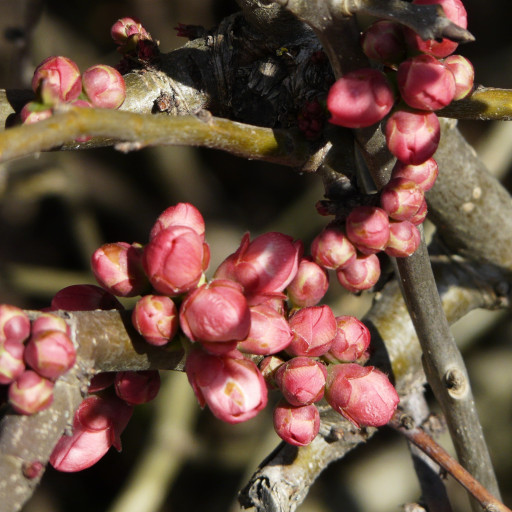
Plant Overview
Often called the "Japanese Flowering Quince" or "Maule’s Quince," this deciduous shrub is a true harbinger of spring. Long before most plants wake up, its bare, thorny branches explode into vibrant clusters of cup-shaped blooms that look like glowing embers against the late winter landscape. Native to Japan, it has been a garden staple for centuries, prized for its rugged "tough-as-nails" personality and spectacular floral display.
🔍 How to Identify
- 🌸 The Blossoms: Waxy, five-petaled flowers usually in shades of fiery red, salmon, or orange. They often appear in small clusters directly on the woody stems before the leaves emerge.
- 🍃 The Foliage: Once they appear, the leaves are simple, oval, and glossy dark green with finely serrated (saw-toothed) edges.
- 🍎 The Fruit: In autumn, it produces small, hard, apple-like fruits known as "pomes." They turn a speckled greenish-yellow and release a wonderful spicy fragrance when ripe.
- ⚔️ The Structure: A dense, tangled mess of gray-brown branches armed with sharp, intermittent thorns.
🏡 In Your Garden
- ✂️ Pruning Nuance: This plant blooms on "old wood." If you prune it heavily in the winter, you’ll cut off all of this year's flowers. The best time to shape it is immediately after the spring blossoms fade.
- 🛡️ Living Security: Because of its dense, thorny growth habit, it is often used as a "security hedge." It creates an almost impenetrable barrier that discourages deer and keeps unwanted foot traffic out of your yard.
- ☀️ The Sunshine Trade-off: While it is incredibly hardy and will grow in partial shade or poor clay soil, you’ll get the most dramatic flower show if you give it a spot in full, bright sun.
⚠️ Safety & Toxicity
- 🩹 Physical Hazard: The primary "danger" of the Japanese Quince is its thorns. They are sharp and can easily puncture skin or gardening gloves. Always wear thick leather gloves when handling this plant.
- 🐾 Pet Safety: The plant is generally considered non-toxic to cats and dogs. However, the hard fruit can be a choking hazard if a curious pet tries to swallow one whole.
- 🍲 Edibility Note: The fruits are technically edible but extremely tart and astringent (mouth-puckering) when raw. They are famous, however, for being exceptionally high in pectin, making them perfect for turning into gourmet jellies or marmalades.
✨ Fun Fact
In the art of Bonsai, Chaenomeles japonica is a superstar. Known as 'Chojubai,' it is one of the most respected species because it can develop a gnarled, ancient-looking trunk while still producing miniature, bright red flowers, making a tiny pot look like a thousand-year-old mountain tree.

Detailed Care Instructions
| Humidity | Normal |
| Lighting | Full Sun |
| Difficulty | Medium |
| Hibernation | Cold Period |
| Sun Exposure | Japanese Quince Will Tolerate Partial Shade But Will Produce The Most Blossoms If Planted In Full Sun. |
| Hardiness Zones | Japanese Quince Is Recommended For Usda Hardiness Zones 5 Through 9. |
To grow Chaenomeles Japonica (also known as Japanese quince), you can follow these steps:
- Choose the right location: Select a spot in your garden that receives full sun to ensure proper growth and flowering.
- Soil preparation: Japanese quince prefers well-draining soil rich in organic matter. Add compost or well-rotted manure to improve the soil's fertility and drainage.
- Planting: Dig a hole that is slightly larger than the root ball of the plant. Place the plant in the hole, ensuring that the soil level matches that of the container or root ball. Backfill the hole with soil and gently firm it around the plant's base.
- Watering: Water the plant thoroughly after planting to settle the soil. Water regularly, especially during the dry season, to keep the soil consistently moist but avoid overwatering.
- Mulching: Apply a layer of organic mulch, such as wood chips or bark, around the base of the plant to conserve moisture, suppress weed growth, and provide insulation.
- Fertilization: Japanese quince doesn't require heavy feeding, but you can apply a balanced slow-release fertilizer in early spring or use compost as a natural fertilizer.
- Pruning: Prune the plant in late winter or early spring to remove damaged or crossing branches and to maintain its shape. This will also promote new growth and flowering.
- Pests and diseases: Watch out for common pests like aphids and scale insects, as well as diseases such as fire blight and leaf spot. Treat any outbreaks promptly with appropriate organic or chemical sprays.
- Propagation: Japanese quince can be propagated by taking hardwood cuttings in late autumn or early winter. Place the cuttings in a well-draining potting mix and keep them in a sheltered location until roots develop.
- Winter protection: In colder climates, protect the plant during winter by mulching around its base or covering it with a frost cloth.
By following these steps, you can successfully grow Chaenomeles Japonica and enjoy its vibrant flowers and fruits.

Place in a window with dappled sun or a spot in the middle of a room. Or directly in a window facing west or east.

To water this particular plant, it is important to water deeply and thoroughly, allowing the water to penetrate the soil and reach the roots. The plant prefers evenly moist soil, but it is important not to overwater and saturate the soil. Avoid getting water on the foliage, as this can create a humid and moist environment that is prone to disease. It is best to water in the morning or evening to minimize evaporation and ensure the water reaches the roots. During periods of dry weather, it may be necessary to increase watering frequency. It is also important to ensure that the soil is well-draining, as prolonged periods of standing water can lead to root rot.
The best time to fertilize the plant is during the early spring before the flowering season starts. Use a balanced fertilizer with an N-P-K ratio of 10-10-10 or 20-20-20. Apply the fertilizer evenly around the base of the plant and water it in thoroughly. Avoid over-fertilizing as it may harm the plant.
For optimal growth of the plant commonly known as Chaenomeles Japonica, it is important to use well-draining soil that is rich in nutrients. The soil should have a pH level between 6.1 and 7.5, which is slightly acidic to neutral. Ideally, the soil should be loamy and sandy, with good drainage to prevent waterlogging and root rot.
It is recommended to mix in organic matter such as compost or well-rotted manure into the soil before planting. This will help to improve soil structure, retain moisture, and add nutrients to the soil. Additionally, adding a slow-release fertilizer specific for flowering shrubs can help to promote healthy growth and vibrant blooms.
When planting the Chaenomeles Japonica, make sure to dig a hole that is twice as wide as the root ball and no deeper than the plant's current soil level. After planting, water the plant thoroughly to help settle the soil and encourage root establishment.
Propagation of this plant can be done through various methods such as seed propagation, softwood cuttings, and grafting. Firstly, for seed propagation, the seeds need to be collected and sowed in a well-draining potting mix with sufficient moisture and light. The germination of the seeds usually takes around 4-6 weeks.
The second method is softwood cuttings, which involves taking a cutting from the plant's new growth. The cutting should be taken during the spring or early summer, and the bottom leaves should be removed. The cutting should then be planted in a potting mix with adequate moisture and kept in a location with sufficient light until roots have developed.
Finally, grafting involves taking a cutting from the desired variety and grafting it onto a rootstock of a similar species. This process is more complicated and requires knowledge and skills. In all methods, it is important to make sure that the plant is healthy and free from diseases before propagating it.
Common pests of the japanese flowering quince include Spider mites, aphids. Make a habit of checking your japanese flowering quince frequently for pests so that any infestations can be caught and managed early.








