Plant Overview
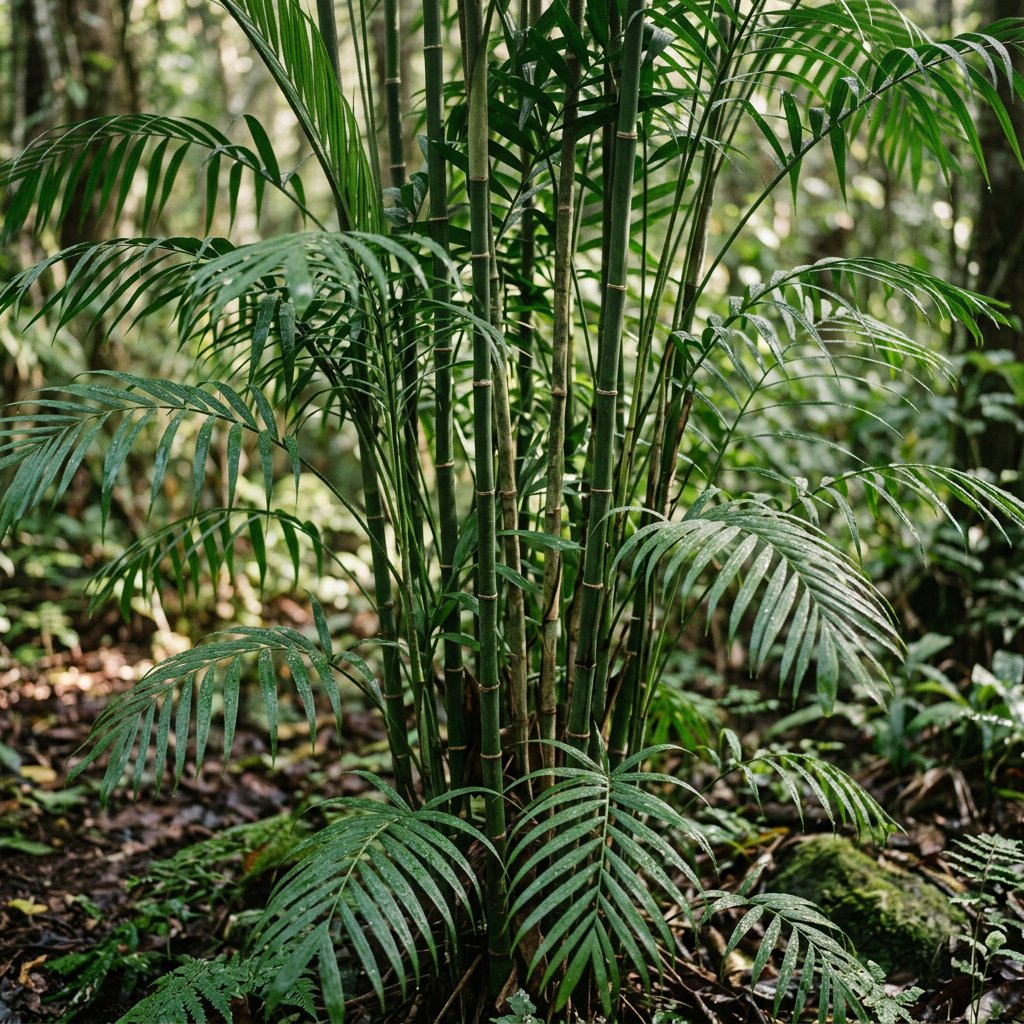
Known widely as the Bamboo Palm or Reed Palm, this lush evergreen is a favorite for those wanting a tropical forest feel without the space requirements of a giant tree. Native to the humid rainforests of Mexico and Central America, it mimics the appearance of bamboo with its slender, ringed stalks. It has earned a prestigious reputation in the plant world not just for its beauty, but for its functional role as a biological air filter.
🔍 How to Identify
- 🎋 The Stems: It grows in dense clumps of slender, reed-like stalks. These stems are light green and feature distinct horizontal rings, giving them a "bamboo" look.
- 🌿 The Foliage: Boasts graceful, arching fronds with narrow, feathery leaflets. The leaves are typically a matte, deep green and grow in a pinnate (feather-like) arrangement.
- 🍒 The Fruit: While rare indoors, mature plants produce small branched inflorescences with tiny yellow flowers, followed by small, pea-sized berries that turn from green to orange and eventually black.
🏡 In Your Garden & Home
- 🌥️ Shadow Lover: In the wild, this palm lives under the thick canopy of larger trees. This means it has evolved to thrive in "bright indirect light." If you place it in direct, harsh sun, the delicate fronds will quickly scorch and turn a crispy brown.
- 💧 Humidity Needs: Because it originates from tropical regions, it appreciates a humid environment. If your home is dry, the leaf tips may turn brown. Grouping it with other plants or using a pebble tray can help mimic its native jungle moisture.
- 🪴 Clumping Growth: Unlike the Single-trunked Majesty Palm, the Bamboo Palm is a "clumping" variety. This makes it an excellent choice for filling empty corners or acting as a living room divider, as it grows "out" as much as it grows "up."
⚠️ Safety & Toxicity
- ✅ Pet Friendly: This is one of the safest palms for a multi-pet household. It is listed by the ASPCA as non-toxic to both dogs and cats.
- 🧒 Human Safety: The plant is generally safe for children. However, if the plant produces berries, they should be kept away from curious toddlers; the sap in the fruit can contain irritating oxalates that cause a stinging sensation if chewed.
✨ Fun Fact
The Bamboo Palm was a star performer in NASA’s famous "Clean Air Study." It was ranked as one of the most effective plants for removing indoor toxins like formaldehyde, benzene, and trichloroethylene from the air we breathe!

Detailed Care Instructions
| Color | Yellow, Orange |
| Soil Ph | Acidic, Neutral |
| Humidity | High |
| Lighting | Part Sun |
| Toxicity | Non-Toxic |
| Soil Type | Moist But Well-Drained |
| Bloom Time | Spring, Summer |
| Difficulty | Medium |
| Plant Type | Perennial, Clustered Parlour Palm, Reed Palm, Cane Palm |
| Mature Size | 4-12 Ft. Tall, 3-5 Ft. Wide |
| Native Area | Central America |
| Temperature | 18°C - 24°C |
| Sun Exposure | Partial, Shade |
| Hardiness Zones | 10-11 |
To successfully grow a Chamaedorea Seifrizii plant, also known as the Bamboo Palm or Reed Palm, follow these steps:
- Choose the right location: Chamaedorea Seifrizii prefers bright, indirect light. Avoid direct sunlight, as it can scorch the leaves. Place the plant near an east or west-facing window or in a spot with filtered light.
- Temperature and humidity: This plant thrives in average room temperatures ranging from 65-85°F (18-29°C). Maintain a humidity level of around 40-50%, which can be achieved by using a humidifier or placing a tray of water near the plant.
- Watering: Keep the soil moist but not waterlogged. Water the plant thoroughly when the top inch of soil feels dry. Ensure proper drainage by using a pot with drainage holes and removing excess water from the tray beneath.
- Soil: Use a well-draining potting mix that contains organic matter. A mix of peat moss, perlite, and sand works well for Chamaedorea Seifrizii.
- Fertilization: Feed the plant with a balanced liquid fertilizer once a month during the growing season (spring and summer). Dilute the fertilizer to half the recommended strength to avoid over-fertilization.
- Pruning: Trim any yellow or brown leaves from the plant to maintain its appearance. Remove any damaged or dead fronds close to the base of the plant.
- Repotting: When the plant outgrows its current container, usually every 2-3 years, repot it into a slightly larger pot with fresh soil. Take care not to damage the roots during the process.
- Pest control: Monitor the plant for common pests like spider mites or mealybugs. If infestations are noticed, treat the plant with an appropriate insecticidal soap or neem oil solution.
By following these guidelines, you can create an ideal environment for your Chamaedorea Seifrizii plant to thrive and grow.

Place in a window with dappled sun or a spot in the middle of a room. Or directly in a window facing west or east.

To water this plant, always check the soil surface before watering to determine whether it is dry or moist. If the soil surface feels dry to the touch, then it is time to water. Water thoroughly, ensuring that the water penetrates through the roots and drains properly from the pot. Do not allow excessive water to accumulate in the plant's container, as this can lead to root rot. When watering, avoid getting water on the plant foliage or crown, as this can promote fungal growth or disease. It is best to use room temperature water, as cold water can shock the plant's roots. Ensure that the plant's soil remains consistently moist, but not waterlogged, to promote healthy growth.
To fertilize this plant, mix a balanced, water-soluble fertilizer at half strength and apply it to the soil every month during the growing season (spring and summer). Avoid fertilizing during the fall and winter months. Water the plant thoroughly after applying the fertilizer to prevent fertilizer burn. Additionally, you can incorporate slow-release fertilizer pellets into the soil during the spring to provide continuous nutrients throughout the growing season.
Chamaedorea Seifrizii plant requires a well-draining soil that is rich in organic matter and nutrients. The soil's pH level should be slightly acidic, with a range of 5.5 to 6.5. A mixture of peat moss, pine bark, and perlite or vermiculite is a good option. It is important not to use heavy soils that might retain water and cause root rot. The soil should be kept consistently moist but not waterlogged. In addition to a good soil mix, regular fertilization can help ensure the plant's healthy growth.
Chamaedorea Seifrizii is a plant that can be propagated in a number of ways. One way is to use its seeds. To do this, one should first gather the seeds from healthy and mature plants. The seeds should then be soaked in water for approximately 24 hours before planting. After planting, the seeds should be kept in moist soil and in a warm environment until they germinate.
Another way to propagate this plant is through division. This involves separating the root system into smaller sections and replanting them in separate pots. To do this, one should carefully dig up the plant and gently separate the roots into smaller sections. Each section should have its own stem and foliage. Once these sections have been separated, they should be replanted in soil that is rich in nutrients and kept moist until they establish themselves.
Finally, this plant can also be propagated through stem cuttings. To do this, one should carefully select a healthy stem and cut it at a point where it is still green and active. The cutting should be planted in moist soil and kept in a warm environment until it has established roots. Once the cutting has rooted, it should be transplanted into a pot with soil that is rich in nutrients and kept moist until it has fully established itself.
Common pests of the bamboo palm include Mealybugs, spider mites, fungus gnats, thrips. Make a habit of checking your bamboo palm frequently for pests so that any infestations can be caught and managed early.








