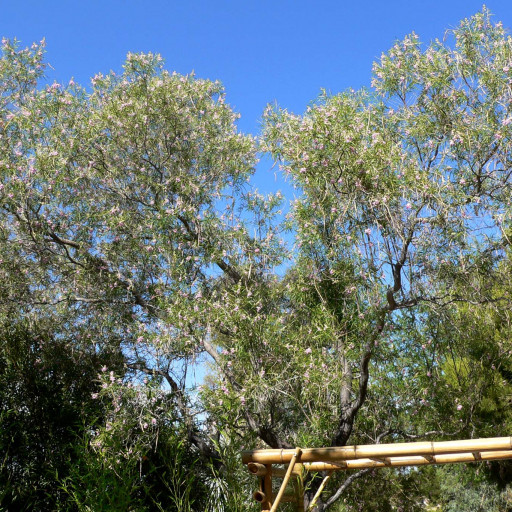
Plant Overview
Known as the "Desert Willow," this sun-loving beauty is actually a relative of the Catalpa tree rather than a true willow. It is a star of the American Southwest and Northern Mexico, prized for its orchid-like blooms and its uncanny ability to thrive in harsh, scorching conditions where other plants might wither. Its graceful, weeping silhouette brings a touch of softness to rugged desert landscapes.
🔍 How to Identify
- 🍃 Linear Foliage: The leaves are long, slender, and willow-like, reaching up to 10 inches in length but staying very narrow, which helps the plant conserve water.
- 🌸 Trumpet Blooms: It produces showy, fragrant, trumpet-shaped flowers in shades of pink, lavender, or white, often featuring delicate purple streaks and yellow "honey guides" inside the throat.
- 🫛 Seed Pods: After flowering, the tree develops long, thin, cigar-like seed pods that can hang from the branches well into the winter months.
🏡 In Your Garden
- ☀️ Sun Worshipper: This plant lives for the heat and requires full, unobstructed sun to produce its spectacular flower display; in the shade, it becomes leggy and refuses to bloom.
- 💧 Drainage is Vital: While it naturally grows near dry creek beds (arroyos) that experience occasional flooding, it cannot handle "wet feet." If your soil is heavy clay, plant it on a slight mound to ensure water drains away from the crown.
- ✂️ Pruning Strategy: It blooms on "new wood" grown in the current season. A light pruning in late winter can encourage a more prolific flowering season and help maintain a tidy, tree-like shape rather than a sprawling shrub.
⚠️ Safety & Toxicity
- ✅ Safe Profile: Chilopsis linearis is generally considered non-toxic to humans, dogs, cats, and horses.
- 🐝 Pollinator Magnet: While the plant itself isn't dangerous, be aware that its nectar-rich flowers are irresistible to bees and hummingbirds—something to keep in mind if you have severe allergies to stings.
✨ Fun Fact
Despite its delicate appearance, the wood of the Desert Willow is incredibly durable and decay-resistant. Indigenous peoples traditionally used the flexible, strong branches to weave intricate baskets and even construct sturdy hunting bows.

Detailed Care Instructions
No! This is why common names are confusing. Its actually part of the begonia family and only has the name desert willow because its leaves look like willow leaves. The flowers of the desert willow look like trumpet flowers.
Does the desert willow have aggressive roots?
No, luckily the roots are not known to be destructive and are quite fibrous. You can safely plant desert willows near driveways, sidewalks, and structures.
| Color | Dark Pink |
| Soil Ph | 6.6-8.5 |
| Lighting | Full Sun |
| Soil Type | Dry To Medium Moisture |
| Bloom Time | May To June |
| Plant Type | Deciduous Shrub |
| Mature Size | 12-18 Ft. Tall -12-18 Ft. Wide |
| Native Area | Southwestern United States And Mexico |
| Sun Exposure | Full Sun |
| Hardiness Zones | 6-9 |
To grow Chilopsis linearis plant, also known as Desert Willow, follow these steps:
- Choose a suitable location: Select a spot that receives full sun exposure for at least 6-8 hours a day. Ensure the soil is well-drained.
- Prepare the soil: Chilopsis linearis thrives in loamy, sandy, or gravelly soil. If your soil is heavy clay, mix in some sand or gravel to improve drainage.
- Planting: Dig a hole twice as wide and slightly deeper than the root ball. Place the plant in the hole, ensuring the top of the root ball is level with or slightly above the soil surface. Backfill the hole with soil and gently press it down around the roots.
- Watering: After planting, water the plant thoroughly to settle the soil around the roots. For the first few weeks, make sure to keep the soil evenly moist. Once established, Chilopsis linearis is drought-tolerant and only requires occasional deep watering during dry spells.
- Mulching: Apply a layer of organic mulch, such as wood chips or shredded bark, around the base of the plant. This helps to conserve moisture, suppress weeds, and regulate soil temperature.
- Pruning: Pruning is optional for Chilopsis linearis, but you can shape the plant by selectively removing unwanted branches. Prune dead or damaged wood in late winter or early spring before new growth begins.
- Fertilizing: Chilopsis linearis generally does not require much fertilizer. However, you can apply a balanced slow-release fertilizer once or twice a year in early spring and/or early fall to provide additional nutrients.
- Pests and diseases: The Desert Willow is relatively resistant to pests and diseases. However, occasional aphids or spider mites may attack the plant. If necessary, use insecticidal soap or a strong spray of water to control them.
- Propagation: Chilopsis linearis can be propagated from seeds or cuttings. Seeds can be collected from mature pods, and cuttings can be taken from semi-hardwood growth in early summer.
By following these steps, you can successfully grow and care for a Chilopsis linearis plant.

Place in a bright room that is sun drenched almost all day. Or directly in a south-facing window.

To properly water this plant, it is important to first consider its specific watering needs. This can typically be determined based on factors such as the plant's age and size, as well as the climate and soil conditions in which it is planted.
It is generally recommended that Chilopsis Linearis be watered deeply and infrequently, rather than giving it frequent light watering. This allows the roots to fully absorb the water and promotes healthy growth.
When watering, it is important to ensure that the soil around the plant has adequate drainage to prevent waterlogged roots. One way to accomplish this is to water slowly and evenly around the base of the plant, rather than applying water too quickly or in concentrated areas.
Additionally, it may be beneficial to mulch around the base of the plant to help retain moisture in the soil, particularly during hot or dry periods.
Overall, proper watering is essential for maintaining the health and vitality of this plant, and should be done with care and attention to the specific needs of each individual Chilopsis Linearis specimen.
To fertilize this plant, add a slow-release, balanced fertilizer in the early spring. Avoid over-fertilizing as it can cause excessive growth at the expense of blooming. Water the plant well before and after applying fertilizer. Apply a light layer of organic mulch around the base of the plant to help retain moisture and nutrients.
When planting Chilopsis Linearis, it is best to use a well-draining soil that is rich in organic matter. The soil should be slightly acidic to neutral, with a pH range of 6.0 to 7.5. It is important to avoid heavy clay soils or those that are prone to waterlogging, as well-draining soil is essential for the health and growth of the plant. A soil mixture that includes sand, peat moss, and compost can be a good option for providing a balanced combination of drainage and nutrient retention. Additionally, it is recommended to add a slow-release fertilizer to the soil at the time of planting to provide the plant with the necessary nutrients for healthy growth.
To propagate this plant, you will need to take a cutting from an existing plant. Choose a healthy branch with several leaves on it. Using a clean pair of garden shears or scissors, make a clean cut at a 45-degree angle just below a leaf node.
Remove the leaves from the bottom third of the cutting. Dip the cut end of the stem in rooting hormone powder and shake off any excess.
Prepare a potting mix of equal parts perlite, vermiculite, and peat moss. Make a hole in the potting mix and insert the cutting, packing the soil around it. Mist the cutting with water and cover the pot with a clear plastic bag to create a humid environment.
Place the pot in a bright, indirect light location, and keep the soil moist but not waterlogged. After a few weeks, check the cutting for roots by gently tugging on it. If it resists pulling, it has anchored itself in the soil and has formed roots.
Once the cutting has developed roots, remove the plastic bag and gradually acclimate the plant to lower humidity levels. When it has acclimated, transplant to a larger pot or outdoors in a well-draining soil.
Common pests of the desert willow include Aphids. Make a habit of checking your desert willow frequently for pests so that any infestations can be caught and managed early.








