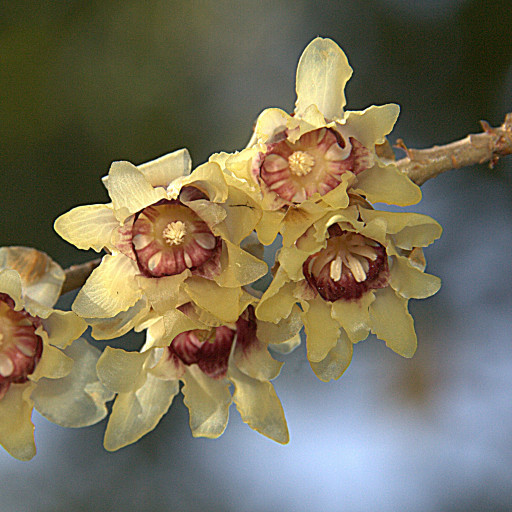
Plant Overview
Often called "Wintersweet" or "Japanese Allspice," Chimonanthus praecox is a winter-blooming marvel that defies the frost. Originating from the mountain forests of China, it is legendary for its intoxicating, spicy-sweet fragrance that can drift across an entire garden on a cold January breeze. It is the ultimate "must-have" for enthusiasts who refuse to let their garden go dormant during the darkest months of the year.
🔍 How to Identify
- 🌼 The Flowers: Waxy, pendant-shaped blooms that look like they are carved from butter or honey. They appear on bare branches long before the leaves emerge.
- 🎨 The Contrast: The flowers feature a "double-color" look; outer petals are a translucent pale yellow, while the inner petals are a striking maroon or brownish-purple.
- 🍃 The Foliage: Large, lance-shaped leaves that are rough to the touch (scabrous) and turn a soft, buttery yellow in autumn.
🏡 In Your Garden
- 🪵 Pruning Patience: This shrub is a slow starter and flowers on wood that is at least two years old. Avoid heavy pruning, or you may accidentally cut away next winter’s flower buds.
- ☀️ Summer Baking: While it blooms in winter, it needs a warm, sunny spot during the summer to "ripen" the new wood. This sun exposure is what triggers the heavy production of fragrant oils and buds.
- 🌬️ Scent Management: Plant it near a doorway, a frequently used path, or a south-facing wall. This traps the fragrance and allows you to enjoy the scent without trekking through the mud.
⚠️ Safety & Toxicity
- 🐾 Moderate Toxicity: The seeds of the Wintersweet plant are the primary concern. They contain toxic alkaloids (specifically calycanthine), which are similar to strychnine.
- ⚠️ Risk Factor: While the plant is generally safe to touch, the seed pods should be kept away from curious pets and livestock. Ingestion can cause tremors, excitement, or more serious neurological distress in animals.
✨ Fun Fact
In its native China, Chimonanthus praecox has been cultivated for over a thousand years. Its name literally translates to "Winter Plum," and its essential oils are so potent they are still used today in high-end perfumery to mimic the scent of violets and gardenias.

Detailed Care Instructions
To grow Chimonanthus Praecox, also known as wintersweet, you can follow these steps:
- Choose a planting location: Select a spot in your garden that receives full sunlight or partial shade. The soil should be well-draining and fertile.
- Prepare the soil: Dig a hole that is wider and deeper than the pot in which the plant is currently growing. Loosen the soil at the bottom and mix in some compost or well-rotted manure to improve fertility and drainage.
- Transplant the plant: Carefully remove the wintersweet plant from its pot, gently loosen the root ball, and place it in the prepared hole. Make sure the top of the root ball is level with the soil surface. Backfill the hole with soil, firming it gently around the roots.
- Watering: Give the plant a thorough watering after transplanting to help settle the soil and encourage root growth. During the growing season, water regularly to keep the soil moist but not waterlogged.
- Mulching: Apply a layer of organic mulch, such as wood chips or straw, around the base of the plant. Mulch helps retain moisture, suppresses weed growth, and regulates soil temperature.
- Pruning: Wintersweet blooms on old wood, so it is best to prune it after the flowering season is over. Remove any dead, damaged, or crossing branches. Light pruning can also be done to shape the plant.
- Fertilizing: Fertilize the plant in early spring with a balanced slow-release fertilizer or compost to encourage healthy growth and flowering.
- Pest and disease control: Monitor the plant regularly for pests like aphids or scale insects. If identified, treat with organic insecticides or horticultural oils. Keep an eye out for any signs of disease, such as leaf spots or powdery mildew, and take appropriate action if necessary.
- Protecting from frost: If you live in a region with cold winters, consider protecting the plant from frost by covering it with horticultural fleece or moving potted plants to a sheltered location.
By following these steps and providing proper care, your Chimonanthus Praecox plant should thrive and produce beautiful fragrant flowers during the winter months.

Place in a bright room that is sun drenched almost all day. Or directly in a south-facing window.

The Chimonanthus Praecox plant should be watered regularly, but not excessively. The soil should be kept moist but not waterlogged. It is important to ensure that the water is able to drain away easily to avoid waterlogged soil. Overwatering can lead to root rot and other fungal diseases. The plant prefers a well-draining soil that is rich in organic matter. It is also important to keep the plant evenly moist during the growing season. During dry spells, the plant may require more frequent watering. In general, the Chimonanthus Praecox plant should be watered at the base of the plant rather than from above to avoid wetting the foliage. This can help to reduce the risk of fungal disease and other issues.
Chimonanthus Praecox requires a balanced, slow-release fertilizer in the spring. Apply the fertilizer evenly around the base of the plant, being careful not to let it touch the stems or leaves. Water the plant after fertilizing to ensure the nutrients are absorbed into the soil. Avoid over-fertilizing or using high-nitrogen fertilizers, as this can lead to excessive growth and reduced flower production.
For the Chimonanthus Praecox plant, it is recommended to use a soil mixture that is well-draining and rich in organic matter. A combination of sandy loam soil and compost or well-rotted manure is ideal. The soil pH should be slightly acidic to neutral, with a range of 6.0 to 7.0.
Adding perlite or vermiculite to the soil can improve drainage, while adding peat moss or leaf mold can increase the organic matter content. It is important to avoid using heavy clay soils or soils that retain excessive moisture, as they can lead to root rot and other fungal diseases.
Before planting, the soil should be prepared by removing any weeds or large rocks and loosening the soil to a depth of 12-18 inches. A layer of mulch can also be added around the base of the plant to help retain moisture and suppress weed growth.
Propagation of this plant can be done through several methods, including seed propagation, softwood cuttings, and grafting. For seed propagation, harvest mature seeds from the plant and sow them in a well-draining soil mix. Keep the soil moist and warm until germination occurs.
For softwood cuttings, take cuttings from the plant when new growth appears in the spring or early summer. Dip the cut end in rooting hormone and plant the cutting in a well-draining soil mix. Keep the soil moist and in a warm location until roots develop.
Grafting can also be used to propagate this plant. Select a rootstock plant that is compatible with Chimonanthus Praecox and graft a scion onto it. The scion should be taken from a healthy, mature plant and should be inserted onto the rootstock using the appropriate grafting technique.
Propagation of Chimonanthus Praecox is generally easy and reliable, but it is important to ensure that the young plants receive adequate water, light, and nutrients to ensure their healthy growth.








