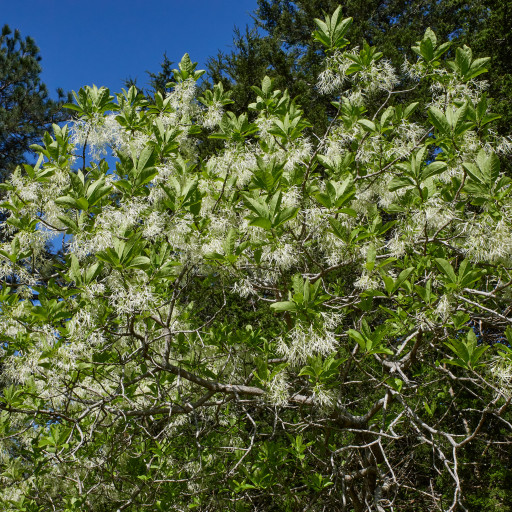
Plant Overview
Often called "Old Man’s Beard" or "Grancy Graybeard," the Chionanthus virginicus is a spectacular native of the Southeastern United States. When in full bloom, it appears to be draped in delicate lace or clouds of white silk, creating a ethereal glow in any landscape. It is widely beloved for its resilience and its transition from a snowy spring showstopper to a golden autumnal beauty.
🔍 How to Identify
- 🌼 The Flowers: The most striking feature is the clusters of creamy-white, fringe-like petals that hang in airy tassels, appearing just as the leaves emerge in late spring.
- 🍃 Leaf Texture: Large, spear-shaped leaves that are thick and waxy, typically measuring 4 to 8 inches long with a deep green color.
- 🫐 The Fruit: On female trees, look for clusters of dark blue, grape-like "drupes" that ripen in late summer, often hidden slightly beneath the foliage.
- 🪵 Growth Habit: A slow-growing, multi-stemmed large shrub or small tree with a wide, rounded canopy that feels both sturdy and elegant.
🏡 In Your Garden
- 💧 Patience with Roots: This tree is famously slow-growing and resents being moved once established. It’s best to choose a "forever home" with moist, acidic soil where its deep roots can settle undisturbed.
- 🕊️ Wildlife Magnet: If you have a female tree, expect a flurry of activity; the dark berries are a high-energy food source for bluebirds, cardinals, and even wild turkeys.
- 🌫️ Pollution Tolerant: Unlike many delicate-looking flowering trees, the Fringe Tree is surprisingly tough and can handle urban air pollution better than most, making it a great street-side specimen.
⚠️ Safety & Toxicity
- ✅ Non-Toxic: Chionanthus virginicus is generally considered safe and non-toxic for humans, cats, and dogs.
- 🐕 Berry Caution: While the berries are a treat for birds, they aren't meant for human consumption and might cause minor digestive upset in pets if eaten in large volumes.
- 🖐️ Skin Friendly: There are no known irritants associated with the bark or leaves, making it safe for gardeners to prune without gloves.
✨ Fun Fact
The name Chionanthus literally translates from Greek as "Snow Flower" (chion meaning snow and anthos meaning flower). Despite its fragile, paper-like appearance, it is a hardy relative of the common Olive tree!

Detailed Care Instructions
To grow Chionanthus Virginicus, also known as fringe tree or Grancy greybeard, follow these steps:
- Climate and location: Chionanthus Virginicus thrives best in USDA hardiness zones 3 to 9. Choose a location that receives full or partial sunlight.
- Soil preparation: The plant prefers well-draining, slightly acidic soil. Amend the soil with compost or organic matter to improve its fertility and drainage.
- Planting: Dig a hole that is twice the size of the plant's root ball and place it in the hole. Make sure the top of the root ball is level with or slightly above the soil surface. Backfill the hole with soil, firming it gently around the roots.
- Watering: Proper irrigation is crucial during the establishment phase. Water the plant deeply and regularly, especially during dry spells. After the first year, it is generally considered drought-tolerant and may only require occasional watering.
- Mulching: Apply a layer of organic mulch around the base of the plant to retain moisture, suppress weeds, and insulate the roots. Leave space around the trunk to prevent moisture buildup and potential rot.
- Pruning: Prune Chionanthus Virginicus in late winter or early spring before new growth appears. Remove any dead, damaged, or crossing branches to maintain a balanced shape. Light pruning of spent flowers can also be done to improve aesthetic appeal.
- Fertilizing: Chionanthus Virginicus generally does not require heavy fertilization. However, if needed, apply a balanced, slow-release fertilizer in early spring. Follow the manufacturer's instructions for proper application.
- Pests and diseases: This plant is relatively pest-resistant, but occasional issues with aphids, scale insects, or leaf spot diseases may arise. Monitor the plant regularly and take appropriate measures, such as using insecticidal soap or pruning affected parts.
Remember to check specific regional gardening guidelines for any additional recommendations or considerations based on your location and climate.

Place in a bright room that is sun drenched almost all day. Or directly in a south-facing window.

Chionanthus Virginicus plant, or the plant in question, requires regular watering to thrive. When watering, it is important to ensure that the soil is moist but not waterlogged. Overwatering can lead to root rot and other fungal diseases.
To water the plant, first check the soil moistness level by sticking your finger into the soil. If it feels dry to the touch, then the plant requires watering. Use a watering can or hose to evenly distribute water throughout the soil. Water should be poured around the edges of the pot or container, not directly onto the leaves or stems of the plant.
It is important to note that the frequency of watering may vary depending on the climate and the plant's environment. In hot and dry weather, the plant may require more frequent watering, and in cooler temperatures, less watering may be necessary.
In addition to regular watering, it is important to ensure that the plant is not placed in direct sunlight for prolonged periods of time, as this can also dry out the soil and damage the plant. Finally, ensure that any excess water is drained off, as standing water can also lead to root rot and other fungal diseases.
To fertilize this plant, apply a balanced fertilizer in the early spring before new growth appears. The fertilizer should be low in nitrogen and high in phosphorus and potassium. Apply the fertilizer evenly around the base of the plant and water thoroughly after application. Avoid fertilizing in the late summer or early fall, as this can stimulate new growth that may not have time to harden off before winter. Instead, wait until the following spring for another application of fertilizer.
Chionanthus virginicus plant prefers well-drained soil that is rich in organic matter. It grows best in fertile loamy soil, but can also thrive in sandy or clay soils as long as they are not too heavy or compacted. The pH level of the soil can range from slightly acidic to slightly alkaline, and the plant can tolerate a moderate level of salt in the soil. It is important to ensure that the soil is moist but not waterlogged, as the plant is sensitive to overwatering and root rot. It is also advisable to add a layer of mulch around the plant to help retain moisture and suppress weeds.
Chionanthus Virginicus is a plant that can be propagated easily through both seeds and stem cuttings. Propagating through stem cuttings is the quickest way to produce new plants.
To propagate through stem cuttings, take a semi-hardwood cutting from the plant during early summer. Make sure that the cutting is about six inches long and has at least two sets of leaves at the top. Cut off the leaves from the bottom half of the cutting and dip the cut end into hormone rooting powder.
Plant the cutting in a pot filled with well-draining soil and cover it with a plastic bag to create a mini greenhouse. Place the pot in a warm, bright area but out of direct sunlight. Water the cutting frequently to keep the soil moist, but not waterlogged.
After a few weeks, roots should begin to develop, at which point you can remove the plastic bag and continue watering regularly. Once the roots are well established, you can transplant the new plant into a larger container or into the ground.
Propagating Chionanthus Virginicus through seeds is also a simple process. Harvest the seeds from the plant in the fall and soak them in water for two to three days to soften the hard outer shell. Plant the seeds in a pot filled with well-draining soil, and cover them with a thin layer of soil. Water the seeds regularly, but do not let the soil become waterlogged.
The seeds should begin to sprout within three to four weeks. Once the seedlings are a few inches tall, you can transplant them into individual pots or into the ground.
Common pests of the white fringetree include Scale insect, aphids, larvae. Make a habit of checking your white fringetree frequently for pests so that any infestations can be caught and managed early.








