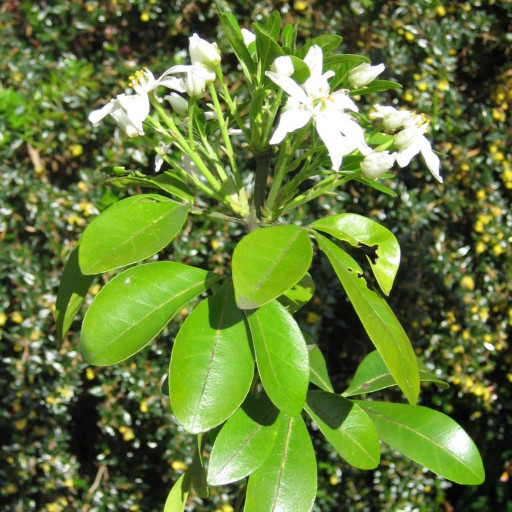
Plant Overview
Affectionately known as the Mexican Orange Blossom, this lush evergreen shrub is a staple for gardeners who love a sensory experience. Originating from the sunny slopes of Mexico, it is prized for its "dual-threat" fragrance: both the delicate white flowers and the glossy green leaves release a sweet, citrus-like perfume when touched. It’s a resilient, elegant plant that bridges the gap between a formal hedge and a wild, fragrant woodland.
🔍 How to Identify
- 🍃 Leaf Structure: Look for distinctive "trifoliate" leaves—this means each leaf is divided into three shiny, leathery leaflets that meet at a single point like a bird's foot.
- 🌸 Star-Shaped Blooms: In late spring and early autumn, the plant produces clusters of small, snowy-white flowers that look remarkably like orange blossoms.
- 🌳 Growth Habit: It naturally forms a neat, rounded mound that stays green all year, typically reaching about 2–3 meters in height if left unpruned.
🏡 In Your Garden
- ☀️ Shelter is Key: While it loves the sun, Choisya ternata is sensitive to "leaf scorch" from icy winter winds. Planting it against a south-facing wall or in a protected corner helps maintain its glossy appearance.
- ✂️ Pruning Strategy: You don’t need to be an expert to keep it tidy. Cutting back the stems by about 12 inches after the first spring bloom often "tricks" the plant into a second, spectacular flowering display in late summer.
- 🚿 Drainage Matters: It hates having "wet feet." If your soil is heavy clay, the roots may rot; it prefers a gritty, well-draining environment where water can move freely.
⚠️ Safety & Toxicity
- 🌿 Skin Sensitivity: The leaves contain essential oils that can occasionally cause mild skin irritation or photodermatitis (sensitivity to sunlight) in gardeners with very sensitive skin. It’s a good idea to wear gloves during heavy pruning.
- 🐾 Pet Safety: It is generally considered non-toxic to dogs and cats. However, because of the high oil content in the leaves, ingestion might lead to a mild upset stomach or drooling.
✨ Fun Fact
Despite its name and scent, the Mexican Orange Blossom isn't actually a member of the orange family (Citrus), though it is a close cousin! They both belong to the Rutaceae family, which explains why the leaves smell exactly like a squeezed orange peel when you crush them between your fingers.

Detailed Care Instructions
The dense bushy growth of the Mexican orange, coupled with the glossy foliage, makes it a popular ornamental plant, either isolated in the landscape or included within large border gardens. Its tolerance for pruning makes it equally useful as a hedge or foundation shrub. In mixed gardens, it is a good companion plant for California lilac, geranium, iris, and shasta daisy. The glossy green foliage and cut flowers are often harvested for use in floral arrangements.
How long does a Mexican orange plant live?
While most small evergreen shrubs are somewhat short-lived, Mexican orange is an exception, often living many decades with little decline in appearance. This requires ideal growing conditions, however.
What about wildlife?
Mexican orange is extremely attractive to bees, butterflies, and other pollinators when it is in bloom. And fortunately, it is fairly resistant to damage from deer, rabbits, and other browsers.
| Color | White |
| Soil Ph | Slightly Acidic |
| Humidity | Normal |
| Lighting | Part Sun |
| Soil Type | Fertile, Well-Drained |
| Bloom Time | Summer |
| Difficulty | Medium |
| Plant Type | Shrub |
| Hibernation | Cold Period |
| Mature Size | Six To Eight Feet In Height And Width |
| Native Area | Mexico |
| Sun Exposure | Full Sun To Partial Shade |
| Hardiness Zones | 7–10 |
To grow Choisya ternata, commonly known as Mexican orange blossom, follow these steps:
- Choose the right location: Choisya ternata prefers full sun to partial shade. Make sure your chosen location receives at least 6 hours of direct sunlight per day.
- Soil preparation: Ensure the soil is well-draining and fertile. Sandy or loamy soil is ideal. If the soil is heavy clay, mix in organic matter like compost to improve drainage.
- Planting: Dig a hole twice as wide and deep as the root ball of the plant. Place the plant in the hole, making sure the top of the root ball is level with the ground. Fill the hole with soil and gently firm it around the plant.
- Watering: After planting, water the plant thoroughly to settle the soil around the roots. Choisya ternata prefers regular watering during its first year to establish itself, but once established, it is relatively drought-tolerant.
- Mulching: Apply a layer of organic mulch, like wood chips or compost, around the base of the plant. Mulching helps retain moisture, suppresses weed growth, and provides valuable nutrients as it breaks down.
- Pruning: Prune Choisya ternata lightly after flowering to maintain its shape and stimulate growth. Remove dead or damaged branches, and trim back leggy growth. Avoid heavy pruning, as it may reduce flower production.
- Fertilizing: Apply a balanced slow-release fertilizer in early spring to promote healthy growth. Follow the package instructions for dosage and application.
- Pests and diseases: Choisya ternata is generally resistant to pests and diseases. However, it may be susceptible to aphids, mealybugs, and scale insects. Regularly inspect the plant for signs of infestation and treat accordingly using insecticidal soap or organic insecticides.
- Propagation: Choisya ternata can be propagated from semi-hardwood cuttings taken in early summer. Dip the cut end in rooting hormone, plant it in well-draining soil, and keep it in a warm, humid environment until it roots.
By following these steps and providing proper care, your Choisya ternata plant should grow and thrive.

Place in a bright room that is sun drenched almost all day. Or directly in a south-facing window.

When watering this plant, it is important to ensure that the soil is moist but not waterlogged. The frequency of watering will depend on factors such as the size of the plant, the pot or garden bed it is in, and the weather conditions. In general, it may be necessary to water the plant once or twice a week during the growing season, and less frequently during the winter months. It is advisable to check the soil regularly to gauge moisture levels and adjust the watering accordingly. When watering, it is best to apply water to the base of the plant, rather than overhead, to avoid wetting the foliage. It is also important to use a well-draining soil mix and to avoid allowing the plant to sit in standing water, as this can lead to root rot.
To fertilize this plant, use a balanced fertilizer with equal parts nitrogen, phosphorus, and potassium. Apply the fertilizer in early spring before new growth appears and once again in late summer. Avoid over-fertilizing as it can lead to weak growth and damage to the plant. Water thoroughly after fertilizing.
For optimal growth and health of the plant, it is recommended to use a well-draining soil mix that is rich in organic matter. The soil should have a neutral pH level, around 6.5 to 7.5. It should also be moist but not waterlogged as the plant does not tolerate waterlogging. Adding perlite or coarse sand to the soil can improve drainage. Additionally, regular fertilizing with a balanced fertilizer can help with the plant's growth and overall health.
Choisya Ternata plant can be propagated using two methods: cuttings and layering.
For the cutting method, take a healthy and mature stem from the plant. Remove the leaves from the bottom third of the stem, leaving only the top leaves intact. Dip the cut end in rooting hormone and plant it in a well-draining potting mix. Water the cutting and keep it in a warm and humid area with indirect sunlight. After a few weeks, the cutting should start to form roots, and new growth can be seen. Once the roots are established, the cutting can be transplanted to its permanent location in the garden.
For the layering method, choose a healthy and mature stem from the plant and remove the leaves directly under a node. Bury the stem into the soil, leaving the top portion with leaves exposed. Water the area around the buried stem and keep it in a warm and humid area with indirect sunlight. After a few weeks, the buried stem should have formed roots, and new growth can be seen. Once the roots are established, the stem can be cut from the parent plant and transplanted to its permanent location in the garden.
Both methods are effective for propagating Choisya Ternata plant and can be done in the spring or summer months.
Common pests of the mexican orange blossom include Mealybugs, spider mites, aphids. Make a habit of checking your mexican orange blossom frequently for pests so that any infestations can be caught and managed early.








