Plant Overview
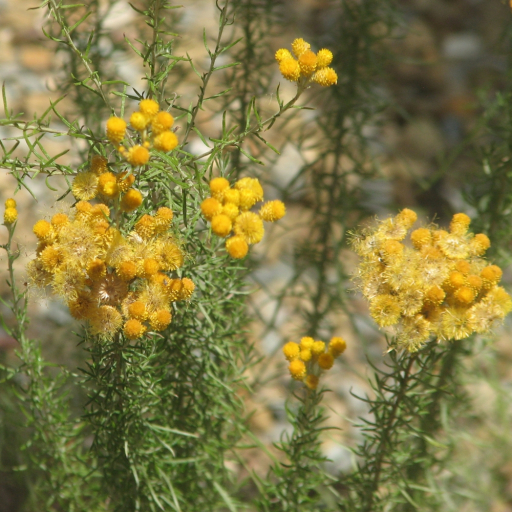
Known affectionately as "Yellow Buttons" or "Clustered Everlasting," this golden Australian native looks like a handful of sunshine scattered across the landscape. It is a resilient survivor, often found clinging to rocky slopes or brightening up dry woodlands. Because its blooms are naturally dry and papery, they stay vibrant long after they are picked, earning it a reputation as a timeless garden favorite.
🔍 How to Identify
- 🌼 Flower Heads: Tiny, bright yellow "buttons" that grow in dense, branching clusters. Unlike typical daisies, they lack the long outer petals, appearing as solid pom-poms of gold.
- 🌿 Foliage: Narrow, needle-like leaves that vary from green to a striking silvery-grey. The stems and leaves are often covered in fine, woolly hairs that help the plant retain moisture.
- 🌱 Growth Habit: A versatile perennial that can form a low-spreading mat or grow into an upright, multi-stemmed bush depending on the specific local variety.
🏡 In Your Garden
- ☀️ The Sun Worshipper: This plant thrives on "tough love." It requires full sun and exceptionally well-draining soil. It is a champion of drought-tolerance, making it perfect for rockeries or Mediterranean-style gardens where water is scarce.
- ✂️ Shape and Vigour: To prevent the plant from becoming "leggy" or woody, it benefits from a heavy haircut. Pruning it back significantly after the flowering season encourages a fresh, dense burst of silvery new growth.
- 🦋 Biodiversity Booster: While the flowers look simple to us, they are landing pads for a variety of native bees, hoverflies, and small butterflies, making your garden a vital pit-stop for local pollinators.
⚠️ Safety & Toxicity
- ✅ General Safety: Chrysocephalum semipapposum is considered non-toxic to humans and common household pets like dogs and cats.
- 🧤 Mild Sensitivity: The fine, woolly hairs on the foliage can occasionally cause very mild skin irritation for people with highly sensitive skin. Wearing gloves during a heavy prune is a good precaution.
✨ Fun Fact
The "everlasting" nature of these flowers is so effective that they were historically used by early settlers and indigenous groups for decoration and craft, as the yellow buttons will hold their shape and brilliant color for years without water once dried.

Detailed Care Instructions
To grow Chrysocephalum Semipapposum plant, also known as Yellow Buttons, follow these steps:
- Choose a suitable location: Yellow Buttons thrive in full sun exposure, so select a spot in your garden that receives at least 6-8 hours of sunlight per day.
- Prepare the soil: Yellow Buttons prefer well-draining soil. Before planting, loosen the soil and mix in organic matter like compost or well-rotted manure to improve drainage and fertility.
- Propagation: Chrysocephalum Semipapposum can be grown from seeds or cuttings. If using seeds, sow them directly into the prepared soil, following the recommended depth indicated on the seed packet. If using cuttings, take a 4-6 inch cutting from a mature plant, remove lower leaves, and plant it in moist potting soil.
- Watering: Keep the soil moist but not waterlogged, especially while the plant is establishing its root system. Once established, Yellow Buttons are fairly drought-tolerant and require less frequent watering.
- Mulching: Apply a layer of organic mulch around the base of the plant to conserve moisture, suppress weeds, and regulate soil temperature.
- Fertilization: Chrysocephalum Semipapposum does not require heavy fertilization. However, you can apply a slow-release fertilizer in the spring to promote healthy growth.
- Pruning: Trim back the plant lightly after flowering to encourage bushier growth and to help maintain its shape.
- Pests and diseases: Yellow Buttons are generally not prone to many pests or diseases. However, keep an eye out for aphids and snails, which can be controlled with organic insecticides or by manually removing them.
- Propagation: To propagate more Yellow Buttons, you can divide mature plants or take cuttings. Dividing can be done every couple of years, while cuttings can be taken in spring or early summer.
Remember to check your specific growing zone and adjust care accordingly. With proper care, Chrysocephalum Semipapposum should grow successfully and provide vibrant yellow blooms in your garden.

Place in a bright room that is sun drenched almost all day. Or directly in a south-facing window.

Chrysocephalum semipapposum is a type of plant that requires a moderate amount of watering. To properly water this plant, you should first check the soil moisture level by touching the soil with a finger. If the soil feels dry to the touch, it is time to water.
When watering the Chrysocephalum semipapposum plant, you should use room temperature water. It is best to avoid using extremely hot or cold water as it can shock the plant. You should slowly pour the water into the soil until it begins to drain out of the bottom of the pot.
It is important not to overwater the Chrysocephalum semipapposum plant as this can lead to root rot. To avoid overwatering, you should allow the soil to dry slightly between waterings. Additionally, you should only water the plant when the top inch of the soil is dry to the touch.
In the winter months, the Chrysocephalum semipapposum plant requires less water than it does in the summer months. You should adjust your watering schedule accordingly to prevent overwatering during the winter.
Overall, watering the Chrysocephalum semipapposum plant requires a bit of attention and care. With proper watering, this plant can thrive and produce beautiful blooms.
To fertilize this plant, use a balanced fertilizer with equal amounts of nitrogen, phosphorus, and potassium. Apply the fertilizer every four to six weeks during the growing season, which is typically spring and summer. Be sure to follow the manufacturer's instructions for the appropriate amount of fertilizer to use based on the size and age of the plant. Water thoroughly after fertilizing to allow the nutrients to penetrate the soil and reach the plant's roots.
Chrysocephalum semipapposum plant requires well-draining soil that has good water holding capacity and nutrient content. The soil should have a pH range of 6.0-7.0, which is slightly acidic to neutral. It is essential to use soil that is rich in organic matter, such as compost or aged manure, to supplement the plant's nutrient requirements. Additionally, the soil should not be compacted as it can inhibit root growth and lead to poor plant performance. It is recommended to use a soil mix that has sand, perlite or vermiculite, and peat moss or coir to ensure good drainage and aeration while retaining moisture. The Chrysocephalum semipapposum plant is drought-tolerant but requires regular watering till it establishes itself, so the soil must be able to retain moisture for longer durations. In summary, a well-draining, slightly acidic to neutral soil mix with good nutrient content and organic matter will help support the growth and development of Chrysocephalum semipapposum plant.
To propagate this plant, take stem cuttings from the parent plant, making sure they are at least 5cm long and have a few leaves on them. Remove the lower leaves from the stem, leaving just a few at the top. Dip the cut end of the stem into rooting hormone powder and place it in well-draining soil. Water the cutting thoroughly, and cover it with a plastic bag or a clear plastic lid to create a mini greenhouse effect. Place the cutting in a warm, bright area but out of direct sunlight. Mist the cutting with water every few days to keep the soil moist and ventilate the mini greenhouse regularly to avoid mold growth. After a few weeks, new growth should appear, indicating successful propagation.








