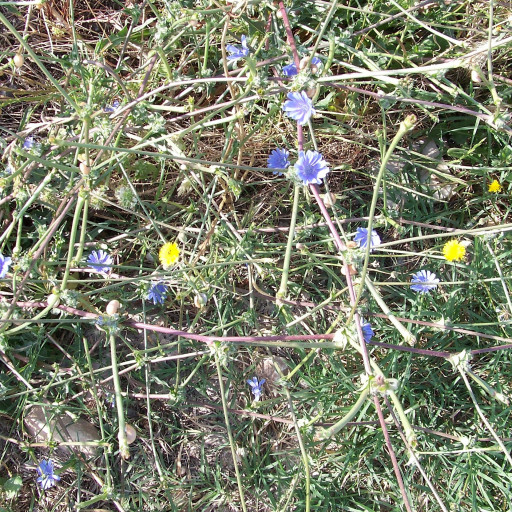
Plant Overview
Often called "Blue Sailors" for its habit of following the sun along dusty roadsides, Chicory is a rugged perennial with a storied history. While many see it as a simple wildflower, it has been cultivated for centuries as a medicinal herb and a hearty, caffeine-free coffee alternative. Its striking cerulean blooms are a late-summer staple, bringing a splash of sky-blue to the toughest, most neglected landscapes.
🔍 How to Identify
- 🌸 The Blooms: Features distinct, rayed flowers in a brilliant sky-blue color, though they occasionally appear in white or pale pink. Each petal has a uniquely fringed or "toothed" edge at the tip.
- 🌿 The Foliage: Lower leaves form a dandelion-like rosette with deeply lobed edges, while the leaves higher up the stalk are much smaller, lance-shaped, and clasp the stem tightly.
- 🦒 Growth Habit: The plant produces tall, stiff, and somewhat "leggy" branched stems that can reach up to four feet high. These stems are often slightly hairy and exude a bitter, milky sap when snapped.
🏡 In Your Garden
- 🌱 The Taproot Factor: Chicory develops a deep, sturdy taproot that allows it to thrive in poor, rocky, or compacted soils. Because of this deep anchor, it is incredibly drought-tolerant but hates being transplanted; once you've tucked it into the soil, it prefers to stay put.
- ☀️ Sun-Chaser: This plant is a dedicated sun-lover. Its flowers are famously phototropic, meaning they usually burst open in the early morning light and close tightly by mid-afternoon or whenever the sky becomes heavily overcast.
⚠️ Safety & Toxicity
- 🥗 Status: Generally safe and highly valued as an edible. The young leaves are used in bitter salads (like radicchio), and the roasted, ground roots are world-famous as a coffee additive or substitute.
- 🐾 Details: It is non-toxic to most pets and livestock. However, the milky latex in the stems can cause mild skin irritation or "contact dermatitis" in sensitive gardeners, so wearing gloves during pruning is a wise choice.
✨ Fun Fact
- 🕰️ Nature's Clock: The famous botanist Carl Linnaeus included Chicory in his "Floral Clock" (Horologium Florae) because of its extreme punctuality; in his Swedish garden, the flowers opened at exactly 5:00 AM and closed at 10:00 AM every single day.

Detailed Care Instructions
| Color | Green Stems And Leaves, Blue, White, And Pink Flowers |
| Soil Ph | 5.5-7.0 |
| Humidity | Normal |
| Invasive | Weed |
| Lighting | Part Sun |
| Toxicity | Non-Toxic |
| Soil Type | Well-Drained, Clay, Loamy |
| Bloom Time | Spring, Summer |
| Difficulty | Medium |
| Plant Type | Perennial |
| Hibernation | Cold Period |
| Mature Size | 3 To 5 Feet Tall |
| Native Area | Europe, North Africa, And West Asia |
| Temperature | 14°C - 24°C |
| Sun Exposure | Full Sun |
| Hardiness Zones | 3-10 |
To grow Cichorium Intybus, also known as chicory, you can follow these steps:
- Choose a suitable location: Chicory prefers well-draining soil and full sun exposure. Make sure the spot you choose receives at least 6-8 hours of direct sunlight per day.
- Prepare the soil: Chicory grows best in loamy soil with a pH level between 5.8 and 6.5. Before planting, loosen the soil to a depth of 8-10 inches and incorporate organic matter such as compost or well-rotted manure. This will improve drainage and provide essential nutrients.
- Sow the seeds: Chicory can be directly sown in the garden or started indoors and later transplanted. If sowing directly, scatter the seeds over the prepared soil and lightly cover them with a thin layer of soil or compost. Water gently to ensure good seed-to-soil contact.
- Watering and care: Keep the soil moist but not waterlogged during germination. Once the seedlings emerge, water regularly, especially during dry periods. Aim to provide about 1 inch of water each week. Avoid overwatering, as it can lead to root rot.
- Thin the seedlings: Once the seedlings are a couple of inches tall, thin them to allow proper spacing. This will prevent overcrowding and promote healthy growth. Keep the strongest and healthiest plants, usually spaced around 6-8 inches apart.
- Fertilization: Apply a balanced granular fertilizer, following the package instructions, once the plants have established themselves. This helps ensure they receive adequate nutrients for optimum growth.
- Weed control: Regularly remove weeds around the chicory plants to reduce competition for nutrients and water. Mulching can also help suppress weed growth and retain soil moisture.
- Harvesting: Chicory leaves can be harvested for salads when they reach a desirable size, usually around 6-8 inches in length. For the roots, they are typically harvested in the fall after the first frost. Dig up the roots, clean them, and store in a cool, dry place.
By following these steps, you should be able to successfully grow Cichorium Intybus plants.

Place in a bright room that is sun drenched almost all day. Or directly in a south-facing window.

When watering this plant, it is best to allow the top layer of soil to dry out slightly before giving it a thorough watering. Make sure the water is able to penetrate deep into the soil, as this plant has a long taproot. Avoid overwatering, as this can lead to root rot. During the growing season, it may need more frequent watering to support its growth. It is important to not let the soil dry out completely, as this can cause stress to the plant. Use room temperature or tepid water, and avoid getting the foliage wet as this can lead to disease.
For optimal growth of this plant, it is recommended to fertilize it every two to three weeks with a balanced fertilizer. Use a 10-10-10 fertilizer or a similar blend. Apply the fertilizer to the soil around the base of the plant and be careful not to get the fertilizer on the leaves or stems as this can burn the plant. Water the plant thoroughly after fertilizing to help the nutrients soak into the soil. Avoid over-fertilizing, as this can lead to excessive leaf growth and reduce flower production.
For Cichorium Intybus plant, it is recommended to use a well-draining soil mix that is rich in nutrients. The soil pH should be between 6.0 to 7.5. A combination of peat moss, perlite, and vermiculite can create an ideal soil mix that will promote healthy growth for the plant. The soil should be kept slightly moist, but not waterlogged. Overwatering can cause root rot, while under-watering can cause the leaves to wilt and turn brown. Adding fertilizer once a month during the growing season can help the plant grow stronger and produce more flowers. Organic fertilizers like compost or liquid kelp are recommended. Overall, the soil for the plant should be well-aerated, balanced in nutrients, and moist but not waterlogged.
There are several methods for propagating this plant. One way is to collect seeds from mature plants and sow them directly into prepared soil in the desired location. Another method is to take stem cuttings from the parent plant, strip off the lower leaves, and dip the cut end into rooting hormone before planting in moist soil. Additionally, the plant can be divided by carefully digging up the root ball and separating it into several clumps, each with its own leaves and roots, which can then be replanted in new locations.
Common pests of the chicory include Spider mites, aphids. Make a habit of checking your chicory frequently for pests so that any infestations can be caught and managed early.








