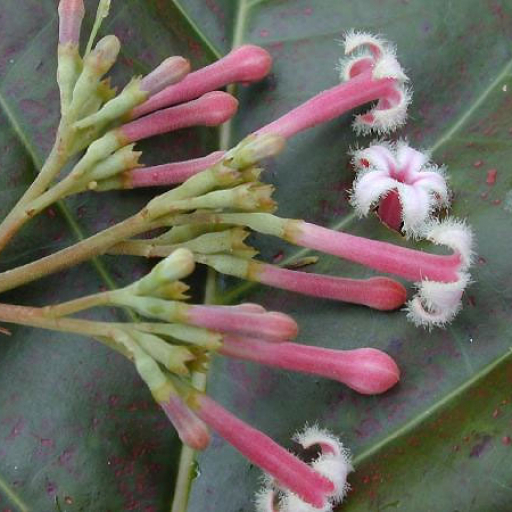
Plant Overview
Known as the Red Cinchona or the Quinine Tree, this South American native is the plant that changed the course of world history. Deeply entwined with colonial tales and the discovery of malaria medicine, it is named after the Countess of Chinchón, who was legendarily cured of a fever by its bark in the 1630s. While visually striking with its large, velvety leaves, it remains a plant of profound medicinal power and ecological complexity.
🔍 How to Identify
- 🍃 Large Silky Leaves: The leaves are broad and oval, often reaching up to a foot in length. They frequently turn a deep, striking red as they age, which gives the tree its common name.
- 🌸 Clustered Blooms: Small, fragrant, trumpet-shaped flowers appear in dense silky clusters (panicles) at the ends of branches, ranging in color from soft white to rose-pink.
- 🪵 Textured Bark: The bark is thick and rough, revealing a reddish-brown interior that has been harvested for centuries for its medicinal alkaloids.
🏡 In Your Garden
- ☁️ Tropical High-Altitude Roots: This tree is native to the Andean cloud forests. It craves consistent humidity and stable, cool-to-warm temperatures; it has zero tolerance for frost and struggles in dry, desert-like air.
- 🚫 An Aggressive Traveler: Outside its native range, particularly in island ecosystems like Hawaii or the Galapagos, this tree is considered a "super-invader." Its wind-dispersed seeds allow it to spread rapidly, so check local ecological guidelines before considering it for an outdoor landscape.
⚠️ Safety & Toxicity
- 💊 Potent Alkaloids: The bark contains high concentrations of quinine and other alkaloids. While historically used as a life-saving medicine, raw ingestion is dangerous and can lead to "cinchonism."
- 🤮 Human & Pet Risk: Symptoms of accidental ingestion include nausea, ringing in the ears (tinnitus), blurred vision, and heart palpitations. It should be kept out of reach of curious pets and children.
✨ Fun Fact
- 🍹 The Gin & Tonic Connection: The bitter quinine extracted from this tree is the reason "Tonic Water" exists. British colonial soldiers mixed their bitter daily anti-malarial rations with gin, sugar, and lime to make the medicine palatable, inadvertently creating one of the world’s most famous cocktails!

Detailed Care Instructions
| Humidity | High |
| Lighting | Part Sun |
| Difficulty | Medium |
| Hibernation | Cold Period |
| Temperature | 18°C - 30°C |
| Hardiness Zones | 10 - 12 |
To grow Cinchona Pubescens, also known as Quina or Peruvian Bark, follow these steps:
- Seed Selection: Obtain high-quality Cinchona Pubescens seeds from a reputable source or purchase young plants from a nursery.
- Planting: Fill a pot with well-draining potting soil. Sow the seeds approximately 1/8 inch deep in the soil. If using young plants, gently transplant them into the pot.
- Location: Place the pot in a partially shaded area that receives filtered sunlight. Cinchona Pubescens prefers growing in cooler climates with temperatures ranging between 60-70°F (15-21°C).
- Watering: Keep the soil evenly moist but not waterlogged. Avoid letting the soil dry out completely. Cinchona Pubescens thrives in moist conditions.
- Fertilization: Feed the plant with a balanced, slow-release fertilizer every few months to provide essential nutrients. Follow the product instructions for the recommended application rate.
- Pruning: Trim the plant occasionally to maintain its shape and encourage bushier growth. Pinch off the tips of the branches to promote branching.
- Pests and Diseases: Monitor the plant for any signs of pest infestation, such as aphids or mealybugs. Treat any pest issues promptly using organic insecticides or horticultural oils to avoid damage to the plant.
- Harvesting: Cinchona Pubescens usually takes around 4-5 years to mature and produce bark suitable for medicinal purposes. Harvest the bark by carefully peeling it from the trunk, leaving enough on the tree to ensure its continued health.
Note: Cinchona Pubescens is a large tree, often exceeding 20 feet (6 meters) in height. If you are planning to grow it in a pot, you may need to transplant it into a bigger container as it grows.

Place in a bright room that is sun drenched almost all day. Or directly in a south-facing window.

Cinchona pubescens is a plant that requires regular watering to maintain its health and growth. The watering schedule may vary depending on the location and climate of its habitat. It is important to ensure that the soil is evenly moist but not waterlogged. Overwatering can lead to root rot and fungal diseases, while underwatering can cause wilting, stunted growth, and foliage loss. It is recommended to water the plant deeply and thoroughly, allowing the water to penetrate the root zone. Avoid watering the leaves or flowers as it can increase the risk of foliar diseases. Depending on the individual plant's needs, it may be necessary to increase or decrease the frequency and amount of watering. Additionally, it is advisable to use a well-draining soil mix that retains moisture but does not hold excess water.
To fertilize this plant, use a balanced fertilizer with equal parts nitrogen (N), phosphorus (P), and potassium (K). Apply the fertilizer to the soil around the plant every 2-3 months during the growing season. Be sure to follow the instructions on the fertilizer package for the appropriate amount to use. Avoid fertilizing during periods of drought or extreme heat.
For Cinchona Pubescens plants, it is recommended to use a well-draining soil mix that is rich in organic matter. The soil should be slightly acidic with a pH between 5.5 to 6.5. A mixture of peat moss, perlite or vermiculite, and compost is ideal for this plant. It is also important to ensure that the soil is kept moist but not waterlogged, and to avoid over-fertilizing the plant. A balanced fertilizer with a ratio of 10-10-10 or 14-14-14 can be used once every 6-8 weeks during the growing season. Additionally, regular pruning and trimming can help promote healthy growth and prevent disease.
To propagate this plant, gather leafy stem cuttings with at least two nodes. Remove the lower leaves and dip the end in rooting hormone powder. Place the cutting in a well-draining soil mix and keep it moist. Cover the pot with a plastic bag to increase humidity and place it in a bright, but indirect light. After two to four weeks, roots should start to form, and new growth will appear. Once the cutting has established roots, gradually acclimate it to direct sunlight, increase water frequency, and reduce bag ventilation.








