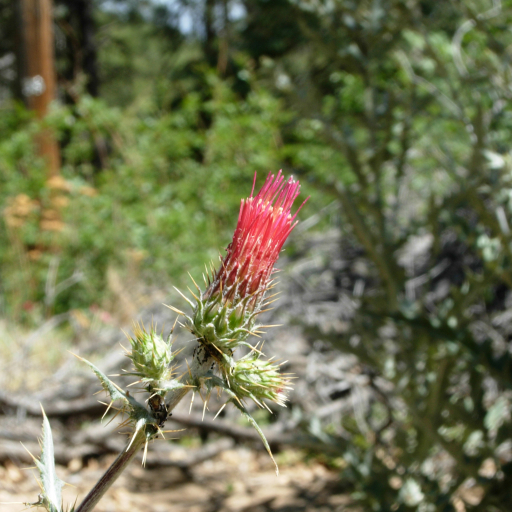
Plant Overview
Commonly known as the Arizona Thistle or Carmine Thistle, this striking desert native is a far cry from the "pesky weeds" many gardeners fear. While it wears a fierce suit of prickly armor, its vibrant, deep-red blooms are a masterpiece of the Southwestern landscape. It is a vital survivor that brings a dramatic, architectural flair to arid gardens and wild mountainsides alike.
🔍 How to Identify
- ❤️ Carmine Blooms: Unlike the common purple thistle, this species boasts brilliant rose-red to carmine-pink flower heads that are long, tubular, and grouped in clusters.
- ⚔️ Spiny Foliage: The leaves are long, silver-green, and deeply lobed, with each tip ending in a sharp, needle-like spine designed to deter hungry herbivores.
- 📏 Stately Stature: It grows as a sturdy, upright plant, often reaching between 2 to 5 feet in height, with branching stems that give it a candelabra-like appearance.
🏡 In Your Garden
- 🏜️ The Taproot Rule: This plant develops a long, stubborn taproot to seek out deep moisture. Because of this, it absolutely hates being moved; once you plant a seed or a seedling, let it stay put or risk losing the plant.
- 🐦 Pollinator Paradise: This thistle is a specialized "hummingbird plant." Its tubular flowers are perfectly shaped for a hummingbird’s beak, making it a high-energy pit stop for migrating birds and large butterflies.
- 🌵 Minimalist Care: It thrives in "lean" soil—meaning it prefers rocky or sandy dirt with very little fertilizer. Over-watering or rich soil will often cause the plant to flop over or rot.
⚠️ Safety & Toxicity
- 🟢 Generally Safe: The Arizona Thistle is not considered chemically toxic to humans, cats, or dogs.
- 🩹 Physical Hazard: The primary danger is mechanical. The spines are exceptionally sharp and can easily penetrate thin clothing or garden gloves. Keep it away from high-traffic paths where children or pets might accidentally brush against it.
✨ Fun Fact
While most thistles are purple to attract bees, the Arizona Thistle evolved its signature red color specifically to catch the eye of hummingbirds! It is one of the few thistles in North America that has pivoted its evolutionary strategy to cater almost exclusively to feathered pollinators.

Detailed Care Instructions

Place in a bright room that is sun drenched almost all day. Or directly in a south-facing window.

Some plants require more regular watering than others, which should be done every few days. It's critical to maintain the soil moist all of the time. The water requirements of the same plant placed in pots with varying sizes will differ. Because the water in the smaller pot evaporates faster than the water in the larger pot, it will require more watering. Regardless of pot size, the surface should constantly be maintained moist.








