Plant Overview
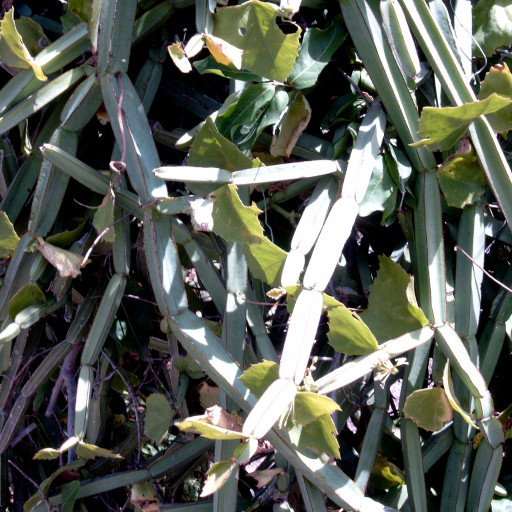
Known affectionately as the "Bone Setter" or "Veldt Grape," Cissus quadrangularis looks more like a prehistoric cactus than a member of the grape family. This architectural marvel has been used for centuries in traditional Ayurvedic medicine, earning a reputation as a powerful healer for fractures and joint pain. Its strange, four-angled stems make it a striking conversation piece for any sunny windowsill or hanging basket.
🔍 How to Identify
- 🌿 Square Stems: The most defining feature is its thick, succulent, four-sided green stems that look like connected rectangular blocks.
- 🍇 Grape-like Tendrils: At each node (the "joint" of the stem), you’ll find thin, curly tendrils that it uses to hitchhike and climb up nearby structures.
- 🍃 Fleeting Foliage: It produces small, heart-shaped leaves at the nodes, but these are often temporary and may drop off during dry periods, leaving just the green, photosynthetic stems.
🏡 In Your Garden
- 🧱 Structural Support: Because it is a scrambling vine, this plant loves a trellis or a moss pole. Without support, it will gracefully spill over the sides of a pot, creating a "waterfall" of geometric stems.
- ☀️ The Desert Vibe: Despite being related to grapes, treat it like a succulent. It stores water in its fleshy stems, meaning it prefers to dry out completely between waterings. Overwatering is the quickest way to upset its "bones."
- ✂️ Easy Propagation: If a segment breaks off, don't worry! You can simply stick the broken end back into well-draining soil, and it will usually root with very little effort.
⚠️ Safety & Toxicity
- 🐾 Mildly Irritating: While humans often consume it in supplement form for joint health, the raw plant contains calcium oxalate crystals.
- 👅 Mouth Irritation: If chewed by curious pets or toddlers, it can cause a stinging sensation or swelling in the mouth and throat. It is best kept on a high shelf out of reach of furry friends.
✨ Fun Fact
The nickname "Bone Setter" isn't just folklore; modern clinical studies have shown that Cissus quadrangularis can actually speed up the healing process of bone fractures by helping the body uptake calcium more efficiently!

Detailed Care Instructions
| Lighting | Part Sun |
| Hardiness Zones | 10B - 9B |
To grow Cissus Quadrangularis (also known as the Veldt Grape or Devil's Backbone), you can follow these steps:
- Purchase seeds or a starter plant from a reputable nursery or online store.
- Choose a location that receives bright indirect sunlight. Cissus Quadrangularis can tolerate some direct sunlight, but too much can scorch the leaves. It can also grow in partial shade, but it may become leggy and produce fewer leaves.
- Prepare well-drained soil that is rich in organic matter. The pH level should be around 6.0 to 7.0. You can add compost or well-rotted manure to improve the soil's fertility.
- Sow the seeds or place the starter plant in the soil. If using seeds, make sure to follow the instructions on the seed packet regarding planting depth and spacing.
- Water the plant regularly, but avoid over-watering. Cissus Quadrangularis prefers slightly dry soil, so let the top inch of soil dry out between waterings. However, do not let the soil completely dry out as it can cause stress to the plant.
- Fertilize the plant every 4-6 weeks during the growing season with a balanced, organic fertilizer. Follow the instructions on the fertilizer packaging for the appropriate dosage.
- Prune the plant as needed to maintain its shape and control its growth. Cissus Quadrangularis can get quite sprawling, so regular pruning can help keep it in check.
- Monitor the plant for pests and diseases. Common pests include aphids and mealybugs, which can be controlled with insecticidal soap or neem oil. Treat any signs of disease promptly.
- During winter, if you live in a cold climate, bring the plant indoors as it is not frost-tolerant. Place it near a sunny window and reduce watering frequency.
Following these steps should help you successfully grow and care for Cissus Quadrangularis.

Place in a bright room that is sun drenched almost all day. Or directly in a south-facing window.

To water this particular plant, it is important to take note of its watering needs. Ensure that the soil is dry before watering, as giving it too much water can result in root rot and other problems. Water the plant only when the top layer of soil is dry and make sure that the water drains well from the pot. It is also important to avoid watering the leaves and stems directly, as this can cause fungal growth and disease. Finally, the plant should be watered more frequently during the active growing season, but less often during the winter or dormant period.
- Choose a balanced fertilizer with equal amounts of nitrogen, phosphorus, and potassium.
- Dilute the fertilizer according to the manufacturer's instructions.
- Apply the fertilizer every two weeks during the plant's growth period.
- Avoid over-fertilizing, as this can lead to root burn or stunted growth.
- Water the plant thoroughly before and after fertilization to prevent the roots from drying out.
- Monitor the plant for any signs of yellowing leaves or other nutrient deficiencies, which may require additional fertilization.
The ideal soil for Cissus Quadrangularis plant should be well-draining and have a pH between 6.0 and 7.5. A mixture of peat moss, perlite, and sand can be used in equal proportions to make the soil. The soil should have a high organic matter content and should be able to retain moisture without becoming waterlogged. The plant should not be over-fertilized, and a slow-release fertilizer should be added to the soil only once a year. The soil should be kept moist but not waterlogged, and the plant should be placed in a bright but indirect light. It is important to avoid exposing the plant to direct sunlight, as this can cause leaf burn and damage to the plant. With proper soil and care, Cissus Quadrangularis plant should be able to thrive and produce healthy foliage.
Cissus Quadrangularis can be propagated by stem cuttings. The stem cuttings should be taken from a healthy and mature plant. The cuttings should be around 10-15 cm in length and should have 2-3 nodes. The lower leaves on the stem cutting should be removed.
The stem cutting should be dipped in rooting hormone powder and then planted in a pot filled with well-draining potting mix. The pot should be kept in a warm and humid place, away from direct sunlight.
The soil should be kept moist but not waterlogged. After a few weeks, roots will start to form and new growth will appear. Once the plant has established itself, it can be transplanted into a larger pot or planted in the ground.
Common pests of the winged treebine include Mealybugs, spider mites, thrips. Make a habit of checking your winged treebine frequently for pests so that any infestations can be caught and managed early.








