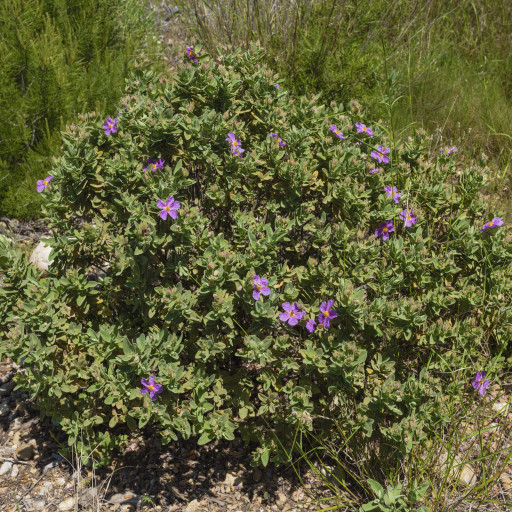
Plant Overview
Commonly known as the Grey-Leaved Rock Rose, this Mediterranean beauty is famous for its "crepey" petals that look like delicate, crumpled tissue paper. Despite its name albidus (meaning white), this plant actually produces stunning pink to lilac blossoms; the name refers to the soft, whitish-grey down that covers its leaves. It is a staple of sunny, dry gardens where it acts as a resilient, low-maintenance evergreen shrub.
🔍 How to Identify
- 🌸 The Flowers: Large, five-petaled blooms in shades of rose-pink with a bright "sunny-side-up" yellow center. Each flower typically lasts only a day, but the plant produces them in great abundance.
- 🌫️ The Foliage: The leaves are stalkless, opposite, and covered in a dense layer of tiny white hairs, giving the entire plant a distinctive silvery-green or "dusty" appearance.
- 🧤 The Texture: The leaves feel soft and velvety to the touch, a natural adaptation that helps the plant retain moisture in scorching heat.
🏡 In Your Garden
- ☀️ Sun Worshiper: This plant thrives in "neglect." It craves the brightest spot in your garden and actually performs better in poor, rocky soil than in rich, fertilized earth.
- 🚫 Don't Move Me: Like many members of the Cistus family, it hates having its roots disturbed. Choose its permanent home carefully, as it may not survive being transplanted once its root system is established.
- 💧 Drought Champion: Once it settles in, it is incredibly water-wise. Overwatering is its greatest enemy and can lead to root rot faster than any pest.
⚠️ Safety & Toxicity
- ✅ Pet & Human Safe: Cistus albidus is generally considered non-toxic to dogs, cats, and humans.
- 🌿 Skin Sensitivity: While not poisonous, the fine hairs on the leaves can occasionally cause mild mechanical irritation to very sensitive skin if handled roughly.
- 🔥 Fire Caution: Because it produces flammable resins (labdanum), it is not recommended for "defensible space" planting in high-risk wildfire zones, as it can burn intensely if ignited.
✨ Fun Fact
The Rock Rose is a "pyrophyte," meaning it has a special relationship with fire. While the parent plant may perish in a bushfire, the intense heat actually triggers its seeds to germinate, allowing a new generation to rise from the ashes!

Detailed Care Instructions
| Humidity | Normal |
| Difficulty | Medium |
| Temperature | 18°C - 28°C |
| Hardiness Zones | 8 - 11 |
To grow Cistus albidus, also known as white rockrose, you can follow these steps:
- Choose a suitable location: Cistus albidus prefers full sun to partial shade, and well-draining soil. Ensure the area has good air circulation and is protected from strong winds.
- Prepare the soil: Before planting, prepare the soil by removing any weeds or grass and loosening the top layer. Add organic matter such as compost or well-rotted manure to improve soil fertility and drainage.
- Planting: Dig a hole slightly larger than the root ball of the plant. Place the Cistus albidus in the hole, ensuring the top of the root ball is level with the ground. Backfill the hole with soil, gently firming it around the plant. Water thoroughly after planting.
- Watering: While Cistus albidus is tolerant of drought, it is important to water the plant regularly during its first growing season to help establish a strong root system. Afterward, only water during periods of extended drought or when the soil feels dry.
- Mulching: Apply a layer of organic mulch around the base of the plant to help conserve moisture, control weeds, and regulate soil temperature.
- Pruning: Cistus albidus generally requires minimal pruning. However, you can trim back any dead or damaged branches in early spring to promote new growth and maintain a desirable shape.
- Fertilization: Cistus albidus is a low-maintenance plant that generally does not require regular fertilization. However, you can apply a slow-release, balanced fertilizer in early spring to provide nutrients to the plant.
- Protection: During extreme cold temperatures, you may need to protect the plant by covering it with a frost cloth or bringing it indoors if possible.
Cistus albidus is typically easy to grow once established, and with proper care, it should thrive and produce beautiful white flowers in spring and summer.

Place in a bright room that is sun drenched almost all day. Or directly in a south-facing window.

Cistus Albidus is a type of shrub that requires adequate watering for its healthy growth. Here are some details on how to water this plant effectively:
1. Watering frequency: Cistus Albidus should be watered regularly during the first year after planting to establish a strong root system. Typically, watering every 2-3 days is necessary during this initial phase. Once established, the shrub can tolerate some dry periods, but regular watering is still important for optimal growth.
2. Soil moisture: Before watering, check the soil moisture level around the root zone of the plant. Stick your finger about an inch into the soil to assess if it feels dry. Avoid watering if the soil is moist, as overwatering can lead to root rot or other fungal diseases.
3. Watering method: The most effective way to water Cistus Albidus is through deep root watering. Use a hose or a watering can with a narrow spout to directly pour water around the base of the plant, targeting the root zone. This ensures that the moisture reaches the roots where it is needed the most.
4. Water quantity: Aim to provide enough water to thoroughly moisten and penetrate the root zone. It is generally recommended to provide about 1 inch (2.5 cm) of water per week for Cistus Albidus during dry periods. Adjust this amount based on climate conditions and the moisture retention capacity of the soil.
5. Watering time: Water the shrub in the early morning or late evening when temperatures are cooler. This helps to minimize water loss due to evaporation, allowing the plant to absorb water more effectively.
6. Mulching: Applying a layer of organic mulch around the base of the plant can help retain moisture in the soil and reduce water evaporation. Spread a 2-3 inch (5-7.5 cm) layer of mulch, such as wood chips or compost, around the plant, while keeping it a few inches away from the stems to prevent rotting.
Remember, always observe the specific watering needs of your Cistus Albidus plant in conjunction with local climate conditions to ensure it receives the appropriate amount and frequency of watering for its healthy development.
- Choose a well-draining soil mix: Cistus Albidus prefers sandy or loamy soils with good drainage.
- Select a suitable fertilizer: Opt for a balanced, slow-release fertilizer with equal NPK (nitrogen-phosphorus-potassium) ratios, such as 10-10-10 or 14-14-14.
- Apply fertilizer during the growing season: Start fertilizing in early spring, once the plant begins to show new growth and continue until late summer or early fall.
- Follow package instructions: Sprinkle the recommended amount of fertilizer evenly around the base of the plant, taking care not to let it touch the foliage or stem.
- Water thoroughly: After applying the fertilizer, water the plant deeply to ensure the nutrients penetrate the root zone.
- Monitor for signs of nutrient deficiencies: Keep an eye out for yellowing leaves, stunted growth, or poor flowering, as these may indicate a need for additional nutrients.
- Avoid excessive fertilization: Over-fertilizing can lead to nutrient imbalances or burn the roots, so it's essential to follow the recommended dosage or dilution rates.
- Adjust fertilizer application as needed: Based on visual cues and the health of the plant, you may need to adjust the frequency or dosage of fertilization throughout the growing season.
- Cease fertilization during winter: Cistus Albidus enters a period of dormancy in winter, so it's best to withhold fertilization during this time.
- Monitor overall plant health: Alongside fertilization, ensure your Cistus Albidus receives adequate sunlight, water, and pest/disease management to promote optimal growth and vigor.
Cistus albidus, a perennial flowering plant native to the Mediterranean region, thrives in soil that meets its specific requirements. Here are the characteristics of the ideal soil for Cistus albidus without mentioning its common names:
- Well-draining: Cistus albidus prefers soil that drains well, preventing the plant's roots from becoming excessively saturated. Heavy or waterlogged soil may lead to root rot and other issues.
- Sandy or loamy: The plant grows best in soil that is sandy or loamy in texture. These types of soil provide good aeration, allowing the roots to access oxygen easily.
- Neutral to alkaline pH: Cistus albidus prefers soil with a neutral to slightly alkaline pH level. Ideally, the pH should range between 6.0 and 8.0. This pH range supports nutrient availability and proper absorption for optimal growth.
- Nutrient-rich: The soil should be fertile, providing an adequate supply of nutrients for the plant's overall health and growth. Incorporating organic matter, such as compost or well-rotted manure, into the soil before planting can help improve its nutrient content.
- Low in clay content: While the soil should be well-draining, it should also have minimal clay content. High clay content can lead to waterlogging, compacted soil, and poor aeration.
- Drought-tolerant: Cistus albidus is adapted to dry Mediterranean climates, so the soil should be well-suited for drought tolerance. Sandy or loamy soils naturally retain less moisture, helping to prevent waterlogging and excessive moisture around the plant's root zone.
- Weed-free: Prior to planting Cistus albidus, it is essential to clear the planting area of weeds or competitive vegetation. Weeds can compete with the plant for resources, so maintaining weed-free conditions will give Cistus albidus the best chance to establish and grow successfully.
Remember to research and consider the specific needs of Cistus albidus and adjust the soil conditions accordingly.
Cistus albidus is a flowering plant that can be propagated through several methods, including seed propagation, softwood stem cuttings, and layering. Here are the steps for each method:
- Seed propagation:
- Collect mature seeds from the plant during late summer or early autumn.
- Prepare a seed tray or pot with well-draining soil mixture.
- Moisten the soil before sowing the seeds.
- Sow the seeds lightly on the surface of the soil and cover them lightly with a thin layer of fine soil.
- Place the tray or pot in a warm, well-lit area, preferably under indirect sunlight.
- Keep the soil consistently moist but not waterlogged, as excess moisture can cause rotting or fungal problems.
- After a few weeks, the seeds should germinate. Once the seedlings grow a few inches tall, they can be transplanted into individual pots or directly into the garden.
- Collect mature seeds from the plant during late summer or early autumn.
- Softwood stem cuttings:
- Take softwood stem cuttings from the plant during early summer when the plant is actively growing.
- Use sharp and sterilized pruning shears to ensure a clean cut.
- Select healthy, non-flowering stems that are about 4-6 inches long.
- Remove the lower leaves from the stem, leaving only a few sets of leaves at the top.
- Dip the cut end of the stem in a rooting hormone powder to enhance rooting.
- Insert the cutting into a small pot filled with a well-draining soil mix or a mixture of perlite and peat moss.
- Place the pot in a warm, bright location with indirect sunlight.
- Mist the cutting regularly to maintain humidity and keep the soil lightly moist.
- After a few weeks, roots should begin to develop. Once the roots are established, the cutting can be potted into a larger container or planted directly in the garden.
- Take softwood stem cuttings from the plant during early summer when the plant is actively growing.
- Layering:
- Select a healthy and flexible stem from the plant that can reach the ground easily.
- Gently wound or scrape the lower part of the stem where it will touch the ground to encourage root development.
- Dig a small hole in the soil where the wounded part of the stem will be placed.
- Secure the wounded part of the stem into the hole using a U-shaped metal pin or a small stone.
- Cover the wounded part and the secured stem with soil, leaving the top part of the stem exposed.
- Water the layered stem well and ensure the soil remains consistently moist throughout the process.
- After a few months, roots should develop from the wounded part of the stem.
- Once sufficient roots have formed, cut the layered stem from the parent plant and transplant it into a desired location.
Propagation can be an enjoyable way to expand your Cistus albidus collection or share it with other gardening enthusiasts. However, please note that the success rate may vary depending on various factors, such as environmental conditions and the health of the parent plant.
- Select a healthy and flexible stem from the plant that can reach the ground easily.
Common pests of the grey-leaved cistus include Spider mites, aphids, whiteflies. Make a habit of checking your grey-leaved cistus frequently for pests so that any infestations can be caught and managed early.








