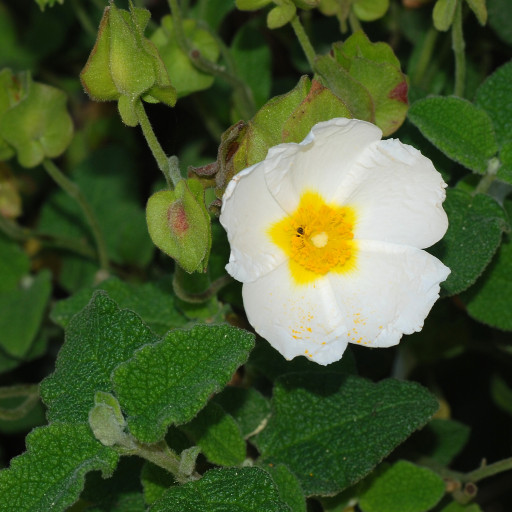
Plant Overview
Commonly known as the Sage-leaved Rock Rose or the "Gallipoli Rose," this Mediterranean native is a master of survival in sun-drenched, rocky landscapes. It earns its name from its textured, grayish-green foliage that looks remarkably like culinary Sage, though it’s actually a member of the Cistaceae family. Despite each flower lasting only a single day, the plant produces such a profusion of blooms that it remains a focal point of the spring garden.
🔍 How to Identify
- 🌼 The "Fried Egg" Bloom: Five delicate, paper-thin white petals surround a bright cluster of golden-yellow stamens in the center.
- 🍃 Sage-like Leaves: The leaves are oval, wrinkled (rugose), and covered in tiny hairs, giving them a soft but rough texture similar to Salvia.
- 🌿 Low-Mounded Habit: It grows as a dense, spreading evergreen shrub, rarely reaching more than 2 feet in height, making it an excellent groundcover.
🏡 In Your Garden
- ☀️ Sun Seeker: This plant thrives in "difficult" spots where other plants wither; it craves full sun and sharp-draining, even poor or sandy soil.
- 🚫 Don't Move Me: Rock Roses have incredibly sensitive root systems and "hate" being transplanted. Once you've tucked it into the ground, it's best to leave it in its permanent home.
- 🔥 Fire Survivor: In the wild, it is a "pyrophyte"—its seeds are often stimulated by the heat of a brushfire, allowing it to be one of the first plants to reclaim scorched earth.
⚠️ Safety & Toxicity
- ✅ Safe for All: Cistus salviifolius is generally considered non-toxic to humans, dogs, and cats.
- 👐 Resinous Texture: While safe, the leaves can sometimes feel slightly sticky due to natural resins; this is harmless but might pick up a bit of garden dust.
✨ Fun Fact
The petals are so thin and fragile that they often appear slightly "crinkled" or wrinkled even when fully open, looking exactly like delicate pieces of discarded crepe paper scattered over the bush.

Detailed Care Instructions
To grow Cistus salviifolius, also known as sage-leaved rock rose, follow these steps:
- Choose a suitable location: Cistus salviifolius prefers full sun and well-drained soil. It can tolerate poor and rocky soil, making it an excellent choice for rock gardens or dry areas.
- Prepare the planting area: Clear the planting area of any weeds or other vegetation. Loosen the soil and remove any large rocks or debris.
- Propagation: Cistus salviifolius can be grown from seeds or cuttings. If starting from seeds, sow them in a well-draining potting mix and keep the soil consistently moist until germination occurs. Cuttings taken from the stem tips in early summer can also be successfully rooted.
- Planting: If starting with seedlings or rooted cuttings, dig a hole slightly larger than the root ball and place the plant in the hole. Backfill the hole with soil and gently firm it around the roots. If planting multiple plants, space them about 2-3 feet apart.
- Watering: Water the newly planted Cistus salviifolius deeply to ensure proper establishment. After that, the plant is relatively drought-tolerant and does not require frequent watering. However, watering during prolonged dry periods or in extreme heat can be beneficial.
- Mulching: Apply a layer of organic mulch around the base of the plant to help conserve moisture, suppress weeds, and protect against extreme temperatures. Avoid placing mulch too close to the stem to prevent rot.
- Pruning: Cistus salviifolius generally requires minimal pruning. However, if needed, prune after flowering to maintain a compact shape or to remove dead or damaged branches.
- Fertilizing: Cistus salviifolius is adapted to nutrient-poor soils and generally does not require fertilization. If the soil is particularly poor, a light application of a balanced fertilizer in spring can be beneficial.
- Protection: Cistus salviifolius is generally hardy and resistant to most pests and diseases. However, monitor the plant for signs of pests such as aphids or spider mites and take appropriate action if necessary.
- Enjoying the blooms: Cistus salviifolius produces beautiful white or pink flowers with yellow centers. Enjoy the colorful blooms from late spring to early summer and appreciate the plant's ability to attract pollinators to your garden.

Place in a bright room that is sun drenched almost all day. Or directly in a south-facing window.

To water this particular plant, you should aim to provide it with adequate moisture without over-watering it. First, make sure the soil is well-draining and not waterlogged, as this can cause root rot. Wait until the top inch of soil is dry before watering, as this will ensure that the plant is not getting too much water. When you do water, pour water slowly onto the soil around the base of the plant, avoiding getting water onto the leaves. This will allow the water to soak in properly and avoid any damage to the plant. It's important to monitor the plant regularly, especially during hot or dry weather, and adjust watering as needed.
To fertilize this plant, it is recommended to use a balanced fertilizer with equal amounts of nitrogen, phosphorus and potassium. It should be applied in early spring, just before new growth starts. The fertilizer should be mixed with water and applied directly to the soil around the base of the plant. It is important not to over-fertilize as this may result in foliage burn or damage to the roots.
To properly care for the plant, it is important to use a suitable soil. The plant prefers well-draining and slightly acidic soil. A mixture of sandy loam soil and organic matter is ideal. It is important to avoid using heavy clay soil or soil that retains too much water, as it can lead to root rot. Additionally, the plant should be planted in a well-draining location and watered sparingly to prevent overwatering.
To propagate this particular plant, there are several steps that need to be followed. Firstly, select healthy cuttings from the plant with a clean and sharp pair of scissors or pruning shears.
Next, ensure that the cuttings are of a suitable size, usually around 4 to 6 inches long. Remove any leaves from the bottom half of the cuttings to reduce transpiration.
Prepare a well-draining potting mix that is moist, but not overly wet. Dip the cuttings into a rooting hormone and then carefully insert them into the potting mix, making sure that the soil is firmly packed around the cutting.
Place the pot in a warm and bright area, but avoid direct sunlight. Keep the soil moist but not waterlogged, and mist the cuttings regularly to maintain humidity.
After a few weeks, the cuttings should begin to grow roots. Once they have a well-established root system, they can be transplanted into larger pots or planted directly into the ground.








