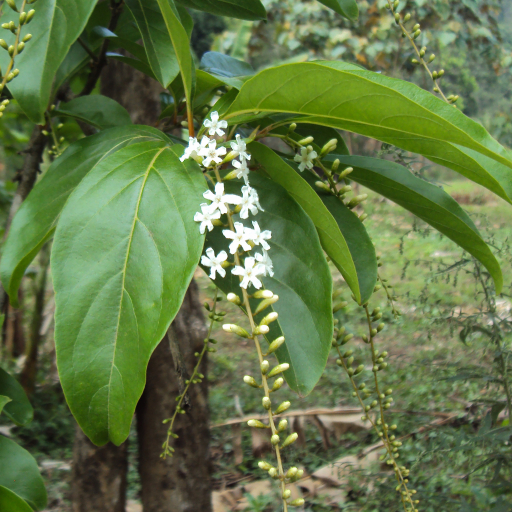
Plant Overview
Known as the Fiddlewood, this elegant tree is a sensory delight for any tropical or subtropical landscape. While its name suggests a musical history, it is most famous for its intoxicating fragrance—reminiscent of sweet almonds or honey—that drifts through the air on warm evenings. Native to the Caribbean and the Southbound Americas, it provides a stunning display of color as its glossy leaves transition through vibrant shades of orange and bronze throughout the year.
🔍 How to Identify
- 🍃 The Foliage: Look for glossy, leathery leaves that are arranged oppositely along the stems. A key giveaway is that older leaves often turn a brilliant "autumnal" orange or reddish-gold before they drop, even in tropical climates.
- 🌸 The Flowers: It produces long, drooping clusters (racemes) of tiny, bell-shaped white flowers. These clusters can reach up to 12 inches long and are the primary source of the tree's powerful perfume.
- 🍒 The Fruit: After flowering, the tree produces small, round berries. These start off green, turn a bright, glossy orange, and eventually ripen into a deep purple-black.
🏡 In Your Garden
- 🦋 Wildlife Magnet: If you want to transform your garden into a sanctuary, this is the tree to plant. The nectar-rich flowers are a favorite for honeybees and butterflies, while the berries provide a feast for local songbirds.
- 🌬️ Coastal Resilience: The Fiddlewood is exceptionally sturdy. It has a high tolerance for salt spray and wind, making it a perfect "barrier" plant or ornamental specimen for coastal homes where other plants might wither.
- ✂️ Growth Habit: Though it can grow into a medium-sized tree, it is very "pliant" and takes well to pruning. Many gardeners use it as a thick, fragrant privacy hedge or a small patio tree.
⚠️ Safety & Toxicity
- 🟢 General Status: Citharexylum spinosum is generally considered non-toxic to humans and common pets.
- 🥣 Berry Caution: While birds love the berries, they are not considered edible for humans and may cause mild stomach upset if ingested in large quantities by curious children or pets.
- 🧤 Maintenance: Unlike many other members of its family, it is relatively "user-friendly" and lacks aggressive thorns, making it safe to prune without heavy armor.
✨ Fun Fact
The name Citharexylum is derived from the Greek words kithara (lyre/lute) and xylon (wood). Historically, the strong, resonant wood of this tree was favored by Caribbean craftsmen for making the sounding boards of stringed musical instruments!

Detailed Care Instructions
To grow Citharexylum Spinosum, also known as the Florida fiddlewood, you can follow these steps:
- Obtain seeds or cuttings: You can purchase seeds or obtain cuttings from a mature Citharexylum Spinosum plant. Cuttings should be taken during the growing season, typically in spring or early summer.
- Prepare the soil: Choose a well-draining soil mix that is rich in organic matter. Citharexylum Spinosum prefers slightly acidic to neutral soil with a pH range of 6.0 to 7.0.
- Plant the seeds or cuttings: If you have seeds, sow them in small containers or pots filled with the prepared soil mix. Gently press the seeds into the soil and cover them lightly with a layer of soil. Keep the soil consistently moist, but not waterlogged.
If you have cuttings, dip the cut ends in a rooting hormone powder and plant them in pots filled with the prepared soil mix. Firmly press the soil around the cuttings to ensure good contact.
- Provide optimal growing conditions: Place the pots in a location that receives full to partial sun. Citharexylum Spinosum thrives in bright, indirect light. Ensure the plants receive at least 4 to 6 hours of sunlight each day.
- Maintain watering and humidity: Keep the soil consistently moist but avoid overwatering, as it can lead to root rot. Water when the top inch of soil feels dry. Mist the leaves occasionally to provide some humidity.
- Fertilize regularly: Apply a balanced, slow-release fertilizer during the growing season to provide necessary nutrients. Follow the package instructions for the appropriate dosage.
- Prune as needed: Trim any dead, damaged, or overgrown branches to maintain a desired shape and promote healthy growth.
- Protect from pests and diseases: Monitor the plant for common pests like aphids, mealybugs, and scale insects. If an infestation occurs, use an organic pesticide or insecticidal soap to control it. Also, ensure good air circulation around the plant to prevent fungal diseases.
By following these steps and providing proper care, you can successfully grow Citharexylum Spinosum plants.

Place in a bright room that is sun drenched almost all day. Or directly in a south-facing window.

Citharexylum Spinosum is a type of plant that needs to be watered regularly to maintain its growth and health. When watering the plant, it is important to ensure that the soil around the roots is thoroughly moistened but not waterlogged.
To water Citharexylum Spinosum, fill a watering can or bucket with room temperature water. Slowly pour the water onto the soil around the base of the plant, taking care not to disturb the roots or foliage. Use enough water to moisten the soil to a depth of at least 6 inches.
It is important to monitor the soil moisture level and only water the plant when the top 1-2 inches of soil feels dry to the touch. Overwatering can lead to root rot and other issues. Additionally, avoid watering the foliage of the plant as this can increase the risk of fungal diseases.
During periods of drought or hot weather, the plant may require more frequent watering to prevent the soil from drying out completely. Consider adding a layer of mulch around the base of the plant to help retain moisture and regulate soil temperature.
Overall, providing consistent and adequate amounts of water is essential for the health of Citharexylum Spinosum. With proper care, the plant can thrive and produce beautiful foliage and flowers.
To fertilize the Citharexylum Spinosum plant, apply a slow-release fertilizer with balanced N-P-K (nitrogen, phosphorus, potassium) ratio in early spring. Use a granular type of fertilizer and apply according to the package instructions. Alternatively, you can foliar feed the plant with a water-soluble fertilizer diluted to half strength every three to four weeks during active growth periods. Be sure to water the plant well after fertilization to avoid fertilizer burn. Avoid fertilizing during the winter dormant period.
The Citharexylum Spinosum plant prefers well-draining soil that is slightly acidic in nature. Ideally, the soil pH should range from 5.0 to 6.5. It is recommended to use a mix of peat moss, vermiculite, and perlite with some coarse sand as the planting soil mix. The soil mixture should be loose and light in texture to promote proper drainage and aeration for the roots. Additionally, adding some organic matter like compost or well-decomposed leaf litter to the soil can provide essential nutrients to the plant for healthy growth. It is important to avoid compacted or heavy clay soils as they don't allow proper root growth, leading to poor plant health and stunted growth.
To propagate this plant, take stem cuttings from a mature, healthy plant during the growing season. Use sharp, sterile shears to make a clean cut below a node where a leaf attaches to the stem. Remove any leaves from the lower half of the cutting, leaving a few at the top. Dip the cut end in rooting hormone powder and place it in a pot filled with well-draining soil. Cover the pot with clear plastic or a clear plastic bag to create a greenhouse effect that will keep humidity high. Keep the soil moist but not waterlogged, and place the pot in a bright, warm location but out of direct sun. After a few weeks, gently tug on the cutting to see if it has rooted. Once it has, you can transplant it to a larger pot or outside in a sunny location.








