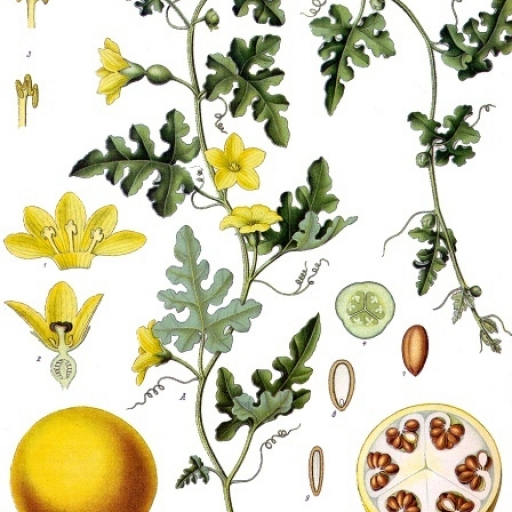
Plant Overview
Often called the "Bitter Apple" or "Desert Gourd," Citrullus colocynthis is a hardy desert survivor that looks deceptively like its cousin, the watermelon. Native to the arid regions of the Mediterranean and Asia, it has been a staple of desert folklore and traditional medicine for millennia. Its sprawling vines tell a story of incredible resilience, thriving in sun-scorched sands where most life withers.
🔍 How to Identify
- 🍃 Rough Foliage: The leaves are deeply lobed and heart-shaped at the base, covered in rough, bristly hairs that give the plant a slightly silver-green tint.
- 🟡 The Fruit: It produces smooth, globular gourds roughly the size of an orange. They begin green with yellow streaks but mature into a dusty, uniform yellow.
- 🌼 Dainty Blooms: Small, five-lobed yellow flowers peek out from the leaf axils, looking like miniature versions of typical squash blossoms.
🏡 In Your Garden
- 🏜️ Deep Taproot: This plant is a "water hunter." It develops a massive, fleshy taproot that anchors it deep into the soil, meaning it hates being moved and can survive months without a drop of rain.
- ☀️ Heat Lover: It requires intense, direct sunlight and very sandy, well-draining soil. In the right conditions, a single plant can spread its vines over several meters, acting as a natural groundcover for xeric (dry) landscapes.
⚠️ Safety & Toxicity
- 🚫 Dangerous Ingestion: While it looks like a melon, it is highly toxic if eaten. The pulp contains colocynthin, a chemical that acts as a violent and potentially fatal purgative.
- 🐾 Risk Level: Keep this plant away from curious pets and children. Contact with the inner fruit pulp can cause skin irritation, and ingestion leads to severe abdominal pain and intestinal distress.
✨ Fun Fact
📜 The Bitter Apple has a long history; it is widely believed by scholars to be the "wild gourd" mentioned in the Bible (2 Kings 4:39), which was accidentally added to a pot of stew, nearly poisoning a group of prophets!

Detailed Care Instructions
| Humidity | Normal |
| Lighting | Full Sun |
| Toxicity | Poisonous |
| Difficulty | Medium |
| Hibernation | Cold Period |
| Temperature | 23°C - 40°C |
| Hardiness Zones | 10 - 12 |
Growing Citrullus colocynthis plants (also known as bitter apple or colocynth) requires a warm and sunny climate, well-drained soil, and regular watering. Here's a general guide to help you grow Citrullus colocynthis:
- Climate: Citrullus colocynthis plants prefer a warm climate with temperatures ranging between 70-90°F (21-32°C). They are native to arid regions and can withstand high heat.
- Soil: Choose well-drained soil with a sandy or loamy texture. It should be slightly alkaline with a pH ranging from 6.5-7.5. The soil should retain some moisture without becoming waterlogged.
- Planting: Sow the seeds directly into the soil in late spring or early summer, after the last frost has passed. Make sure there is enough space between each plant, as Citrullus colocynthis plants tend to spread. Plant the seeds about 1 inch deep.
- Sunlight: Find a location that receives full sun for most of the day. These plants thrive under direct sunlight.
- Watering: Citrullus colocynthis plants require regular watering, especially during dry spells. However, avoid overwatering as excessive moisture can lead to root rot. Water the plants at the base to prevent water from contacting the foliage.
- Fertilizing: These plants can benefit from a balanced fertilizer, such as a 10-10-10 or 14-14-14 formula. Apply the fertilizer according to the manufacturer's instructions, usually during the growing season.
- Pruning: Prune the plants by removing any dead or damaged branches. This will promote better airflow and prevent the spread of diseases.
- Pest and disease control: Citrullus colocynthis plants are generally resistant to pests and diseases. However, monitor your plants regularly for any signs of infestation or disease, and take appropriate measures if necessary.
- Harvesting: The fruits of Citrullus colocynthis are bitter and toxic when raw. They are typically harvested when fully ripe and then dried or cooked to remove the bitterness.
Remember that growing Citrullus colocynthis may require specific knowledge of your local climate and soil conditions. Adapt the above steps to suit your specific region or consult with local gardening experts for more precise guidance.

Place in a bright room that is sun drenched almost all day. Or directly in a south-facing window.

To successfully water this type of plant, it is important to understand its watering needs. The plant should be watered deeply once a week, or as needed depending on the soil moisture level. Make sure the soil has good drainage and the water is not accumulating in the pot. Water should be directed towards the base of the plant, avoiding the foliage. During the hot and dry months, the plant may require more frequent watering. It is important to let the soil dry out between watering to prevent overwatering and root rot. Additionally, avoid getting water on the leaves as this can create a humid environment, favoring the development of fungal diseases.
Citrus plant requires regular fertilizing for optimal growth. Apply a balanced fertilizer, with equal parts nitrogen, phosphorus, and potassium, every two weeks during the growing season. Water the plant well before and after fertilizing to prevent root burn. Avoid fertilizing during the dormant season, as this can damage the plant. Alternatively, you can use organic fertilizers such as compost or aged manure, which provide a slow release of nutrients over time.
The ideal soil for the specific plant mentioned in this prompt is a well-draining, sandy loam soil. It should have a pH range of 6.0-7.5 and be rich in organic matter. The soil should also be able to retain moisture without becoming waterlogged, as this can cause root rot and other issues. Additionally, adding a layer of mulch around the base of the plants can help to regulate soil temperature and moisture levels, while also reducing weed growth and nutrient loss.
To propagate this plant, you will need to start by collecting its seeds. When the fruit of the plant has turned brown, remove it from the vine and allow it to dry out completely. Once it has dried, break open the fruit and collect the seeds.
Fill a seed tray with a good quality potting mix and sprinkle the seeds on top. Cover the tray with plastic wrap or a clear lid to maintain humidity levels and place it in a warm, well-lit spot.
Keep the soil moist but not saturated, and be patient as these seeds can take up to four weeks to germinate. Once you see sprouts emerge, remove the plastic covering and make sure the young plants are getting plenty of light.
When the plants have developed several sets of leaves, it's time to transplant them into individual pots. Fill each pot with fresh potting soil, gently remove the seedling from the tray and place it in the new pot. Water the plant thoroughly and keep it in its warm, sunny location until it has established strong roots.
Once the plant has matured and developed a strong root system, it can be repotted as needed or planted in a garden.








