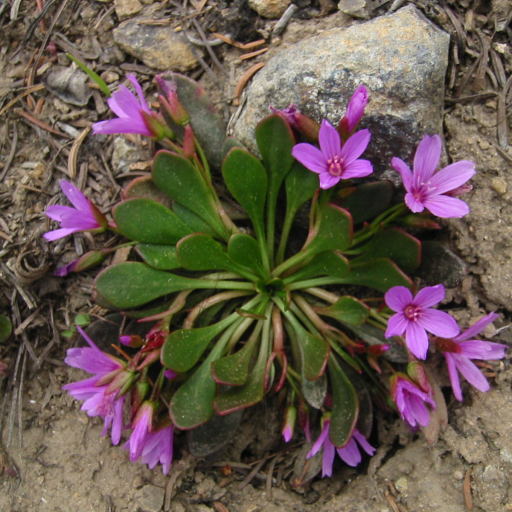
Plant Overview
Often called the Alpine Springbeauty, Claytonia megarhiza is a true survivor of the high-altitude wilderness. Its name literally translates to "large root," a nod to the massive, anchor-like taproot that keeps it grounded against the harshest mountain winds. Often found peeking out from rocky crevices where few other plants dare to grow, it looks like a delicate succulent that has been misplaced in a rugged, alpine landscape.
🔍 How to Identify
- 🍃 The Rosette: It features a dense, circular arrangement of fleshy, spoon-shaped leaves. These leaves often take on a reddish or purplish tint, which acts as a "sunscreen" against intense mountain UV rays.
- 🌸 The Bloom: Small, star-shaped flowers emerge in clusters. They range from snowy white to soft pink, usually decorated with delicate pink or purple veins that guide pollinators.
- 🧱 The Growth Habit: This is a prostrate plant, meaning it hugs the ground closely. It forms a tight, succulent cushion to avoid the drying effects of high-altitude winds.
🏡 In Your Garden
- 🏔️ Rock Garden Royalty: In a home setting, this plant is the king of the rockery. It requires "scree" conditions—extremely sharp drainage consisting of gravel and grit—to mimic its home in the mountain peaks.
- 🚫 The "No-Move" Policy: Because of that famous "mega" taproot, this plant absolutely hates being transplanted. If you snap the taproot during a move, the plant rarely recovers. Choose its permanent home carefully.
- 💧 Winter Dryness: While it loves water during its short spring growing burst, it cannot stand "wet feet" during the winter, which will cause the thick root to rot.
⚠️ Safety & Toxicity
- ✅ Generally Safe: Like its famous cousin, Miner's Lettuce, Claytonia megarhiza is considered non-toxic to humans and pets.
- 🥗 Oxalate Caution: While edible, the leaves contain oxalates (similar to spinach or rhubarb). In very large quantities, these can be irritating to the kidneys, but as a garden curiosity, it is harmless.
✨ Fun Fact
- 🔋 The Underground Battery: That massive taproot isn't just for stability; it acts as a giant energy storage tank. This allows the plant to bloom almost immediately after the snow melts, using its stored "battery power" to produce flowers before other mountain plants have even woken up.

Detailed Care Instructions
To grow Claytonia Megarhiza, also known as miner's lettuce, follow these steps:
- Choose the right location: Miner's lettuce prefers partial shade and moist, well-drained soil. It can tolerate full sun in cooler climates but might require extra watering.
- Planting time: Claytonia Megarhiza can be planted in early spring or fall. It is a cool-season plant that grows best in mild temperatures.
- Prepare the soil: Ensure the soil is loose and fertile. Remove any rocks, weeds, or debris from the planting area. Add organic matter like compost or well-rotted manure to improve soil fertility.
- Sow seeds: Scatter Claytonia Megarhiza seeds directly on the soil surface. Gently press them into the soil using your hand. A seed spacing of about one inch (2.5 cm) between seeds is ideal.
- Watering: After sowing the seeds, water the area thoroughly to settle the soil. Keep the soil consistently moist throughout the growing season. Monitor the moisture levels, especially during dry periods. Avoid overwatering, as it can lead to root rot.
- Fertilizer: Miner's lettuce usually doesn't require much fertilizer. However, you can use a balanced organic fertilizer once or twice during the growing season to provide additional nutrients.
- Weed control: Ensure that the planting area remains weed-free. Mulching around the plants can help suppress weeds and retain soil moisture.
- Harvesting: Claytonia Megarhiza can be harvested as early as 5-6 weeks after sowing. Harvest the outer leaves when they are large enough, while allowing the inner leaves to continue growing. Cut the leaves close to the base of the plant, or simply pinch them off.
- Succession planting: To have a continuous supply of miner's lettuce, consider succession planting. Sow seeds every few weeks to ensure a steady harvest throughout the growing season.
By following these steps, you should be able to successfully grow Claytonia Megarhiza. Remember to adjust the care based on your specific climate and growing conditions.

Place in a bright room that is sun drenched almost all day. Or directly in a south-facing window.

Claytonia megarhiza is a plant that requires regular watering to thrive. To water this plant, you should first make sure that the soil is consistently moist, but not waterlogged. This can be achieved by watering the plant deeply once a week or more frequently if the soil dries out quickly.
When watering, it is important to avoid getting water on the foliage as this can contribute to rot and disease. Instead, aim to water the plant at the base, ideally using a watering can or hose with a gentle, steady stream. Be sure to water the plant until the soil is saturated, but not until water is pooling on the surface.
Additionally, it is important to monitor the plant closely during periods of high heat or dryness, as it may require more frequent watering during these times. It is also important to take care not to overwater the plant, as this can lead to root rot and other issues. By providing the right amount of moisture, you can help your Claytonia megarhiza plant thrive and grow into a healthy, vibrant specimen.
To fertilize this plant, use a balanced, water-soluble fertilizer every two to three weeks during the growing season. Dilute the fertilizer to half the recommended strength to avoid over-fertilizing. Apply the fertilizer to the soil around the plant, being careful not to get it on the foliage. Water the plant thoroughly after fertilizing.
The ideal soil for this plant is well-draining and rich in organic matter. It should be slightly acidic to neutral in pH and have a sandy loam texture. A mixture of 2 parts peat moss, 1 part perlite, and 1 part vermiculite can be used as a suitable growing medium. It is important to avoid heavy clay soils or those with poor drainage, as these can lead to root rot. Additionally, adding a layer of organic mulch around the base of the plant can help retain moisture and improve soil fertility.
To propagate this plant, you will need to collect and plant its seeds. Choose a mature plant that has seed pods (small capsules) and wait until they have turned brown and begun to split open. Collect the seeds from the pods. You can plant them directly in a pot or in the garden soil. Plant the seeds shallowly and maintain moist soil during germination. The best timing to plant is in early spring. The small, succulent leaves of Claytonia Megarhiza will begin to emerge within a few weeks. Keep the soil evenly moist until the plants are established. Once established, this plant can self-seed, so you may not need to do this type of propagation every year.








