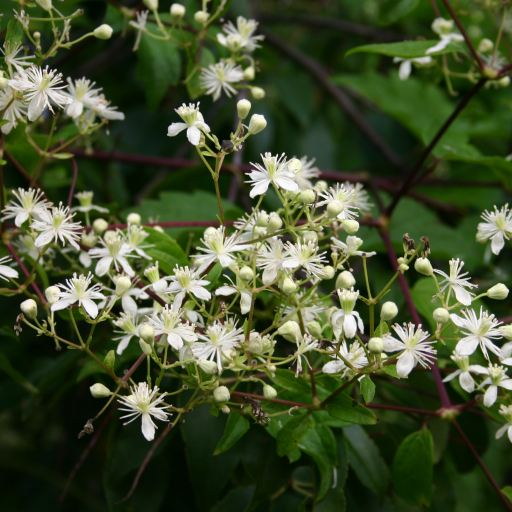
Plant Overview
Often called "Virgin’s Bower" or "Devil’s Darning Needles," this native North American vine is a late-summer superstar. While many gardeners opt for flashy, large-flowered hybrids, this wild beauty offers a delicate "froth" of white blooms that fills the air with a honey-like fragrance. It is a vigorous climber, perfect for those looking to add a touch of untamed woodland elegance to their vertical spaces.
🔍 How to Identify
- 🌸 Starry Clusters: It features masses of small, creamy-white flowers (about 1 inch wide) that lack true petals, relying instead on four showy sepals.
- 🍃 Toothed Trifoliate Leaves: The bright green leaves almost always grow in groups of three, with distinctive coarsely toothed (jagged) edges.
- 🌪️ Silky Seed Heads: As autumn nears, the flowers transform into spectacular, feathery silver plumes that catch the light and provide winter interest long after the leaves have fallen.
🏡 In Your Garden
- 🧱 Supportive Growth: This vine climbs by twisting its leaf stalks around anything it can touch. It needs a trellis, fence, or even a sturdy shrub to scramble over, as it can easily reach 12 to 20 feet in a single season.
- 💧 Cool Feet, Warm Head: In the wild, it hugs stream banks and moist thickets. To keep it happy at home, ensure the roots are kept cool and shaded with mulch or groundcover, while the foliage gets plenty of bright sunlight.
- ✂️ Control the Chaos: Because it is such a fast grower and self-seeds readily, it can become aggressive. Pruning it back hard in early spring helps keep it within bounds and encourages more prolific blooming.
⚠️ Safety & Toxicity
- 🚫 Toxic Assessment: Harmful if ingested. The plant contains protoanemonin, an acrid toxin common in the buttercup family.
- 🐕 Pet & Human Risk: If eaten, it can cause mouth sores, drooling, and digestive upset in cats, dogs, and humans. The sap can also cause mild skin irritation or "Clematis dermatitis," so wearing gloves while pruning is highly recommended.
✨ Fun Fact
The nickname "Devil’s Darning Needles" comes from an old folk superstition that the long, pointed plumes of the seed heads could sew up the eyes or ears of children who fell asleep near the vines!

Detailed Care Instructions
To grow Clematis Virginiana (also known as Devil's Darning Needles or Virgin's Bower), you can follow these steps:
- Choose a planting location: Select a spot that has well-drained soil and receives full sunlight or partial shade. Clematis Virginiana can tolerate various soil types, but it prefers slightly alkaline or neutral soil.
- Prepare the soil: Before planting, amend the soil with organic matter like compost or well-rotted manure to improve its fertility and drainage.
- Sow the seeds: Clematis Virginiana can be propagated from seeds. Start by scarifying the seeds by gently filing or sanding their hard outer coating to encourage germination. Soak the seeds in warm water for 24 hours before sowing.
- Plant the seeds: Sow the seeds in spring or fall, about ¼ inch deep in the prepared soil. Space the seeds at least 6 inches apart.
- Water regularly: Keep the soil consistently moist but not waterlogged. Water the plant regularly, especially during dry spells or hot summer months.
- Provide support: Since Clematis Virginiana is a climbing vine, provide a trellis, arbor, or other suitable support for it to climb and grow. Install the support structure near the plant early on to avoid disturbing its growing roots later.
- Prune if needed: Clematis Virginiana generally requires little pruning. However, you can trim any dead or damaged branches in early spring.
- Mulch and fertilize: Mulch around the base of the plant with organic material like compost or wood chips to retain moisture and suppress weed growth. Additionally, you can fertilize the plant once or twice a year with a balanced fertilizer to enhance its growth and flowering.
- Monitor for pests and diseases: Occasionally check for common pests like aphids or spider mites. Treat them with insecticidal soap or other appropriate measures. Watch out for diseases like powdery mildew and promptly address any signs of infection.
- Enjoy the blooms: Clematis Virginiana typically blooms from mid-summer to early fall, producing masses of small white flowers with a pleasing fragrance. Sit back, relax, and enjoy the beautiful display of flowers.
Remember to always refer to specific growing instructions provided by the seed supplier or a local gardening expert for the best results in your specific climate and region.

Place in a bright room that is sun drenched almost all day. Or directly in a south-facing window.

First, ensure that the Clematis Virginiana plant is growing in well-draining soil as this will prevent overwatering and root rot.
When watering, avoid overhead watering and instead use a soaker hose or watering can to target the soil directly and avoid getting water on the leaves.
Water deeply once a week or as needed, making sure the soil stays consistently moist but not waterlogged.
During hot and dry weather, increase watering frequency to prevent the plant from drying out.
Lastly, monitor the plant for any signs of overwatering or underwatering, such as yellowing leaves or wilting, and adjust your watering schedule accordingly.
For optimal growth and blooming, apply a balanced fertilizer with an NPK ratio of 10-10-10 in early spring before new growth appears and again after the first bloom cycle. Follow the manufacturer's instructions for application rates and be sure to water deeply after fertilization. Avoid fertilizing during periods of drought or extreme heat to prevent burning the roots.
Clematis Virginiana prefers a well-drained soil that is moist but not waterlogged. The ideal soil should also be slightly acidic with a pH range of 5.5 to 6.5. The soil should be rich in organic matter to provide adequate nourishment for the plant. It is essential to ensure that the soil is loose and crumbly to enable proper aeration and water penetration. Additionally, the soil should be free of weeds and other vegetation that may compete for nutrients with the Clematis Virginiana plant. Proper soil preparation is crucial before planting to ensure that the plant grows and thrives well.
One way to propagate this plant is through stem cuttings. Begin by selecting a healthy stem with several leaves, about 3-4 inches long. Cut the stem just below a node (where a leaf attaches to the stem).
Remove the leaves from the bottom half of the stem. Dip the cut end in rooting hormone powder, then plant it in a pot with well-draining soil. Keep the soil moist and the cutting in a shaded area until roots have formed.
Another method is to divide the plant. When the plant is dormant, dig up the entire plant and separate it into smaller sections, making sure each section has some roots and shoots. Replant each section in a new location with well-draining soil.
Lastly, Clematis Virginiana can also be propagated through layering. Find a low-growing stem and bend it down to the ground. Cover a section of the stem with soil, leaving the end of the stem pointing upwards. Keep the soil moist and the stem in a shaded area until it has rooted. Once roots have formed, cut the stem from the mother plant and replant it in a new location.








