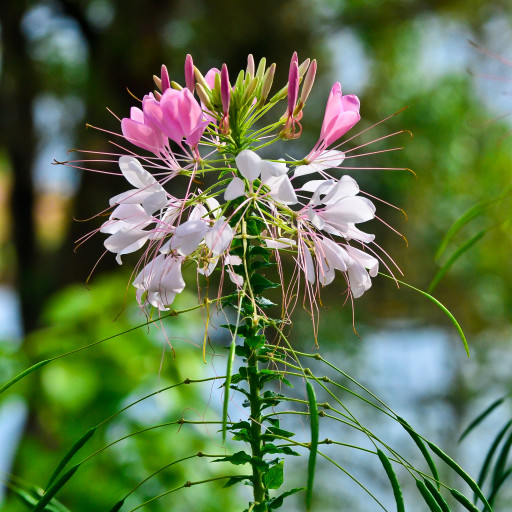
Plant Overview
Known famously as the Spider Flower, the Cleome is the high-drama queen of the summer garden. Native to South America, these tall, airy annuals are beloved for their "exploding" floral displays that resemble a botanical firework show. Often used to add height to the back of garden borders, they bring a whimsical, Victorian-era charm to any landscape.
🔍 How to Identify
- 🌸 Spidery Blooms: The most striking feature is the cluster of four-petaled flowers boasting exceptionally long, thread-like stamens that protrude outward like spider legs.
- 🍃 Hemp-like Foliage: The leaves are "palmate" (shaped like a hand), usually featuring 5 to 7 leaflets. Because of this shape, they are frequently mistaken for cannabis plants from a distance.
- 🌱 Dangling Pods: As the flowers fade, they are replaced by long, thin seed pods that project horizontally from the stem, adding to the plant’s spindly silhouette.
- 🌵 Sticky Stems: The main stalks are thick and sturdy but often feel slightly "clammy" or sticky to the touch and are frequently guarded by small, sharp spines.
🏡 In Your Garden
- ☀️ Sun Seekers: Cleome is incredibly heat-tolerant. While other plants might wilt in the August sun, this plant thrives, provided it has well-draining soil to keep its feet from getting soggy.
- 🦋 Pollinator Magnet: The long nectar tubes are a specialized feast for hummingbirds and nocturnal hawk moths. If you want a garden that "moves" with life, this is the plant to choose.
- 🛑 Root Sensitivity: These plants develop a deep taproot quite quickly. They are notoriously "homebodies" and hate being transplanted, so it is best to sow them directly in the soil or move them while they are still very small.
⚠️ Safety & Toxicity
- 🐾 Pet Friendly: Cleome is generally considered non-toxic to dogs, cats, and horses, making it a safe choice for busy family backyards.
- 🌵 Prickly Defense: While not poisonous, the plant does have small thorns at the base of the leaves. Wear gloves when pruning or pulling them up at the end of the season to avoid scratches.
✨ Fun Fact
Cleome is a master of the "self-fling." When the seed pods ripen, they dry out and eventually snap open with enough tension to catapult seeds several feet away from the parent plant, ensuring a fresh patch of flowers next spring!

Detailed Care Instructions
To grow Cleome plants, you can follow these steps:
- Choose a location: Cleome plants prefer full sun but can tolerate partial shade. Select a spot in your garden that gets at least 6-8 hours of direct sunlight per day.
- Prepare the soil: Cleome plants thrive in well-draining soil. Amend the soil by adding compost or organic matter to improve its fertility and drainage.
- Sow the seeds: Cleome plants can be grown from seeds. Sow the seeds directly into the garden bed or start them indoors 4-6 weeks before the last frost date. If starting indoors, transplant them outdoors after the danger of frost has passed.
- Watering: Cleome plants prefer consistently moist soil but do not let the soil become waterlogged. Water your plants deeply once or twice a week, depending on rainfall and weather conditions.
- Fertilizer: Use a balanced, slow-release fertilizer or organic compost when planting, and then fertilize once a month during the growing season. Follow the package instructions for application rates.
- Stake support: Cleome plants can grow quite tall and may require staking to keep them upright. Install stakes or a trellis near the plants early in the growing season to support their height.
- Pruning: Pinch back the tops of young Cleome plants when they reach about 6-8 inches tall. This will help promote bushier growth and prevent them from becoming too leggy.
- Mulching: Apply a layer of organic mulch around the base of the plants to help conserve moisture, suppress weed growth, and regulate soil temperature.
- Pests and diseases: Cleome plants are generally quite resistant to pests and diseases, but keep an eye out for common garden pests like aphids, caterpillars, or spider mites. If necessary, use organic insecticides or hand-pick the pests off the plants.
- Harvesting seeds: If you want to save seeds from your Cleome plants, allow the seed pods to dry on the plant until they turn brown and start to split open. Then, collect the seeds and store them in a cool, dry place for future use.
By following these steps, you can successfully grow Cleome plants in your garden and enjoy their beautiful flowers throughout the growing season.

Place in a bright room that is sun drenched almost all day. Or directly in a south-facing window.

To water this plant, ensure that the soil is first checked for dryness. The plant should be watered deeply, making sure that the soil is thoroughly soaked. Avoid watering during the hottest part of the day to prevent evaporation. Watering should be done regularly, especially during the growing season and when the temperature is hot. It is essential to make sure that the soil is not waterlogged to prevent root rot. Additionally, the plant can be mulched to help maintain soil moisture.
To fertilize this plant, apply a balanced, all-purpose fertilizer every 4-6 weeks throughout the growing season. Be sure to follow the manufacturer's instructions for application rates and methods. Additionally, adding compost or organic matter to the soil prior to planting can provide a slow-release source of nutrients for the plant. Avoid over-fertilizing, as this can lead to root burn and damage to the plant.
When planting Cleome, it is recommended to use a well-draining, nutrient-rich soil that is slightly acidic with a pH range of 5.5 to 6.5. The soil should be loose and airy, with good water-holding capacity, and should be amended with organic matter to enhance nutrient retention. In addition, it is important to cultivate the soil before planting, as Cleome has deep roots that require a deep soil stratum. Avoid using heavy clay soils or soils that are compacted, as this can lead to poor root development and stunted growth. Finally, the site should receive at least six hours of direct sunlight per day, and the soil should be kept evenly moist to prevent wilting.
To propagate this plant, you need to follow a few steps. First, you need to select a healthy & vigorous plant that you want to propagate. Secondly, you need to take a stem cutting from the plant using a clean, sharp pair of scissors. Make sure the cutting is at least 4-6 inches long. Thirdly, remove the lowest set of leaves from the stem cutting and dip the cut end into rooting hormone powder. Fourthly, plant the cutting in a well-drained pot of soil or vermiculite. Finally, place the pot in a bright, warm, but not directly in sunlight, location and keep the soil moist. In a few weeks, you should see new growth, indicating that the cutting has taken root, and you have successfully propagated a new plant.







