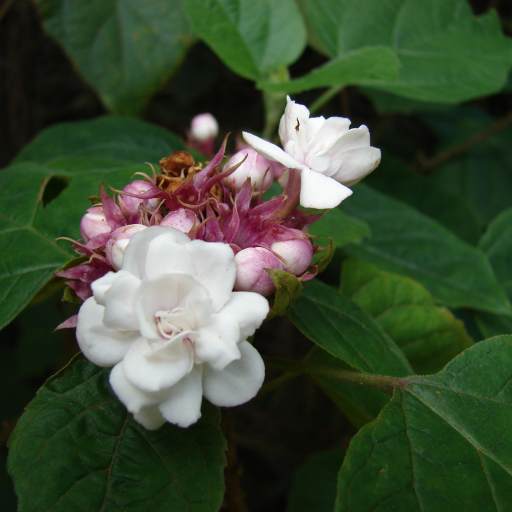
Plant Overview
Known affectionately as the "Honolulu Rose" or the "Chinese Glory Bower," this lush shrub is a sensory delight. While it may not be a true rose, its dense, pom-pom clusters of white and blush-pink blossoms mimic the appearance of a miniature bouquet. Native to East Asia, it has traveled the world, enchanting gardeners with a fragrance so potent it can perfume an entire courtyard on a warm summer evening.
🔍 How to Identify
- 🌸 The Blooms: Its most striking feature is the "double" flower structure. These tightly packed, rose-like blossoms appear in rounded clusters (cymes) and transition from creamy white to a delicate pale pink.
- 🍃 The Foliage: The leaves are large, broadly heart-shaped, and covered in fine, soft hairs that give them a velvety texture. They have coarsely toothed edges and can grow quite large, providing a deep green backdrop to the pale flowers.
- 🌿 Growth Habit: This is a multi-stemmed woody shrub that typically reaches 3 to 7 feet in height. It has a somewhat "scruffy" but charming habit, often forming thickets via underground runners.
🏡 In Your Garden
- 🌱 Space to Wander: This plant is a "creeper" by nature. Because it spreads through underground suckers, it is best planted in large containers or in garden beds where you don't mind it claiming a bit of territory. It’s perfect for filling in empty corners quickly.
- 💧 Thirsty Roots: Unlike some of its drought-tolerant cousins, the Chinese Glory Bower prefers "feet" that stay consistently moist. If the soil dries out too much, those large, velvety leaves will wilt dramatically to let you know it’s time for a drink.
- ☀️ Light Balance: While it loves the sun, in very hot climates, it appreciates some afternoon shade. Dappled light through taller trees mimics its natural woodland-edge habitat perfectly.
⚠️ Safety & Toxicity
- 🟢 General Status: Generally considered non-toxic to humans and common pets.
- 🐾 Pet Watch: While not listed as a high-danger plant, the large leaves can cause mild stomach upset if chewed by curious dogs or cats. As with any ornamental plant, it is best to discourage pets from using it as a snack.
- 👐 Skin Contact: The leaves have a slightly musky scent when bruised, but they do not cause irritation for most people.
✨ Fun Fact
Most Clerodendrum chinense plants found in gardens are "sterile," meaning they don't produce seeds. Instead of relying on pollinators to reproduce, the plant has mastered the art of "cloning" itself by sending out roots that pop up as new baby plants nearby!

Detailed Care Instructions
To grow a Clerodendrum Chinense plant, also known as the Glory Bower or Mexican Hydrangea, follow these steps:
- Choose a suitable location: Select a spot in your garden that receives full sunlight or partial shade. Make sure the soil is well-draining and enriched with organic matter.
- Propagate the plant: You can grow Clerodendrum Chinense from either seeds, stem cuttings, or by dividing an established plant. If using seeds, sow them in a seed-starting mix and keep them moist until germination occurs. For stem cuttings, take a 6-8 inch cutting from a healthy plant and remove the lower leaves. Dip the cut end in rooting hormone and plant it in a pot filled with well-draining soil. For dividing an established plant, dig up the plant and separate the rooted sections.
- Prepare the soil: Whether planting seeds, cuttings, or divided sections, ensure the soil is loose and fertile. Incorporate compost or well-rotted manure to improve soil structure.
- Plant the Clerodendrum Chinense: Dig a hole big enough to accommodate the roots of the plant. Place the plant in the hole, ensuring it is at the same depth it was previously growing. Fill the hole with soil, gently firm it around the base, and water thoroughly.
- Watering and maintenance: Keep the soil consistently moist, especially during the summer months. However, avoid overwatering, as the plant can be susceptible to root rot. Mulching around the plant can help retain soil moisture. Additionally, fertilize the plant every 1-2 months during the growing season with a balanced fertilizer.
- Pruning: Regularly prune the plant to maintain its shape and control its size. Pruning also encourages bushier growth and more abundant flowering. Remove any dead or diseased branches, and cut back long or leggy stems.
- Pests and diseases: While Clerodendrum Chinense is relatively resistant to pests and diseases, it can occasionally be affected by aphids, scale insects, or powdery mildew. Monitor the plant regularly and take appropriate measures, such as using insecticidal soap or neem oil if necessary.
- Winter care: In areas with mild winters, the plant can be left outdoors. However, in colder regions, it is best to bring the plant indoors or protect it with a layer of mulch to prevent frost damage.
By following these steps, you can successfully grow a Clerodendrum Chinense plant in your garden and enjoy its beautiful flowers.

Place in a bright room that is sun drenched almost all day. Or directly in a south-facing window.

To water this particular plant, you should wait until the soil is dry to the touch before watering again. When watering, slowly pour water onto the soil around the base of the plant, being careful not to wet the leaves. It is important to avoid overwatering, as this can lead to root rot and other issues. Additionally, make sure the plant is not sitting in standing water, as this can also cause root damage. As with all plants, it is important to monitor the moisture levels and adjust watering as needed based on the specific growing conditions of the plant's environment.
To fertilize this plant, you can use a water-soluble fertilizer with balanced nutrients, such as 10-10-10 or 20-20-20. Dilute the fertilizer according to the instructions on the package, and apply it to the soil around the base of the plant every two to three weeks during the growing season. Be careful not to over-fertilize, as this can lead to burnt leaves or damage to the root system. Additionally, make sure to water the plant thoroughly before and after fertilizing to prevent any fertilizer burn.
The best soil to use for this plant is a well-draining soil mix that is moderately rich in organic matter. The soil should contain a combination of sand, perlite, vermiculite, and peat moss or compost. It should also have a neutral to slightly acidic pH level between 6.0 and 7.0. The plant prefers soil that is moist but not soggy, so ensure that the soil is well-draining to prevent waterlogging. The plant can tolerate a range of soil types, including sandy, loamy, and clay soil, but it will thrive best in a fertile soil that has good drainage. Additionally, it is recommended to add a slow-release fertilizer to the soil during the growing season to help the plant produce healthy foliage and flowers.
Propagation of this plant can be achieved through various methods such as stem cuttings, layering, and seed propagation. Stem cuttings are the most common and easiest way to propagate this plant. Cuttings should be taken from mature stems during the growing season and should be around 6-8 inches in length. The leaves should be removed from the bottom half of the stem, and the cutting should be placed in a rooting hormone before being planted in a well-draining potting mix. The cutting should be kept moist and warm until roots start to form.
Layering is another method of propagation that involves bending a stem to the ground and covering it with soil. Once roots have formed, the stem can be cut and planted separately.
Seed propagation is a less common but still viable option. Seeds can be collected from mature plants and sown in a well-draining potting mix. Keep the soil moist and warm until the seeds germinate.
Overall, propagation of this plant is relatively easy and can be done with minimal effort.








