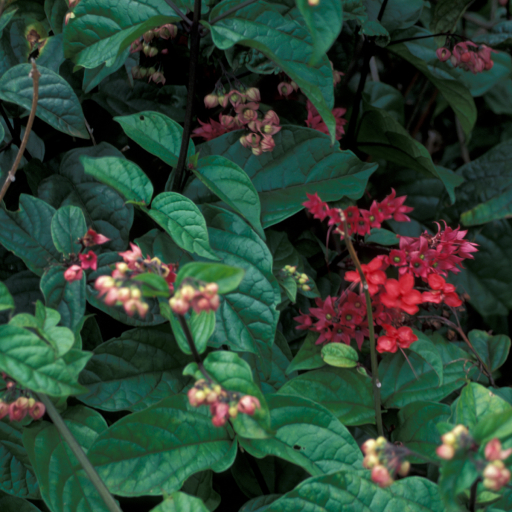
Plant Overview
Often called the "Flaming Glorybower," this woody evergreen vine is a true showstopper of the tropical world. Native to Western Africa, it is beloved for its brilliant clusters of scarlet flowers that look like tiny torches against a backdrop of deep green foliage. It’s a vigorous climber that brings a sense of wild, lush drama to any garden or sunlit patio.
🔍 How to Identify
- 🌺 Flaming Clusters: Features dense, rounded clusters of brilliant scarlet or deep crimson flowers that emerge from pale green calyxes.
- 🍃 Lush Foliage: The leaves are large, heart-shaped (ovate), and have a rich, dark green color with a slightly leathery, glossy texture.
- 🪜 Twining Habit: As a woody climber, it lacks tendrils but instead wraps its stems tightly around supports to reach heights of up to 10–12 feet.
🏡 In Your Garden
- 🏗️ Vertical Ambition: Because it is a vigorous twining vine, it requires a sturdy trellis, fence, or arbor. Without support, it tends to become a tangled, sprawling groundcover rather than a vertical feature.
- 💧 The Humidity Factor: Originating from tropical rainforests, this plant thrives on "consistent moisture." It hates drying out completely and prefers high humidity; if the air is too dry, it may drop its lower leaves in protest.
- ✂️ Pruning Strategy: It blooms on new growth, so it’s best to prune it back hard in late winter or early spring to encourage a massive flush of flowers and keep its vigorous size under control.
⚠️ Safety & Toxicity
- ✅ Generally Safe: The Flaming Glorybower is not considered highly toxic to humans. However, the sap may cause very mild skin irritation for gardeners with sensitive skin.
- 🐾 Pet Precautions: While not listed as a major hazard, it is best to keep curious cats and dogs from chewing the foliage. Ingesting large amounts of any ornamental vine can lead to minor stomach upset or nausea in pets.
✨ Fun Fact
The genus name Clerodendrum is derived from the Greek words "kleros" (chance or fate) and "dendron" (tree)—referring to the varied and unpredictable medicinal properties found across different species in this plant family!

Detailed Care Instructions
To grow a Clerodendrum Splendens plant, you can follow these steps:
- Location: Choose a bright and warm location for your plant, as Clerodendrum Splendens prefers full sun or partial shade. Ensure that the area has good air circulation.
- Soil: Use well-draining soil with organic matter mixed in. The soil should be slightly acidic to neutral (pH 6.0-7.0). Good drainage is important for the plant's health.
- Watering: Water your Clerodendrum Splendens plant regularly, keeping the soil consistently moist but not waterlogged. Allow the top inch of soil to dry out between waterings. Adjust watering frequency based on the climate and temperature.
- Fertilization: Feed your plant with a balanced fertilizer, such as a 10-10-10 NPK (nitrogen, phosphorus, potassium) formula. Apply the fertilizer every two to four weeks during the growing season (spring and summer). Follow the instructions on the fertilizer packaging for proper dosage.
- Pruning: Regularly prune your Clerodendrum Splendens to maintain its shape and promote bushier growth. Remove dead or diseased branches and trim back any excessive growth. Pruning can be done in early spring before new growth emerges.
- Propagation: Clerodendrum Splendens can be propagated through stem cuttings. Take a 4-6 inch cutting from a healthy plant, remove the lower leaves, and dip it in rooting hormone. Plant the cutting in a small container filled with a well-draining potting mix. Keep the soil moist, and the cutting should establish roots within a few weeks.
- Pests and diseases: Monitor your plant for pests like aphids, mealybugs, and spider mites. If infestations occur, treat them with insecticidal soaps or neem oil following the manufacturer's instructions. Inspect the leaves regularly for signs of diseases such as powdery mildew or leaf spot, and take appropriate measures like removing affected leaves or applying fungicides if necessary.
Remember, growing conditions may vary depending on your specific location and climate, so it is important to adapt care techniques accordingly.
To water this plant properly, it is important to make sure the soil is moist but not waterlogged. One way to achieve this is to check the soil regularly by sticking your finger about an inch into the soil. If it feels dry, it is time to water.
It is best to water at the base of the plant rather than on the leaves or flowers, as wet foliage can lead to disease or mold. Use room temperature water and avoid getting water on the foliage as much as possible. If the plant is in a container, allow excess water to drain out of the drainage holes at the bottom.
During periods of high heat or low humidity, it may be necessary to water more frequently to prevent the soil from drying out completely. However, be careful not to overwater, as this can also harm the plant.
Overall, it is important to monitor the soil moisture regularly and adjust watering frequency accordingly to ensure this plant stays healthy.
To keep your plant healthy, fertilize it once every month during the growing season with a balanced fertilizer that has a ratio of 10-10-10. Apply the fertilizer according to the manufacturer's instructions, taking care not to over-fertilize, which can damage the plant. Water the fertilizer thoroughly into the soil and then water the plant again with plain water to flush out any excess fertilizer salts. Do not fertilize the plant during the dormant season.
When selecting the appropriate soil for a Clerodendrum Splendens plant, it is important to consider its specific growing conditions and requirements. Generally, it is recommended to use a well-draining soil mix that is rich in organic matter, such as compost or peat moss. The soil should also have a slightly acidic to neutral pH level, with a range of 6.0 to 7.0 being ideal. Additionally, incorporating perlite or sand into the soil mix can improve drainage and ensure the plant's roots do not sit in waterlogged soil. It is also important to note that Clerodendrum Splendens prefer moist, but not overly wet soil, so avoid allowing the soil to completely dry out or become waterlogged.
To propagate this plant, one should first select a healthy parent plant with no signs of disease or pests. Cut a 4-6 inch stem from the parent plant just below a leaf node, making sure to use a clean, sharp pair of scissors or pruning shears. Remove the leaves from the bottom half of the stem, leaving only the top few leaves intact. Dip the cut end of the stem in rooting hormone, then plant it in moist potting soil or a well-draining mix of perlite and vermiculite. Cover the pot with a plastic bag to increase humidity and place it in a warm, bright spot out of direct sunlight. After 4-6 weeks, the stem should begin to develop roots and new growth. Once the new plant has grown to a sufficient size, it can be transplanted into a larger pot or into the ground, and cared for like any other mature plant of its kind.








