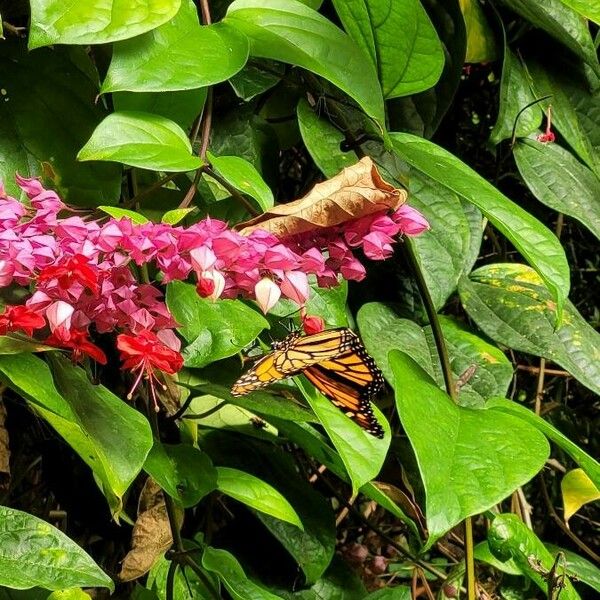
Plant Overview
Often called the Java Glory Bower, this stunning tropical hybrid is a master of visual deception, looking far more delicate than it actually is. It is a cross between two African species, resulting in a vigorous climber famous for its "flower-within-a-flower" appearance, where fiery scarlet blooms emerge from soft, dull-pink bracts. This plant is a favorite for those wanting a lush, romantic vibe, often seen draping over pergolas or climbing garden trellises in warmer climates.
🔍 How to Identify
- 🌺 The Flowers: Its most striking feature is the bicolored bloom—a deep crimson or scarlet corolla (the inner flower) that pops out from a persistent, bell-shaped calyx that ranges from dusty rose to lavender-purple.
- 🍃 The Foliage: The leaves are large, deep green, and ovate (egg-shaped) with a smooth texture and prominent veins that give the plant a rich, heavy look even when not in bloom.
- 🌿 Growth Habit: This is a "scandent" shrub, meaning it behaves like a woody vine. It uses its long, flexible stems to twine around supports rather than using tendrils or suckers to stick to walls.
🏡 In Your Garden
- 🧗 Need for Support: Because it lacks "grabbing" mechanisms like ivy, you must provide a sturdy trellis, fence, or arbor. Without something to lean on, it will form a messy, mounding shrub rather than a graceful climber.
- 💧 The Humidity Factor: While it is surprisingly hardy for a tropical, it hates dry air. If you are growing it indoors or in a dry climate, regular misting or a gravel tray is essential to prevent the leaf tips from browning and the flower buds from dropping prematurely.
⚠️ Safety & Toxicity
- 🐾 Status: Generally considered non-toxic to humans and pets, making it a safer choice for family gardens than many other tropical vines.
- 🧤 Skin Sensitivity: While not poisonous, the sap can occasionally cause mild skin irritation for those with sensitive skin. It is always wise to wear gloves when pruning back heavy growth to avoid a "sticky" situation.
✨ Fun Fact
The name Clerodendrum translates from Greek as "Chance Tree" or "Fate Tree." In ancient times, it was believed that species within this genus could either heal or harm depending on "chance," though this specific hybrid is purely a Victorian-era horticultural triumph!

Detailed Care Instructions
Clerodendrum x speciosum, also known as the Java Glorybower, is a tropical plant that can be grown in USDA hardiness zones 9b to 11. Here are some tips on how to grow and care for this plant:
- Light: Clerodendrum x speciosum prefers full sun to partial shade. Make sure to place it in a location where it can receive direct sunlight for at least 6 hours a day.
- Soil: This plant thrives in well-draining, fertile soil. You can amend the soil with organic matter like compost or peat moss to improve its drainage and nutrient content.
- Watering: Water your Clerodendrum x speciosum regularly, keeping the soil consistently moist but not waterlogged. Water it more frequently during the growing season and reduce watering in the winter months.
- Fertilizing: Feed your Clerodendrum x speciosum with a balanced, water-soluble fertilizer every 4-6 weeks during the growing season. Be sure to follow the manufacturer's instructions for application rates.
- Pruning: Regularly prune your Clerodendrum x speciosum to maintain its shape and size. Remove any dead or damaged branches to promote new growth and improve air circulation within the plant.
- Propagation: You can propagate Clerodendrum x speciosum through stem cuttings. Take a 4-6 inch cutting from a healthy stem, remove the lower leaves, and place it in a pot with moist potting soil. Keep the cutting in a warm, humid environment until it roots.
- Pests and diseases: Keep an eye out for common pests like aphids, mealybugs, and spider mites, which can infest Clerodendrum x speciosum. Use organic insecticidal soap or neem oil to control pest infestations. Additionally, be vigilant for diseases like powdery mildew and rust, which can be treated with fungicides.
With proper care and attention, your Clerodendrum x speciosum plant should thrive and reward you with its beautiful, fragrant flowers.

Place in a window with dappled sun or a spot in the middle of a room. Or directly in a window facing west or east.

To water this plant, you should ensure that the soil around it is moist but not waterlogged. It is important to avoid letting the soil completely dry out between waterings as this could lead to stress and damage to the plant. One way to check the moisture level of the soil is to insert your finger about an inch into the soil; if it feels dry, it is time to water. When watering, pour water slowly and evenly over the soil until it begins to drain out the bottom of the pot. Be careful not to let water collect on the leaves or flowers, as this could cause damage or disease. Additionally, it is important to allow the soil to drain completely before returning the plant to its usual location. The frequency of watering may vary depending on the temperature, humidity, and sunlight the plant is exposed to, so be sure to regularly monitor the soil moisture level and adjust the watering schedule accordingly.
To fertilize Clerodendrum X Speciosum, apply a slow-release balanced fertilizer in the spring and summer months. Use a fertilizer with an NPK ratio of 10-10-10 or similar. Follow the manufacturer's instructions for application rates, and be sure to water the plant thoroughly after fertilizing. Avoid over-fertilizing, as this can damage the plant.
The best soil for the plant in question is a well-draining soil mixture. This can be achieved by combining regular potting soil with perlite or sand to increase the drainage abilities of the soil. Additionally, adding organic matter like compost or peat moss can help improve moisture retention while also providing nutrients for the plant. pH level should be slightly acidic to neutral, around 5.5 to 7.0. It is important to ensure that the soil is not too compacted as this can lead to poor drainage and the potential for root rot. Regular fertilization with a balanced fertilizer can help keep the plant healthy. Overall, the soil should be able to provide adequate drainage, moisture retention, and nutrients for the plant to thrive.
To propagate Clerodendrum X Speciosum plant, you can start by taking stem cuttings from a mature and healthy plant. Choose a stem that is around 4-6 inches long and has several nodes. Use a sharp, clean pair of scissors or pruning shears to cut the stem just below a node.
Next, remove the leaves from the lower half of the cutting to expose the nodes. Dip the cut end of the stem in rooting hormone to encourage root growth. Plant the cutting in a small pot filled with well-draining soil, making sure that at least one node is buried in the soil. Water the cutting thoroughly and place it in a warm, bright location with indirect sunlight.
Keep the soil consistently moist but not waterlogged, and mist the cutting regularly to maintain humidity. After a few weeks, roots should start to form, and you can transplant the cutting into a larger pot or into the garden once it has established a healthy root system.
Propagation can also be done through division, by separating the plant's rhizomes to create new plants. Simply dig up the plant and carefully separate the rhizomes, making sure that each division has some roots attached. Plant the divisions in separate pots or directly in the garden, and care for them as you would mature plants.
Common pests of the red bleeding heart vine include Spider mites, aphids, whiteflies. Make a habit of checking your red bleeding heart vine frequently for pests so that any infestations can be caught and managed early.








