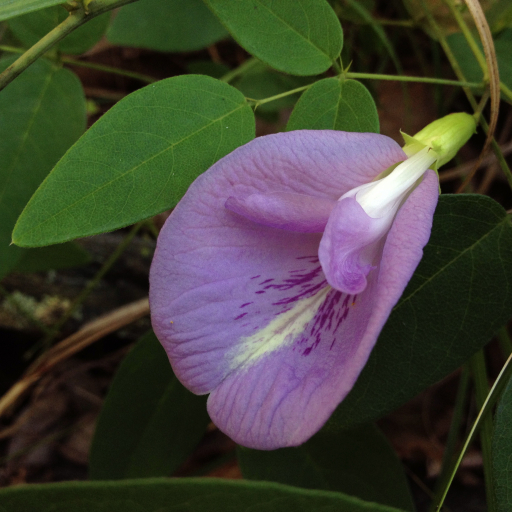
Plant Overview
Often called the Atlantic Pigeonwings, this charming native vine of the southeastern United States is famous for its large, showy lavender-pink blossoms. While its genus name might raise an eyebrow, it was named by early botanists for the flower’s unique anatomical resemblance. Often found trailing along forest edges or rocky hillsides, it brings a touch of delicate, wild elegance to any native plant garden.
🔍 How to Identify
- 🌸 The Flower: Features large, solitary, funnel-shaped blooms that are typically lavender or pale blue with darker purple veins leading to a pale center.
- 🍃 Leaf Structure: Look for "trifoliate" leaves, which means they grow in distinct groups of three smooth, lance-shaped leaflets.
- 🌱 Growth Habit: This is a delicate, herbaceous vine. Unlike aggressive climbers, it tends to sprawl across the ground or twin loosely around nearby stalks, reaching about 1 to 3 feet in length.
🏡 In Your Garden
- 🪵 The Taproot Secret: This plant develops a deep, sturdy taproot that helps it survive droughts. However, this means it hates being moved! If you plant it from a nursery pot, do so gently and avoid disturbing the root ball.
- ⚡ Soil Enhancer: As a member of the pea family, it is a "nitrogen fixer." It works with beneficial soil bacteria to pull nitrogen from the air and store it in the ground, naturally improving the soil quality for surrounding plants.
- 🦋 Pollinator Support: It is a high-value plant for native bees and serves as a host for the Long-tailed Skipper butterfly larvae, making it a "must-have" for conservation-minded gardeners.
⚠️ Safety & Toxicity
- 🌿 General Safety: Clitoria mariana is generally considered non-toxic to humans and common household pets.
- 🐾 Seed Caution: While not high-risk, the seed pods (which look like small green beans) contain saponins. If a large number of seeds are ingested by a curious pet, it might cause minor stomach upset or nausea.
✨ Fun Fact
The Atlantic Pigeonwings was a favorite of the famous botanist Linnaeus. During the Victorian era, many botanists tried to change the plant's genus name because they found the reference to human anatomy too scandalous for polite society—but the original name eventually won out and remains official today!

Detailed Care Instructions
To grow Clitoria Mariana (also known as Atlantic pigeonwings or butterfly-pea), you can follow these steps:
- Choose a suitable location: Clitoria Mariana prefers full sun to partial shade, so select a spot in your garden that receives at least 6 hours of direct sunlight per day. The soil should be well-draining with a pH level between 5.5 and 7.5.
- Prepare the soil: Before planting, loosen the soil in the chosen area using a garden fork or shovel. Remove any weeds or rocks and amend the soil with organic matter, such as compost or well-rotted manure, to improve fertility and drainage.
- Sow the seeds: Clitoria Mariana can be grown from seeds. Scarify the seeds by nicking or scratching the hard outer seed coat with sandpaper or a file, as this will help them germinate more easily. Soaking the seeds in water overnight can also enhance germination. Sow the scarified seeds directly into the prepared soil, spacing them about 6 to 12 inches apart. Lightly cover the seeds with a thin layer of soil.
- Watering: Water the planted area thoroughly after sowing the seeds and keep the soil consistently moist until the seeds germinate, which usually takes around 10 to 14 days. Once the seedlings have emerged, water them regularly, providing about 1 inch of water per week. Avoid overwatering, as Clitoria Mariana prefers evenly moist soil but can be susceptible to root rot in excessively wet conditions.
- Care and maintenance: Clitoria Mariana does not require much maintenance. Remove any weeds that may compete with the young plants for nutrients and water. Providing a layer of organic mulch around the plants can help retain moisture and suppress weed growth. You may also consider supporting the climbing vines of mature plants with trellises or stakes.
- Harvesting and propagation: Once mature, Clitoria Mariana plants produce attractive purple-blue flowers. You can collect the seeds from the dried pods and store them for future plantings. The plant also readily self-seeds, so you may find new seedlings popping up nearby.
Overall, Clitoria Mariana is a hardy and resilient plant that can tolerate heat, drought, and poor soil conditions. With proper care and suitable growing conditions, you should be able to enjoy its beautiful blooms and attractive foliage.

Place in a window with dappled sun or a spot in the middle of a room. Or directly in a window facing west or east.

To properly water this particular plant, it is important to understand its watering needs. Firstly, it requires regular watering, especially during the growing season. However, it is important not to over-water the plant as this can lead to root rot. One way to determine if the plant needs watering is by checking the soil moisture level. To do this, insert a finger into the soil up to the second knuckle. If the soil feels dry, it is time to water the plant. When watering, ensure that the water penetrates the soil down to the roots, but do not allow the plant to sit in standing water. It is also important to avoid getting water on the leaves as this can lead to fungal diseases. Lastly, during the dormant season, it is important to reduce watering frequency to avoid waterlogging the soil.
To fertilize the plant, use a balanced fertilizer with equal parts nitrogen, phosphorus, and potassium. Apply the fertilizer in spring before and after the plant flowers, and again in early summer. Use a slow-release granular fertilizer, and apply it evenly around the base of the plant. Water the plant immediately after fertilizing to help dissolve the fertilizer and transport the nutrients to the roots. Avoid over-fertilizing as it can cause damage to the plant.
Clitoria Mariana prefers well-draining soil that is slightly acidic with a pH of 6 to 7.5. The soil should be rich in organic matter and have a medium texture. Sandy loam or loamy soil is ideal for this plant. It is important to avoid heavy clay soil, as it can retain too much water and cause root rot. The plant also requires regular watering but should not be allowed to sit in standing water. A layer of mulch around the base of the plant can help retain moisture and regulate soil temperature. Fertilizer should be applied sparingly, as excessive nutrients can lead to excessive foliage growth at the expense of flowers.
To propagate this plant, you will need to collect seeds from mature plants and plant them in a well-draining soil mixture. They should be kept moist but not waterlogged, and can be grown in a well-lit area with indirect sunlight until they reach a suitable size for transplanting. Alternatively, clippings from existing plants can be taken and rooted in water or directly in soil with a hormone rooting treatment to encourage growth. This technique requires monitoring the moisture levels and avoiding chemical fertilizers until the plant is established.
Common pests of the butterfly-pea include Spider mites, thrips, whiteflies, larvae. Make a habit of checking your butterfly-pea frequently for pests so that any infestations can be caught and managed early.








