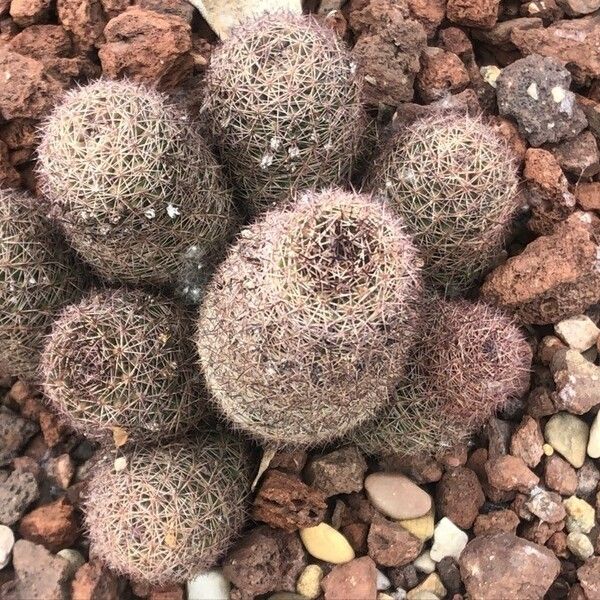
Plant Overview
Known as the "Strawberry Cactus" or "Fishhook Cactus," this resilient desert dweller is a favorite among succulent collectors. Native to the arid regions of Baja California and the Southwestern US, it earned its name from its delicious fruit and the sharp, hooked central spines that resemble miniature fishing hooks. It is a rugged survivor that balances its prickly defense with surprisingly delicate, cream-colored blooms.
🔍 How to Identify
- 🌵 The Hooked Spines: Each cluster of spines features a prominent, dark, reddish-brown central spine that curves sharply downward like a tiny fishhook.
- 🌸 Delicate Blooms: Unlike many neon-colored cacti, this species produces elegant, funnel-shaped flowers in shades of cream or pale yellow, often featuring faint pinkish mid-stripes.
- 🍓 Club-Shaped Fruit: After flowering, it produces bright red, elongated fruits that look like tiny chili peppers or strawberries emerging from the top of the cactus.
🏡 In Your Garden
- 🏜️ The Drainage Mandate: Because it is a desert native, this cactus is highly susceptible to root rot. It thrives in gritty, mineral-heavy soil—think more pumice and sand than peat moss—to ensure water never sits around the roots.
- ☀️ Sun for Structure: To maintain its tight, cylindrical shape and deep spine color, it needs intense sunlight. In low-light conditions, the plant will "stretch" (etiolate), becoming weak and losing its iconic hook-like appearance.
⚠️ Safety & Toxicity
- 🛡️ Physical Hazard: This plant is not chemically toxic to humans or pets, but it is physically formidable. The "fishhooks" are incredibly effective at snagging skin, fur, and clothing.
- 🐾 Paws and Claws: Keep this plant out of reach of curious pets. If a hook catches a pet’s paw or nose, it can be difficult and painful to remove without causing further skin irritation.
✨ Fun Fact
The name "Strawberry Cactus" isn't just a metaphor for the fruit's color—the berries are actually edible! They have a sweet, tart flavor reminiscent of a cross between a strawberry and a kiwi, and they were historically used as a food source by Indigenous groups in the Sonoran Desert.

Detailed Care Instructions








