Plant Overview
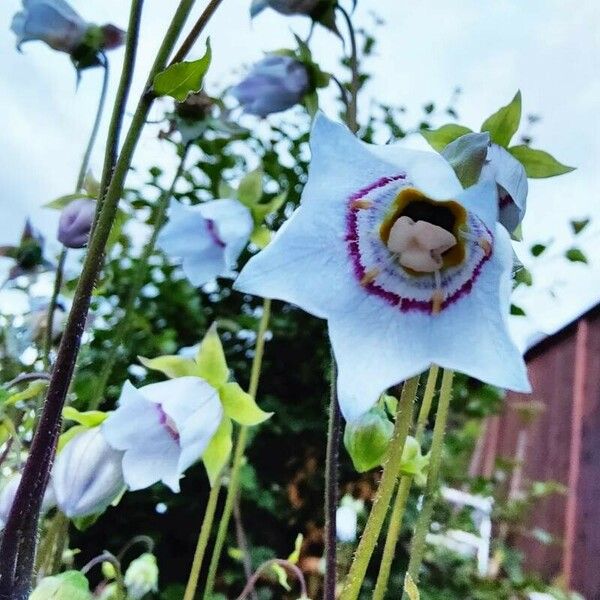
Often called the Bonnet Bellflower, this Himalayan native is a master of understated elegance. While its nodding, pale blue flowers might look modest from a distance, they hide a secret masterpiece of geometric rings and "honey spots" inside each bloom. It is a favorite for those who appreciate "hidden beauty" in the garden, as you often have to lift the flowers to see their true artistry.
🔍 How to Identify
- 🌸 The Bloom: Pendent, bell-shaped flowers that are a soft, icy-blue or ghostly grey-white, appearing in mid-summer.
- 👁️ The Inner "Eye": The interior of the bell features a striking, intricate pattern of orange, maroon, and deep purple rings that look almost hand-painted.
- 🌿 The Foliage: Small, oval to heart-shaped leaves with a soft, velvety texture and a distinct grey-green hue.
🏡 In Your Garden
- 🌬️ The Fragrance Factor: Be prepared for its unique personality; the foliage emits a strong, pungent odor often described as "skunky" or "foxy" when brushed. It is best planted at the back of a border or on a slope where you can see the flowers without being directly "in range" of the scent.
- 🧱 Placement & Roots: It possesses brittle, carrot-like taproots that absolutely hate being moved once established. Choose a permanent spot in well-drained, cool soil where it can scramble over a stone wall or weave through sturdier shrubs for support.
⚠️ Safety & Toxicity
- ✅ Status: Generally Non-Toxic.
- 🐾 Details: This plant is not known to be poisonous to humans, cats, or dogs. However, the pungent "skunky" smell of the leaves usually acts as a natural deterrent, ensuring that curious pets and toddlers rarely take a second bite.
✨ Fun Fact
In its native habitats across the mountains of Central Asia, this plant is a survivor; it is incredibly cold-hardy and is a distant relative of Codonopsis pilosula, a plant used in traditional medicine as "poor man’s ginseng."

Detailed Care Instructions
To grow Codonopsis Clematidea, also known as Bushy Seedpod, you can follow these steps:
- Select a suitable location: Choose an area in your garden that receives partial sun to shade. Codonopsis Clematidea prefers cool, shady environments.
- Prepare the soil: The plant prefers well-draining soil that is rich in organic matter. Amend the soil with compost or well-rotted manure before planting.
- Sow the seeds: Sow the seeds directly in the prepared soil in spring or fall. Make sure to sow them at the recommended depth, usually 1/8 to 1/4 inch deep.
- Watering: Keep the soil consistently moist but not waterlogged. Be careful not to overwater, as excessive moisture can cause root rot.
- Fertilization: Codonopsis Clematidea doesn't require heavy fertilization. However, you can apply a balanced slow-release fertilizer once a year in early spring.
- Mulching: Apply a layer of mulch around the plants to help retain moisture and suppress weed growth. Organic mulch such as straw or shredded bark works well.
- Support structures: Codonopsis Clematidea is a vining plant that requires support to climb. Provide a trellis or support structure for the plant to grow on.
- Pruning: Prune the plant after flowering to remove any dead or damaged stems. This will help maintain its shape and encourage new growth.
- Pest and disease control: Monitor the plant for any signs of pests or diseases such as aphids or fungal infections. Treat as necessary using appropriate organic pest control methods.
- Harvesting: Codonopsis Clematidea produces seed pods that can be harvested once they are fully mature. Allow the pods to dry on the plant before collecting the seeds.
By following these steps, you should be able to successfully grow Codonopsis Clematidea in your garden.

Place in a window with dappled sun or a spot in the middle of a room. Or directly in a window facing west or east.

To water Codonopsis clematidea plants, you should follow these steps:
1. Start by checking the soil moisture: Insert your finger about 1-2 inches into the soil around the plant. If the soil feels dry, it is time to water.
2. Choose the right time to water: It is preferable to water Codonopsis clematidea plants in the early morning or late afternoon. Avoid watering during the hottest parts of the day to prevent evaporation.
3. Use the proper watering technique: Use a watering can or a hose with a gentle spray nozzle to water the plant. Aim the water directly at the base of the plant, near the roots. Avoid wetting the foliage as excess moisture can promote fungal diseases.
4. Water thoroughly: Give the plant a deep watering, ensuring the soil is evenly moistened. Water until you see water coming out of the drainage holes at the bottom of the pot or until the soil feels adequately moist.
5. Drain excess water: After watering, allow any excess water to drain away. Empty the saucer or tray underneath the pot to avoid waterlogging and root rot.
6. Monitor soil moisture levels: Regularly check the soil moisture by inserting your finger into the soil. Only water again when the soil starts to feel dry.
7. Adjust watering frequency based on environmental conditions: Factors such as temperature, humidity, and light levels can affect the water requirements of Codonopsis clematidea plants. During hot and dry periods, you may need to water more frequently, while in cooler and more humid conditions, watering may be required less often.
Remember, providing appropriate and consistent moisture is essential for the healthy growth of Codonopsis clematidea plants.
Here are fertilizing instructions for Codonopsis clematidea plant:
- Choose a well-balanced fertilizer: Look for a fertilizer that has an equal ratio of nitrogen (N), phosphorus (P), and potassium (K). This balanced composition will provide essential nutrients for the plant's growth and development.
- Dilute the fertilizer: Mix the fertilizer with water according to the instructions mentioned on the packaging. Generally, a ratio of 1 tablespoon of fertilizer per gallon of water is suitable for most plants.
- Apply fertilizer during the growing season: Fertilize the Codonopsis clematidea plant during the active growing period, which is typically in the spring and summer months. Avoid fertilizing during the dormant stage.
- Use a watering can or a sprayer: Apply the diluted fertilizer solution to the soil around the base of the plant. Avoid getting the solution directly on the leaves or flowers to prevent burning or damage.
- Follow a regular fertilizing schedule: Depending on the fertilizer type and brand, follow the recommended frequency of application. Generally, monthly fertilization during the growing season is sufficient for healthy growth.
- Monitor the plant's response: Observe the plant's overall health and growth after fertilization. If you notice any signs of over-fertilization, such as burnt or yellowing leaves, reduce the fertilizer amount or frequency.
Remember, every plant has slightly different fertilization needs, so it's always best to research specific requirements for Codonopsis clematidea or consult with a local horticulturist or nursery for tailored advice.
Codonopsis Clematidea is a specific type of plant that requires a particular type of soil for optimal growth. This plant thrives best in loamy soil that is well-draining and rich in organic matter. The soil should have a slightly acidic to neutral pH level, preferably ranging from 5.5 to 7.0.
Loamy soil contains a balanced mixture of sand, silt, and clay particles. The sandy component provides good drainage, preventing waterlogging and root rot, which is crucial for the healthy growth of Codonopsis Clematidea. The silt and clay particles help retain moisture and nutrients, promoting a favorable environment for root development.
Additionally, it is essential to ensure that the soil is rich in organic matter. Organic matter contributes vital nutrients and promotes soil structure, providing a stable base for the plant. Adding compost or well-rotted manure to the soil can help improve its organic content.
While Codonopsis Clematidea prefers moist soil, it is crucial to avoid waterlogged conditions as excessive moisture may cause root rot. Therefore, the loamy soil used for this plant should allow water to drain freely while retaining enough moisture to keep the roots hydrated.
In summary, Codonopsis Clematidea thrives in loamy soil that has good drainage, a slightly acidic to neutral pH, and is rich in organic matter. These soil conditions create an ideal growing environment for the healthy development of this plant.
Propagation of Codonopsis Clematidea plants can be achieved through various methods, including seed propagation and stem cuttings. Here's some detail on each method:
- Seed Propagation:
- Collect mature seeds from the plant during the autumn season.
- Prepare a seed tray or pots filled with well-draining soil mix.
- Sow the seeds on the soil surface, and lightly cover them with a thin layer of soil.
- Mist the soil gently to moisten it without waterlogging.
- Place the tray or pots in a warm, well-lit location with indirect sunlight.
- Maintain a constant temperature between 68-86°F (20-30°C) to facilitate germination.
- Keep the soil consistently moist but not soaked.
- Germination usually occurs within 2-4 weeks.
- Once the seedlings have developed a few true leaves, carefully transplant them into individual pots filled with well-draining soil.
- Continue providing suitable growing conditions until the plants are well-established.
- Stem Cuttings:
- Select a healthy, mature plant with a developed root system.
- Using clean and sharp pruning shears, take 4-6 inch (10-15 cm) long stem cuttings from the plant.
- Ensure the cuttings have at least two sets of leaves.
- Remove the lower leaves from the cuttings, leaving only the top few leaves intact.
- Fill small pots or containers with a well-draining soil mix.
- Create holes in the soil, using a pencil or similar object.
- Dip the bottom end of the stem cutting in a rooting hormone powder to enhance root development (optional).
- Insert the cutting into the prepared hole, ensuring at least one set of leaves is above the soil surface.
- Press the soil gently around the cutting to provide stability.
- Mist the soil and cutting with water to maintain moisture.
- Place the pots in a warm, bright location with indirect sunlight.
- Maintain a consistent temperature between 68-77°F (20-25°C) for better rooting.
- Keep the soil consistently moist but not waterlogged.
- Roots typically develop in 4-8 weeks.
- Once the cutting has established roots, it can be transplanted into individual pots or directly into the garden.
Remember to provide proper care and suitable growing conditions, such as well-draining soil, regular watering, and protection from intense sunlight, to ensure the healthy growth of Codonopsis Clematidea plants.








