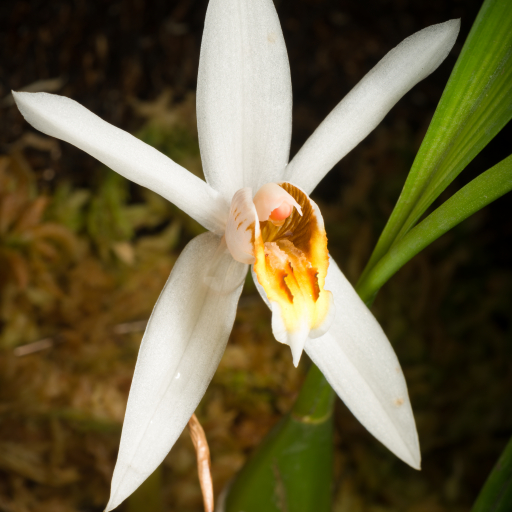
Plant Overview
Known to orchid enthusiasts as the Sticky Coelogyne, this elegant species hails from the misty cloud forests of Southeast Asia and the Himalayas. It is a prized "snow orchid" that produces cascading clusters of crystalline white blooms, often emerging during the cooler months to brighten up indoor spaces. Its name, viscosa, hints at the slightly resinous or sticky texture found on its floral structures, a clever adaptation for its humid mountain home.
🔍 How to Identify
- ❄️ The Blooms: Features delicate, snow-white flowers with a striking "lip" marked by intricate veins of burnt orange, yellow, or chocolate brown.
- 🪴 Pseudobulbs: It grows from smooth, egg-shaped green bulbs (pseudobulbs) that cluster tightly together, acting as the plant's personal water reservoir.
- 🍃 The Foliage: Each pseudobulb typically supports two long, leathery, lance-shaped leaves that have a graceful, arching habit.
- 👃 The Scent: When in bloom, it releases a distinct, pleasant fragrance that many describe as a mix of sweet honey and musk.
🏡 In Your Garden
- ☁️ Cloud Forest Vibes: Because it originates in high-altitude forests, it craves high humidity and excellent air circulation. It thrives in "intermediate" temperatures—meaning it enjoys a cooling dip at night, which often triggers its spectacular flowering.
- 💧 The "Drying Out" Rule: While it loves moisture during the growing season, it is sensitive to "wet feet." Using a chunky orchid bark mix is essential to ensure the roots can breathe. If the pseudobulbs look shriveled, it’s a signal the plant is thirsty or the air is too dry.
- 🪟 Light Nuance: It prefers bright, filtered light—think of the dappled sun hitting a tree trunk. Direct midday sun will quickly scorch its beautiful emerald leaves.
⚠️ Safety & Toxicity
- ✅ Status: Generally considered non-toxic.
- 🐾 Details: Like most members of the orchid family, Coelogyne viscosa is not known to be poisonous to cats, dogs, or humans. However, to keep both the plant and your pets happy, it's best kept on a high shelf where curious paws can't reach the delicate flowers.
✨ Fun Fact
The genus name Coelogyne comes from the Greek words koilos (hollow) and gyne (female), referring to the deeply recessed or "hollow" stigma found in the center of the flower!

Detailed Care Instructions

Place in a window with dappled sun or a spot in the middle of a room. Or directly in a window facing west or east.

Water-loving plants flourish in wet or sloppy soil and near ponds. The extensive root system enables these plants to absorb plenty of water. The surface of the soil should be kept moist at all times. Place your pot in a container filled with water to guarantee that plants get enough water. If the ground becomes dry, it is recommended that you water it well. Plants in smaller pots will need to be watered more frequently. Water the soil in which the plant is standing thoroughly using a watering can.








