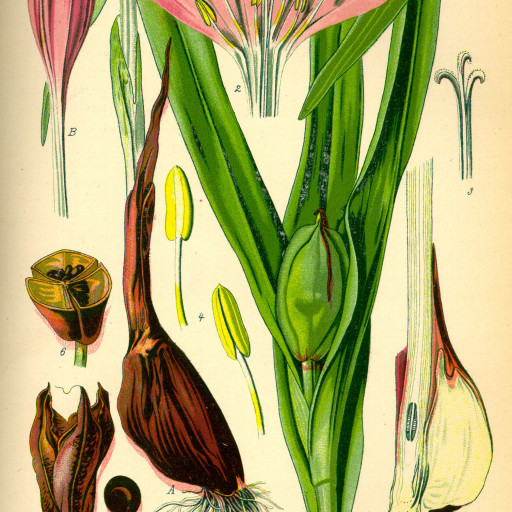
Plant Overview
Often called "Naked Ladies" or "Meadow Saffron," this mysterious beauty pulls a disappearing act by sending up elegant, goblet-shaped blooms in the fall long after its foliage has withered away. While it mimics the look of a spring crocus, it belongs to an entirely different botanical family and carries a dark, potent history in both folklore and medicine. It is the perfect choice for gardeners looking to add a final splash of color before the winter frost.
🔍 How to Identify
- 🌸 The "Naked" Bloom: Large, pale lilac to deep pink cup-shaped flowers that emerge directly from the bare soil in autumn without any accompanying green leaves.
- 🍃 Spring Foliage: Broad, strap-like green leaves that appear in early spring, looking somewhat like tulip foliage, before dying back completely by mid-summer.
- 📐 The Rule of Six: Unlike true crocuses (which have only three stamens), Colchicum autumnale boasts six prominent yellow stamens—a crucial detail for identification.
🏡 In Your Garden
- 🌦️ The Summer Sleep: Because this plant goes dormant in the heat of summer, it is best planted under deciduous trees or tucked into lawns where it won't be disturbed while the corms "rest" underground.
- 🪵 Moisture Balance: It thrives in rich, heavy soil that stays moist during the growing season but requires excellent drainage during its winter dormancy to prevent the corms from rotting.
⚠️ Safety & Toxicity
- 🚫 DANGER: This plant is extremely toxic. It contains colchicine, a potent alkaloid that can be fatal if even small amounts are ingested.
- 🐾 Pets & Kids: Keep this plant away from curious pets and children. Ingestion causes severe gastrointestinal distress, organ failure, and can lead to death. It is recommended to wear gloves when handling the corms, as the toxins can occasionally cause skin irritation.
✨ Fun Fact
Despite its deadly nature, Colchicum autumnale is a medical marvel. Its primary toxin, colchicine, has been used since the time of Ancient Egypt to treat gout and is still used by modern scientists today to create new plant varieties by doubling their chromosomes!

Detailed Care Instructions
To grow Colchicum Autumnale plant, follow these steps:
- Planting location: Choose a sunny or partially shady spot with well-draining soil. Colchicum Autumnale prefers loamy soil but will tolerate slightly clayey soil as long as it is not waterlogged.
- Planting time: The ideal time to plant Colchicum Autumnale bulbs is in late summer or early fall, around September or October. This allows the bulbs to establish roots before the onset of winter.
- Bulb planting: Dig a hole that is about 6-8 inches deep. Place the bulb with the pointed end upwards and cover it with soil. Space the bulbs about 4-6 inches apart.
- Watering: After planting, give the bulbs a thorough watering to settle the soil around them. Keep the soil slightly moist but not waterlogged during the growing season.
- Mulching: Apply a layer of organic mulch, such as straw or wood chips, around the plants. This will help conserve moisture and regulate soil temperature.
- Fertilizing: Colchicum Autumnale does not require much fertilizer. However, you can add a balanced organic fertilizer in early spring or late fall to improve overall plant health.
- Maintenance: Remove any weeds that may compete with the plants for nutrients or sunlight. After the flowers have bloomed and the foliage starts to turn yellow, let it die back naturally. This allows the bulb to store energy for the next year's growth.
- Propagation: Colchicum Autumnale can be propagated by dividing the bulbs in late summer or early fall when they are dormant. Carefully dig up the bulbs, separate the offsets, and replant them at the desired location.
- Winter care: Colchicum Autumnale is hardy and can tolerate cold temperatures. However, in areas with severe winters, it is beneficial to provide a layer of straw or leaves to insulate the bulbs.
By following these steps, you can successfully grow Colchicum Autumnale plants and enjoy their beautiful fall blooms.

Place in a bright room that is sun drenched almost all day. Or directly in a south-facing window.

Water the plant by ensuring that the surrounding soil is moist, but not soaked. Wait until the topsoil becomes dry before watering again. Avoid allowing the plant to sit in standing water for extended periods of time as this can cause root rot. During the growing season, be sure to increase watering frequency to support flowering.
- Select a well-draining soil mix for your Colchicum Autumnale plant.
- Choose a planting location that receives partial to full sunlight.
- Prior to planting, prepare the soil by loosening it and removing any weeds or debris.
- Dig a hole that is about 4-6 inches deep.
- Place the Colchicum Autumnale bulb in the hole, with the pointed end facing upwards.
- Backfill the hole with soil, ensuring that the bulb is covered entirely.
- Water the newly planted bulb thoroughly, providing enough moisture to saturate the surrounding soil.
- In early spring, when new growth emerges, apply a granular or liquid fertilizer specifically formulated for flowering bulbs.
- Follow the package instructions for dosage and frequency, as different fertilizers may have varying recommendations.
- Water the plant after fertilizing to help distribute the nutrients throughout the soil.
- Repeat the fertilization process once a year in early spring.
- Monitor the plant's growth and adjust the fertilization schedule if necessary, based on the health and vigor of the plant.
The ideal soil for this plant should be well-draining and moderately fertile. It should have a pH that is slightly acid to neutral, typically around 6.0 to 7.0. The plant prefers soil that is moist but not waterlogged, and it should not be consistently dry or overly wet. The addition of organic matter, such as leaf mold or compost, can improve soil structure and provide nutrients. The plant is adaptable to a range of soil types, but heavy clay or sandy soils should be amended to improve drainage and fertility.
The process of propagating Colchicum Autumnale plant involves several steps:
- Select a healthy mother plant: Choose a mature and vigorous Colchicum Autumnale plant for propagation. Ensure that it is disease-free and shows no signs of pests or damage.
- Timing: The best time to propagate Colchicum Autumnale is during its dormant period, typically in late spring or early summer. The plant produces leaves in the spring and flowers in the fall.
- Prepare the mother plant: Cut back any foliage and remove any spent flowers or seed heads. This will help the plant focus its energy on root production rather than sustaining aerial parts.
- Division: Carefully dig up the mother plant and gently separate the bulbs or corms. Ensure that each division has healthy roots attached. Divisions can be easily separated by hand or with a sharp, sterilized knife.
- Soil preparation: Prepare a well-draining soil mix for the new plants. A mixture of sandy loam soil and organic matter like compost or leaf mulch is recommended. Avoid heavy soil that may retain excess moisture and cause rotting.
- Planting: Plant the corms or bulbs at a depth of about 4-6 inches (10-15 cm) and space them several inches apart to allow for proper growth. Ensure they are positioned with their pointed end facing upwards.
- Watering and care: After planting, water the new divisions well to moisten the soil. However, avoid overwatering to prevent rotting. Throughout the growing season, provide adequate moisture to support root development.
- Fertilization: Colchicum Autumnale plants don't require heavy fertilization. However, you can lightly apply a balanced, slow-release fertilizer during the growing season to provide necessary nutrients.
- Protection: Protect the newly planted divisions from extreme weather conditions, such as excessive rainfall or strong winds. Consider providing a layer of mulch around the plants to insulate them and conserve moisture.
- Patience and monitoring: It may take some time for the new divisions to establish and begin producing foliage and flowers. Be patient and regularly monitor the plants for any signs of diseases, pests, or watering issues.
By following these steps, you can successfully propagate Colchicum Autumnale plants and expand your collection.








