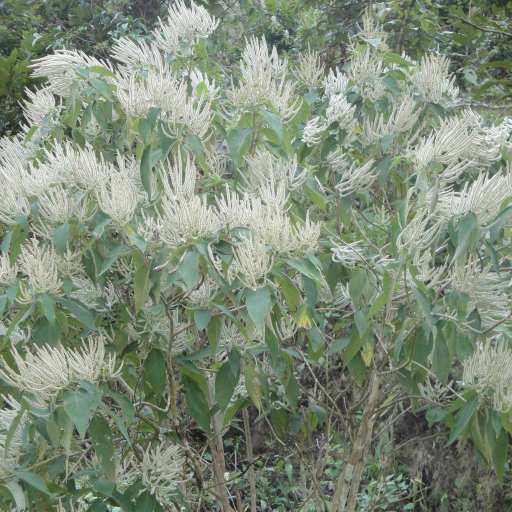
Plant Overview
Often called the Indian Squirrel Tail, this striking shrub earns its name from the soft, fluffy white flower spikes that sway in the breeze like a bushy tail. Native to the subtropical foothills of the Himalayas, it brings a touch of wild, silvery elegance to any landscape. It belongs to the mint family (Lamiaceae), though it trades a minty scent for velvety textures and unique, woolly blooms.
🔍 How to Identify
- 🌿 Velvety Leaves: The large, lance-shaped leaves are arranged in opposite pairs. They are covered in fine, greyish-white hairs (tomentose), giving them a soft, felt-like texture.
- 🐿️ "Squirrel Tail" Blooms: The plant produces long, slender, cylindrical spikes of tiny white flowers. These spikes look distinctly fuzzy and appear clustered at the branch tips.
- 🌳 Sturdy Shrub Habit: It is a large, perennial shrub that can grow quite tall, often reaching 3–5 meters, with a sprawling, woody framework.
🏡 In Your Garden
- ⛰️ Mountain Hardiness: Because it hails from rocky Himalayan slopes, it is remarkably resilient. It thrives in well-draining soil and is quite tolerant of poor soil conditions or rocky terrain where other plants might struggle.
- 🦋 Pollinator Magnet: Those fuzzy white spikes are a favorite for bees and butterflies. Adding this to your garden is a great way to support local biodiversity and bring more "wing-life" to your yard.
- ✂️ Pruning Nuance: It can become leggy if left to its own devices. Light pruning after the flowering season helps maintain a bushy, attractive shape and encourages more "tails" next year.
⚠️ Safety & Toxicity
- 🟢 Status: Generally non-toxic and safe for home landscapes.
- 🐾 Pet & Kid Safety: There are no recorded major toxicity concerns for dogs, cats, or children. However, the fine hairs on the leaves can occasionally cause very mild skin irritation for individuals with highly sensitive skin. It is an ornamental plant and should not be ingested.
✨ Fun Fact
In traditional Himalayan medicine, the downy hairs found on the leaves and the plant's sap have been used for generations as a natural "band-aid" to help clot blood and treat minor cuts!

Detailed Care Instructions
To grow Colebrookea oppositifolia, also known as Nepali Hogweed or Himalayan Hogweed, follow these steps:
- Climate and soil requirements: Colebrookea oppositifolia thrives in warm and temperate regions, preferably with a minimum average temperature of 15-20°C. It can tolerate a variety of soil types, but well-draining soil with organic matter is ideal.
- Seed collection: Collect seeds from mature plants during the autumn or winter when the seed heads turn brown. Dry the seeds in a cool, dark place for a few weeks, after which they should be ready for planting.
- Seed preparation: Gently rub the dried seed heads between your hands to separate the seeds from the chaff. Remove any remaining debris by winnowing or sieving.
- Seed stratification: Colebrookea oppositifolia seeds require stratification (cold treatment) to encourage germination. Store the seeds in a damp paper towel or in moist sand in a plastic bag and keep them in the refrigerator for 4-6 weeks.
- Planting: After stratification, sow the seeds in pots or trays filled with moist, well-draining soil. Cover the seeds with a thin layer of soil and lightly press them down. Keep the soil consistently moist but not waterlogged.
- Germination and growth: Place the pots or trays in a warm and bright location, such as a greenhouse or a sunny window sill. Colebrookea oppositifolia seeds usually germinate within 2-4 weeks. Once the seedlings develop their first true leaves, transplant them into larger pots or directly into the garden.
- Transplanting: Choose a sunny or partially shaded location in your garden with well-draining soil. Space the plants about 2-3 feet apart to allow sufficient room for growth. Ensure the soil is amended with compost or organic matter to enhance its fertility.
- Care and maintenance: Colebrookea oppositifolia requires regular watering, especially during dry spells. Apply a layer of mulch around the base of the plant to retain moisture and suppress weed growth. Prune the plants in late winter or early spring to remove dead or damaged branches and encourage bushier growth.
- Fertilization: Feed the plants with a balanced slow-release fertilizer or organic fertilizer in early spring and mid-summer. Follow the product's instructions for dosage and application.
- Pest and disease control: Colebrookea oppositifolia is generally resistant to pests and diseases. However, keep an eye out for common garden pests like aphids and caterpillars, and treat them with appropriate organic insecticides or insecticidal soaps if necessary.
Remember to check your local regulations and ensure that Colebrookea oppositifolia is not invasive in your area before planting it.

Place in a window with dappled sun or a spot in the middle of a room. Or directly in a window facing west or east.

Colebrookea Oppositifolia is a plant that requires regular watering for healthy growth. To water this plant, place it in a tray or container that has drainage holes at the bottom. Fill the tray with water until it reaches about half an inch to an inch from the base of the plant. Allow the plant to absorb the water for about an hour or until the soil feels moist to the touch. Pour out any excess water from the tray to prevent the roots from becoming waterlogged.
Alternatively, you can water Colebrookea Oppositifolia by using a watering can. Slowly pour water over the soil until it starts to run out of the drainage holes at the bottom of the pot. Make sure to water evenly around the plant, avoiding the foliage.
It is important to note that Colebrookea Oppositifolia should not be overwatered as it can lead to root rot and other issues. To determine when to water, check the soil regularly by sticking your finger about an inch into the soil. If it feels dry, it is time to water the plant. In hot and dry weather, the plant may need to be watered more frequently.
Overall, providing adequate and consistent watering is essential for maintaining the health and vitality of Colebrookea Oppositifolia.
- Choose a fertilizer that has a balanced NPK ratio, such as a 10-10-10 or 20-20-20 blend.
- Dilute the fertilizer according to the manufacturer's instructions.
- Water the plant thoroughly before applying fertilizer.
- Apply the fertilizer evenly around the root zone, avoiding contact with the leaves or stem.
- Water the plant again after fertilizing to help distribute the nutrients.
- Repeat fertilization every 2-4 weeks during the growing season.
Colebrookea Oppositifolia prefers a well-draining soil that is slightly acidic with a pH level between 6.0 and 6.5. It thrives in soils that are rich in organic matter and nutrients, so using a high-quality potting mix or adding compost to the soil can be beneficial. It is important to avoid over-watering the plant as it can lead to root rot, so the soil should be allowed to dry between watering sessions. A good way to ensure proper drainage is by adding perlite or sand to the soil mix. The plant prefers a warm and humid environment, so it is important to keep the soil consistently moist and provide adequate humidity levels.
To propagate this plant, take a stem cutting that is around 6-8 inches in length and has a few leaves. Make sure to cut the stem cleanly with a sharp knife or pruning shears. Remove any leaves from the lower part of the stem.
Prepare a pot with well-draining soil and gently push the stem cutting into the soil until it is about halfway in. Water the soil well and cover the pot with a plastic bag or a clear plastic container to create a humid environment.
Place the pot in a warm, brightly-lit spot but avoid direct sunlight as it can cause the cutting to wilt. Keep the soil moist but be careful not to overwater as this can cause the cutting to rot.
After a few weeks, check the cutting for signs of new growth. Once you see new leaves, you can remove the plastic covering and continue to care for the new plant as you would a mature Colebrookea Oppositifolia plant.








